Synchronized Alien Planets Display Surprisingly Messy Layouts
Analysis of hundreds of multi-planet systems suggests that synchronized orbits correlate with greater physical disorder rather than strict sequential ordering.
Compact planetary systems orbiting close to mathematical orbital sync points turn out to be surprisingly messy, challenging long-held assumptions about how alien solar systems mature. Astronomers examining multi-planet setups across thousands of light-years found that planetary systems locked near orbital resonances exhibit less orderly physical arrangements than their non-resonant counterparts.
The research, published on the arXiv preprint server in November 2026, analyzed hundreds of multi-planet configurations discovered by NASA space telescopes. Lead authors Agustin Heron, Songhu Wang, and Cristobal Petrovich investigated whether the physical sizing and heaviness of worlds lined up sequentially from their host stars depending on whether the planets traveled in synchronized orbits.
Measuring Planetary Order and Chaos
In astronomy, many compact systems display a peas-in-a-pod phenomenon where neighboring worlds share similar sizes and regular spacings. To test if these layouts followed strict monotonic sequences where planets grew larger or smaller step-by-step with distance, the team evaluated planetary radius and mass properties across 184 Kepler systems, 34 K2 systems, and 34 TESS systems. They restricted their study to compact systems with orbital periods shorter than 100 days and containing planets smaller than four Earth radii.
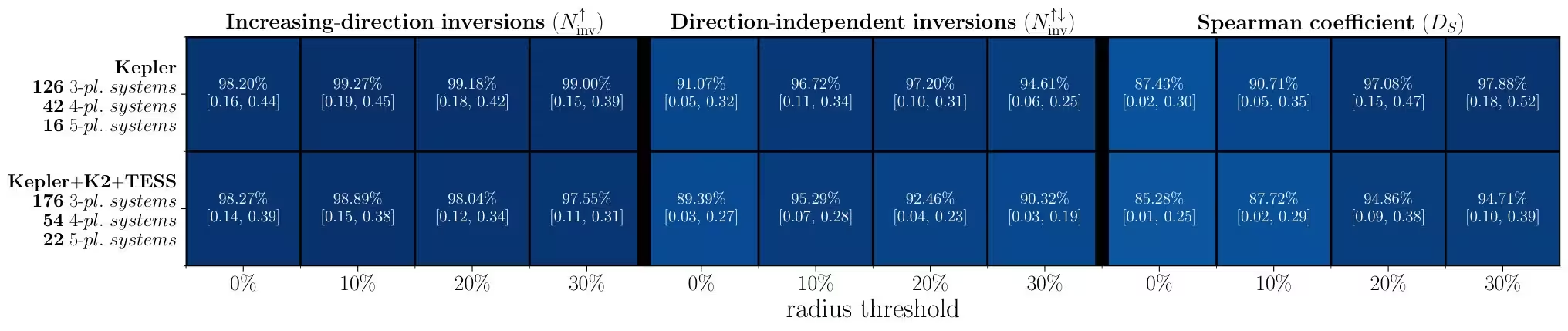
The researchers deployed advanced statistical metrics, including Spearman rank correlation coefficients and inversion-based counting methods, to measure how many planet pairs fell out of a perfect sequence. They also used Monte Carlo sampling to account for observational uncertainties and stellar radius errors. By standardizing these scores against every possible mathematical permutation of the planets, the team could directly compare systems with different numbers of member worlds.
Why Synchronized Orbits Disruption Surprised Astronomers
The prevailing expectation in exoplanet dynamics was that chaotic gravitational disruptions should tear apart the primordial, orderly arrangements of initially resonant systems, leaving non-resonant systems in a much more disordered state. Instead, the authors report the exact opposite pattern. Non-resonant planetary systems displayed more consistent, monotonic ordering in both radius and mass than systems residing near mean-motion resonances.
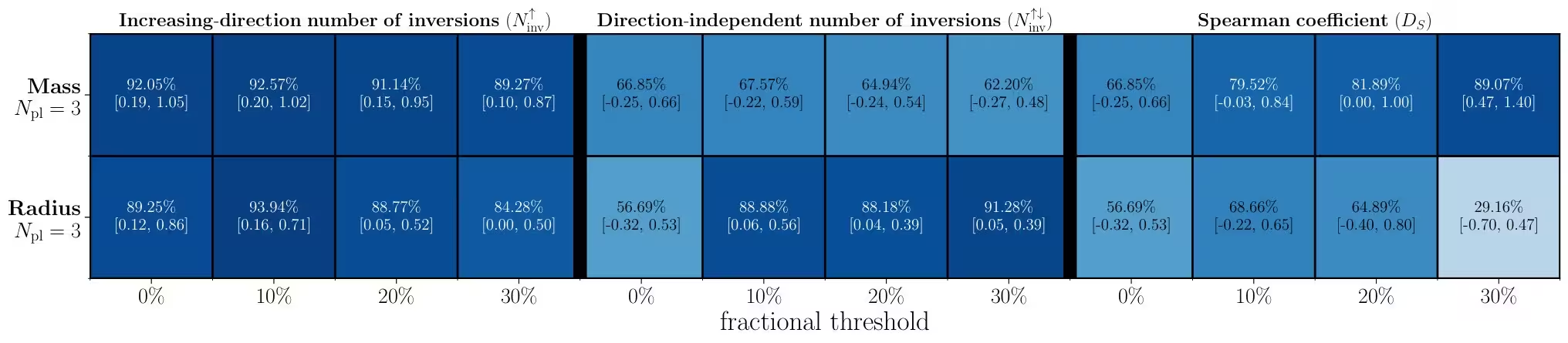
While near-resonant systems are not randomly arranged in an absolute sense, their physical layouts show weaker monotonic progression than their non-resonant peers. Three-planet systems provided the strongest statistical signal, while systems with four or five planets yielded broader, less conclusive distributions due to smaller sample sizes.
What These Architectural Clues Mean for Planet Formation
The results suggest that uniformity and monotonic ordering describe entirely different facets of planetary architecture. Previous work demonstrated that near-resonant systems possess enhanced intra-system radius uniformity, yet this physical similarity does not translate into strict sequential ordering by size or mass.
The authors note that subsequent evolutionary processes, such as photoevaporation, core-powered mass loss, and tidal heating, can reshape planetary radii long after orbital layouts settle. However, because the mass sample showed a qualitatively similar trend, radius evolution alone cannot explain the observed ordering contrast. Future observations with higher detection completeness and precise mass measurements will be required to determine whether this structural divide originates during birth or forms through later dynamical violence.
The study was posted to the arXiv preprint server on November 17, 2026.
This article has been fact checked for accuracy, with information verified against reputable sources. Learn more about us and our editorial process.
Last reviewed on .
Article history
- Latest version
Reference(s)
- Heron, Agustin. “Near Resonance, Less Ordered: Radius and Mass Ordering in Compact Multi-planet Systems.” arXiv.org <http://arxiv.org/abs/2611.23217v1>.
Cite this page:
- Posted by Nida Rehman