Cosmologists Discover Fixed Mathematical Ratio Connecting Two Major Eras in Cosmic History
A newly identified constant bridges cosmic expansion and structure formation, offering a sensitive test to expose deviations in dark energy and modified gravity.
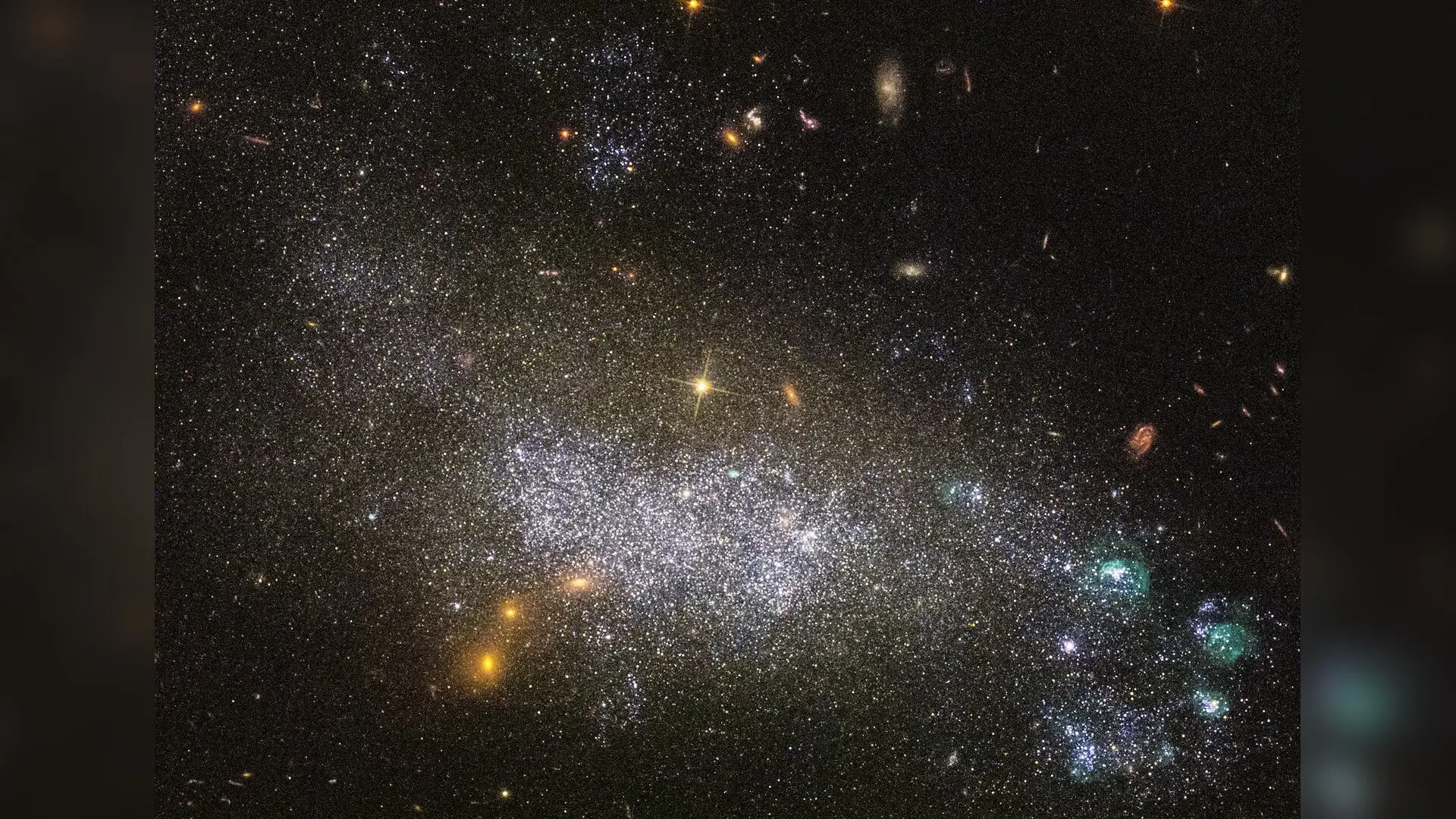
Cosmologists have discovered a fixed mathematical ratio linking two major evolutionary milestones in our expanding Universe. By comparing when cosmic acceleration began with the peak period of cosmic structure growth, researchers found a universal constant that remains unchanged regardless of the matter density of the cosmos.
The study, available on the arXiv preprint server, introduces a novel consistency test for the standard cosmological model, known as the Lambda cold dark matter universe. This framework relies on a cosmological constant representing dark energy combined with cold dark matter. By connecting the background expansion of space with the growth dynamics of large-scale structures, the authors found a precise mathematical bridge between two distinct epochs in cosmic history.
How Two Cosmic Turning Points Create a Universal Ratio
The evolution of the Universe features two major transition points governed by competing physical forces. The first milestone is the onset of cosmic acceleration, when the repulsive push of dark energy begins to overcome the attractive pull of gravity, causing the expansion of space to speed up rather than slow down. The second milestone is the turnover point of linear structure growth, measured using a cosmological parameter known as $f\sigma_8$, which tracks how matter clumps together under gravity against the outward friction of cosmic expansion.
The research team, consisting of Anjan A. Sen and Purba Mukherjee, investigated whether the separation between these two epochs depends on how much matter is present in the Universe today. Through mathematical analysis, they demonstrated that in a flat Lambda cold dark matter universe, the ratio of the scale factors at these two eras equals exactly 1.1596 when expressed in terms of redshifts. This value stays completely independent of the present matter fraction, the Hubble constant measuring the expansion rate, or the overall normalization of structure growth.
Testing Dark Energy and Modified Gravity Models
The constancy of this ratio stems from a scaling symmetry shared across a broad class of cosmological models. When dark energy or modified gravity scenarios depend on a single characteristic density scale, changing the amount of present-day matter simply shifts both epochs by the same amount in logarithmic scale factor, leaving their separation intact.
However, the ratio changes when the underlying physics deviates from the standard cosmological model. Examining thirteen distinct theoretical families, including evolving dark energy, phantom-divide crossing models, holographic dark energy, and modified gravity theories such as braneworld scenarios and DGP gravity, the authors found measurable departures from the standard ratio of 1.1596. For instance, enhanced gravitational clustering pushes the ratio higher, while weakened gravity pulls it lower.
What Current Astronomical Observations Reveal
To see how well current data matches these theoretical predictions, the researchers analyzed recent astronomical datasets, including baryon acoustic oscillations from the Dark Energy Spectroscopic Instrument, Type Ia supernovae, and redshift-space distortion measurements. Their reconstruction of the expansion history and structure growth showed that current observational data remains fully consistent with the standard cosmological prediction within statistical margins.
Future galaxy surveys and high-precision telescopes will improve these measurements significantly. If next-generation observations uncover a statistically significant departure from the predicted ratio, it could signal new physics beyond the standard cosmological model, offering a powerful tool to unravel the true nature of dark energy and cosmic acceleration.
The study was posted to the arXiv preprint server on November 17, 2026.
This article has been fact checked for accuracy, with information verified against reputable sources. Learn more about us and our editorial process.
Last reviewed on .
Article history
- Latest version
Reference(s)
- Sen, Anjan. “A Universal Ratio Linking Cosmic Expansion and the Growth of Structure.” arXiv.org <http://arxiv.org/abs/2611.23200v1>.
Cite this page:
- Posted by John Williams