Hydrogel Vaccine Prevents Type 1 Diabetes in Mice Through Sustained Immune Delivery
An injectable hydrogel depot slowly releases insulin and immune-calming proteins, protecting more than half of treated mice from type 1 diabetes.

A new injectable hydrogel depot protects mice prone to type 1 diabetes by steadily releasing insulin and immune-calming proteins, successfully preventing the condition in more than half of treated animals. Type 1 diabetes is a chronic autoimmune disease where self-reactive immune cells destroy the insulin-producing beta cells in the pancreas, forcing patients to rely on lifelong insulin replacement therapies and constant monitoring.
While modern technologies like continuous glucose monitors have improved daily disease management, they fail to address the underlying root cause. Tolerogenic immunotherapies offer a promising alternative by attempting to retrain the immune system to tolerate specific autoantigens without causing widespread immunosuppression, though past efforts have struggled with controlled drug delivery and short therapeutic windows.
Engineering a Slow-Release Immune Niche
To overcome these delivery hurdles, researchers at Stanford University developed a self-assembled polymer-nanoparticle hydrogel designed to slowly co-deliver insulin and specific immunomodulatory cytokines over extended periods. The study, published in Advanced Science, details how this biomaterial creates a temporary inflammatory niche beneath the skin that recruits immune cells and reprograms them locally.
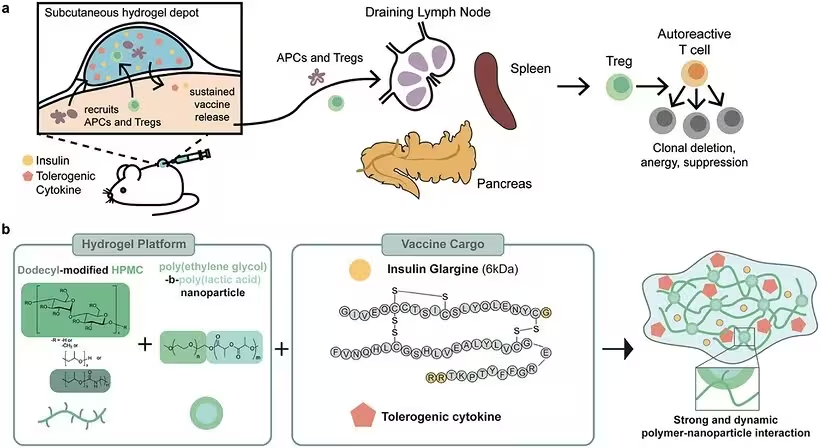
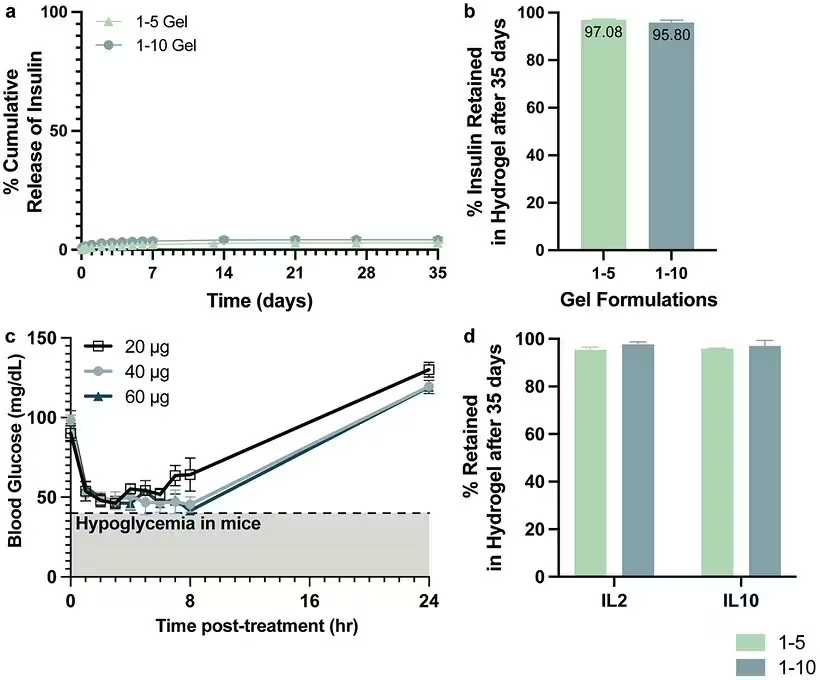
The research team formulated the hydrogel using dodecyl-modified hydroxypropyl methylcellulose and polymer-nanoparticle interactions that yield high shear-thinning and self-healing properties. This allows the material to flow easily through a needle during subcutaneous injection and immediately reform into a stable depot. Laboratory release assays confirmed that the hydrogel matrix successfully retains over 95 percent of encapsulated insulin, interleukin-2, and interleukin-10 over a 35-day period, supporting a monthly vaccination schedule.
Preventing Disease Onset in Animal Models
The team tested the vaccine formulations in non-obese diabetic mice, a standard laboratory model that spontaneously develops autoimmune diabetes with high similarity to human pathology. Mice received three monthly doses starting at eight weeks of age, a developmental stage when immune cells begin infiltrating the pancreatic islets. Animals treated with a combination of insulin and interleukin-2 experienced a significant delay in disease onset, pushing median development from 20 weeks to more than 40 weeks.
Furthermore, this targeted intervention kept 55 percent of the treated mice completely disease-free by the end of the 40-week study. Flow cytometry analyses of the injection sites, draining lymph nodes, spleens, and pancreases revealed that the sustained interleukin-2 delivery significantly expanded regulatory T cells while keeping cytotoxic effector T cell populations balanced. This created an elevated ratio of regulatory to killer T cells, signaling a robust systemic shift toward immune tolerance.
Understanding the Limitations and Next Steps
Not all tested cytokine combinations yielded positive outcomes, highlighting the delicate balance required in biomaterial-based immunology. While interleukin-2 successfully drove protective regulatory T cell expansion, formulations combining insulin with interleukin-10 or the chemokine granulocyte-macrophage colony-stimulating factor failed to alter disease progression or proved counterproductive. The authors suggest that persistent exposure to pleiotropic factors like granulocyte-macrophage colony-stimulating factor may inadvertently cross a threshold into pro-inflammatory activation.
The investigators note that several limitations remain before these findings can be translated to human patients. The therapeutic ceiling observed in the study is partly constrained by the choice of insulin as a single autoantigen, whereas human type 1 diabetes typically involves a broader array of autoantibodies. Future research will explore encapsulating multiple autoantigens to broaden bystander suppression and evaluate long-term systemic safety panels in broader preclinical settings.
The research was published in Advanced science (Weinheim, Baden-Wurttemberg, Germany) on November 15, 2026.
This article has been fact checked for accuracy, with information verified against reputable sources. Learn more about us and our editorial process.
Last reviewed on .
Article history
- Latest version
Reference(s)
- Nguyen, Leslee T.., et al. “Tolerogenic Immunotherapy for Type 1 Diabetes Through Sustained Autoantigen Delivery in a Transient Inflammatory Niche.” Advanced Science, November 15, 2026 Wiley, doi: 10.1002/advs.78758. <https://doi.org/10.1002/advs.78758>.
Cite this page:
- Posted by Rohan Kumar