Self-Powered Electronic Bandage Accelerates Wound Healing by Nearly a Third
Biotechnology

Self-Powered Electronic Bandage Accelerates Wound Healing by Nearly a Third

A novel millimetre-thick patch delivers targeted electrotherapy without external wires, significantly boosting tissue regeneration and collagen deposition in preclinical models.
By Robert Brown
Published:
Email this Article
Self-Powered Electronic Bandage Accelerates Wound Healing by Nearly a Third
Photo by Alan Aprilio on Unsplash

Applying a self-powered electrical bandage to skin injuries accelerates wound healing by nearly a third while eliminating the bulky external wires and cumbersome equipment that typically plague electrotherapy treatments. Medical researchers have long known that tiny natural electric currents guide skin repair after an injury, but harnessing this phenomenon in a clinical setting has proven difficult due to complex machinery that disrupts standard wound care. To solve this translation barrier, a team of biomedical engineers designed an electronics-free, millimetre-thick patch that functions just like a conventional adhesive bandage.

The novel platform, termed Wearable Disposable Electrotherapy, integrates a printed electrochemical battery, hydrogel stimulation interfaces, and a standard wound dressing into a flexible, single-dose unit. When placed over intact skin directly surrounding an injury, the patch delivers a targeted direct-current dose without making direct contact with the fragile wound bed itself. This clever geometry avoids mechanical disruption while driving therapeutic electrical signals across the healing tissue.

How the Self-Powered Bandage Accelerates Tissue Repair

To evaluate the therapeutic efficacy of the platform, the investigators tested the device in a full-thickness excisional rat wound model, comparing the self-powered patch against both a sham device and a traditional constant-current stimulator connected to external wires. The findings, published in Advanced Science, reveal that the bandage significantly sped up recovery trajectories. Specifically, wounds treated with the self-powered patch reached the crucial 50 percent closure milestone in about 5.02 days, representing a 29 percent reduction in time compared to the untreated sham group, which took 7.10 days.
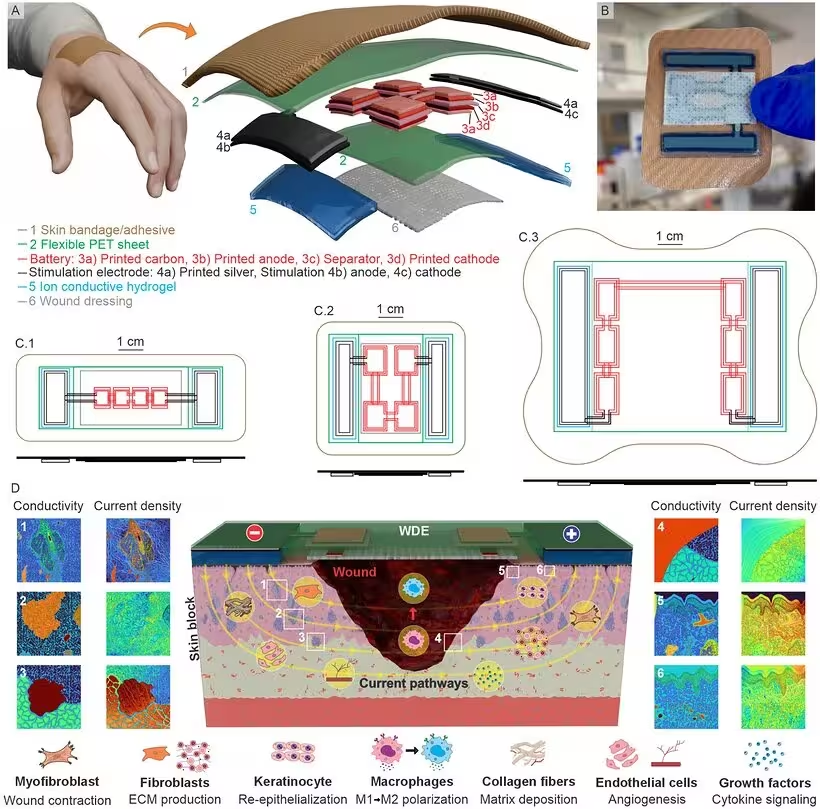
FIGURE 1: Design concept, scalable architecture, and proposed mechanism of action of the Wearable Disposable Electrotherapy (WDE) wound healing platform. (A) WDE schematic with multilayer architecture. The mm‐thick flexible patch is applied like a conventional adhesive dressing. The wound is under the felt, avoiding hydrogel contact and mechanical disruption. Lateral stimulation is delivered between hydrogel electrodes on intact peri‐wound skin, which also provides device adhesion. The self‐powered battery architecture delivers a defined single‐use dose upon application. (B) Photograph of the fabricated WDE device (medium size). The thin, flexible form factor conforms to the skin. (C) Scalable WDE layouts for small (C.1), medium (C.2), and large (C.3) wound geometries. Modular battery design enables a range of electrical doses applied across various wounds. (D) Proposed mechanism of WDE‐mediated wound healing illustrating microscopic tissue electrical properties, simulated current path, and repr
Design concept, scalable architecture, and proposed mechanism of action of the Wearable Disposable Electrotherapy (WDE) wound healing platform. (A) WDE schematic with multilayer architecture. The mm‐thick flexible patch is applied like a conventional adhesive dressing. The wound is under the felt, avoiding hydrogel contact and mechanical disruption. Lateral stimulation is delivered between hydrogel electrodes on intact peri‐wound skin, which also provides device adhesion. The self‐powered battery architecture delivers a defined single‐use dose upon application. (B) Photograph of the fabricated WDE device (medium size). The thin, flexible form factor conforms to the skin. (C) Scalable WDE layouts for small (C.1), medium (C.2), and large (C.3) wound geometries. Modular battery design enables a range of electrical doses applied across various wounds. (D) Proposed mechanism of WDE‐mediated wound healing illustrating microscopic tissue electrical properties, simulated current path, and repr Credit: Mojtaba Belali Koochesfahani et al. / Advanced science (Weinheim, Baden-Wurttemberg, Germany)

Crucially, the performance of the self-powered patch matched that of traditional benchtop constant-current stimulators without requiring any external hardware or batteries. The built-in alkaline zinc-manganese dioxide battery delivered an average current of 286 microamperes, maintaining a stable output over a 120-minute daily treatment window before gradually depleting its energy storage and safely turning itself off.

Cellular Changes Driving Faster Wound Closure

Beyond simply closing the wound faster, histological examinations at day 14 showed profound improvements in structural regeneration and tissue remodeling beneath the patch. Wounds treated with the electrotherapy device displayed a roughly 25 percent increase in collagen deposition, which provides the essential structural framework for healing skin, alongside a 73 percent rise in overall cellularity compared to sham controls.

Immunofluorescence analysis further uncovered elevated levels of key regenerative markers. The expression of alpha-smooth muscle actin, an indicator of myofibroblast activation necessary for wound contraction, jumped nearly 2.6-fold. Meanwhile, markers for blood vessel formation such as CD31 doubled, pointing to robust angiogenesis. The treatment also successfully modulated immune responses, increasing both pro-repair M2 macrophage markers and inflammatory M1 indicators without disrupting their overall balance.
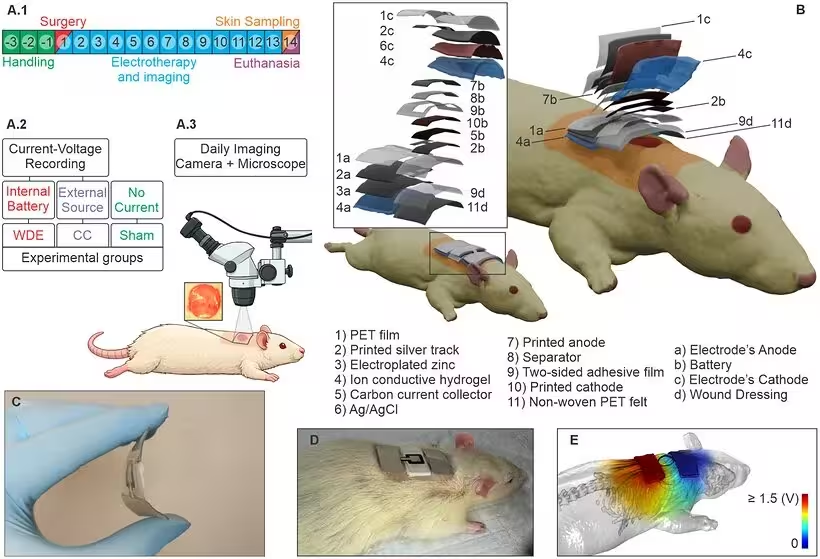
FIGURE 2: Wearable Disposable Electrotherapy configured for the experimental wound healing rat model. (A.1) Experimental timeline. Rats were acclimated for 3 days before surgery (days ‐3—1). Full‐thickness excisional wounds were created on day 1, followed by daily wound imaging and electrotherapy. Electrotherapy continued daily through day 13. On day 14, final imaging was done, and tissue samples were collected for histological and immunofluorescence analysis. (A.2) Schematic of the experimental setup with electrotherapy delivery and recording of stimulation voltage/current during electrotherapy. (A.3) Daily wound imaging was performed using a digital camera for macroscopic wound documentation and a stereomicroscope for higher‐magnification assessment of the wound surface and margins. (B) Exploded view of WDE structure. (C) Photograph of a fabricated device, conforming to the body with a thin profile. (D) WDE was applied to the dorsal wound of a rat, with peri‐wound electrode placement, and band
Wearable Disposable Electrotherapy configured for the experimental wound healing rat model. (A.1) Experimental timeline. Rats were acclimated for 3 days before surgery (days ‐3—1). Full‐thickness excisional wounds were created on day 1, followed by daily wound imaging and electrotherapy. Electrotherapy continued daily through day 13. On day 14, final imaging was done, and tissue samples were collected for histological and immunofluorescence analysis. (A.2) Schematic of the experimental setup with electrotherapy delivery and recording of stimulation voltage/current during electrotherapy. (A.3) Daily wound imaging was performed using a digital camera for macroscopic wound documentation and a stereomicroscope for higher‐magnification assessment of the wound surface and margins. (B) Exploded view of WDE structure. (C) Photograph of a fabricated device, conforming to the body with a thin profile. (D) WDE was applied to the dorsal wound of a rat, with peri‐wound electrode placement, and band Credit: Mojtaba Belali Koochesfahani et al. / Advanced science (Weinheim, Baden-Wurttemberg, Germany)

Computational Modeling Reveals Microscopic Electrical Hotspots

To understand the biophysics behind these cellular improvements, the research team developed an advanced cellular-resolution computational model of the wound microenvironment utilizing boundary element methods. The simulations demonstrated that structural heterogeneity within normal skin, including hair follicles, sweat glands, blood vessels, and cellular membranes, creates localized electrical hotspots.

When the peri-wound electrical stimulation is applied, current is preferentially concentrated and redirected tangentially along the wound margins, mirroring the body’s natural injury currents. These microscopic biophysical cues act directly on surrounding cells, guiding their migration and proliferation to accelerate tissue regeneration. While these preclinical animal findings are promising, the authors note that further clinical trials are necessary to validate the platform’s potential for human patients suffering from chronic or diabetic wounds.

The research was published in Advanced science (Weinheim, Baden-Wurttemberg, Germany) on November 15, 2026.

Fact Checked

This article has been fact checked for accuracy, with information verified against reputable sources. Learn more about us and our editorial process.

Last reviewed on .

Article history

  • Latest version

Reference(s)

  1. Koochesfahani, Mojtaba Belali., et al. “Self‐Powered Electronics‐Free Wearable Disposable Electrotherapy (WDE) Platform for Accelerated Wound Healing.” Advanced Science, November 15, 2026 Wiley, doi: 10.1002/advs.78814. <https://doi.org/10.1002/advs.78814>.

Cite this page:

Brown, Robert. “Self-Powered Electronic Bandage Accelerates Wound Healing by Nearly a Third.” BioScience. BioScience ISSN 2521-5760, 18 November 2026. <https://www.bioscience.com.pk/en/subject/biotechnology/self-powered-electronics-free-wearable-disposable-electrotherapy-wde-platform-for-accelerated-wound-healing>. Brown, R. (2026, November 18). “Self-Powered Electronic Bandage Accelerates Wound Healing by Nearly a Third.” BioScience. ISSN 2521-5760. Retrieved November 18, 2026 from https://www.bioscience.com.pk/en/subject/biotechnology/self-powered-electronics-free-wearable-disposable-electrotherapy-wde-platform-for-accelerated-wound-healing Brown, Robert. “Self-Powered Electronic Bandage Accelerates Wound Healing by Nearly a Third.” BioScience. ISSN 2521-5760. https://www.bioscience.com.pk/en/subject/biotechnology/self-powered-electronics-free-wearable-disposable-electrotherapy-wde-platform-for-accelerated-wound-healing (accessed November 18, 2026).
End of the article