Physicists Discover Exotic Superconductor That Defies Conventional Quantum Laws
Physicists have discovered time-reversal symmetry breaking in the superconductor YbSb2, a rare behavior previously linked only to unconventional materials.
An international team of researchers, spearheaded by the Indian Institute of Science Education and Research (IISER) Bhopal, has uncovered an extraordinary quantum state in the material YbSb2. According to their findings, published in Physical Review Letters on September 23, 2026, this compound represents a rare intersection of type I superconductivity, unconventional electron pairing, and nontrivial electronic topology.
Superconductors are defined by their ability to transmit electricity with zero resistance below a specific critical threshold. Historically, these materials are categorized based on how they interact with magnetic fields and how their electrons couple together. While type I superconductors typically expel magnetic fields entirely until their superconducting state collapses, type II superconductors allow for partial magnetic penetration. Until now, the phenomenon of broken time-reversal symmetry—a state where the laws of physics appear different if time were to run backward—was primarily linked to the latter group.
Mapping the Quantum Landscape of YbSb2
To investigate the properties of YbSb2, the researchers synthesized high-purity single crystals and analyzed their structural integrity through X-ray diffraction. As the team cooled the material toward absolute zero, electrical resistance vanished at approximately -272 degrees Celsius (-457.6 degrees Fahrenheit). Further analysis of the material’s specific heat confirmed its identity as a type I superconductor with a fully gapped state.
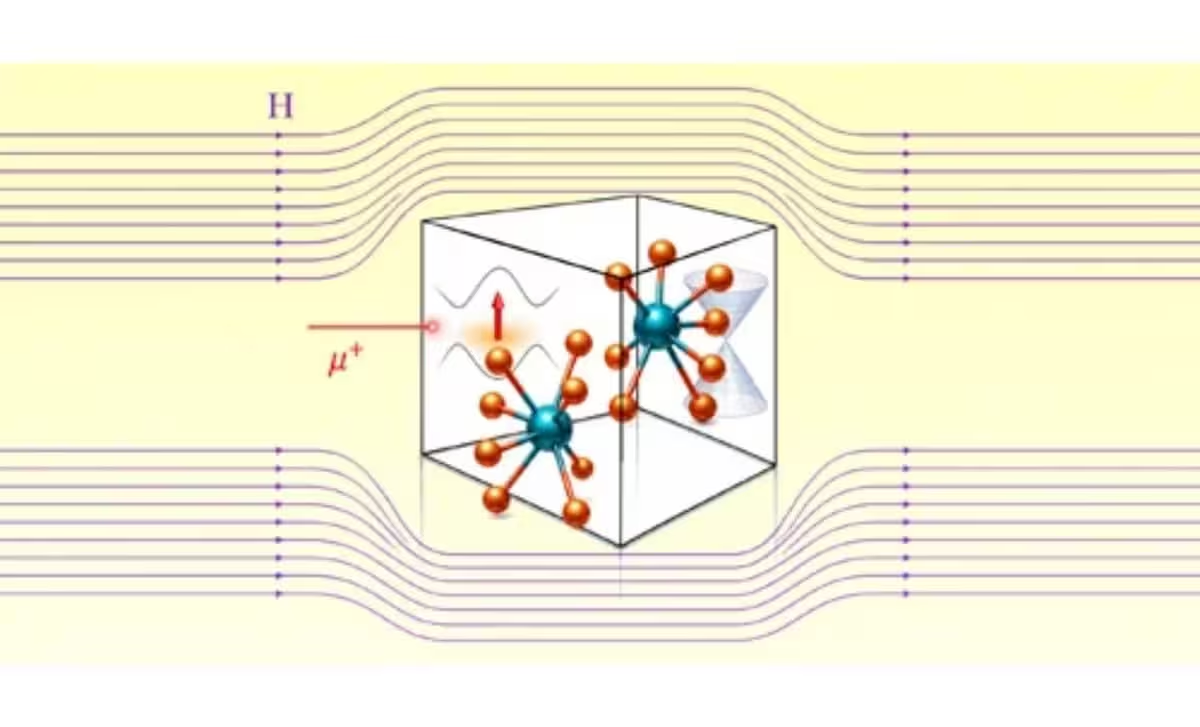
The team utilized muon spin relaxation and rotation to peer into the material’s internal magnetic environment. By implanting muons—subatomic particles that act as precise magnetic probes—the researchers discovered spontaneous internal magnetic fields emerging immediately after the material entered its superconducting phase. This internal magnetism is a hallmark of broken time-reversal symmetry, as magnetic fields typically reverse direction when the arrow of time is flipped. The experimental data, bolstered by transverse-field measurements, clearly distinguishes YbSb2 from previously studied materials.
Theoretical Implications for Majorana Modes
Beyond experimental observations, the study employed complex theoretical modeling to understand the underlying mechanics of this behavior. The researchers suggest that YbSb2 hosts an internally antisymmetric nonunitary triplet (INT) state. In this configuration, Cooper pairs—the electron duos responsible for superconductivity—arise from different energy orbitals, leading to a residual magnetic moment that breaks time-reversal symmetry even in the absence of an external magnetic field.
𝗜𝗜𝗦𝗘𝗥 𝗕𝗛𝗢𝗣𝗔𝗟 | 𝗥𝗘𝗦𝗘𝗔𝗥𝗖𝗛 𝗕𝗥𝗘𝗔𝗞𝗧𝗛𝗥𝗢𝗨𝗚𝗛
𝗧𝗶𝗺𝗲-𝗥𝗲𝘃𝗲𝗿𝘀𝗮𝗹 𝗦𝘆𝗺𝗺𝗲𝘁𝗿𝘆 𝗕𝗿𝗲𝗮𝗸𝗶𝗻𝗴 𝗗𝗶𝘀𝗰𝗼𝘃𝗲𝗿𝗲𝗱 𝗶𝗻 𝗮 𝗧𝘆𝗽𝗲-𝗜 𝗦𝘂𝗽𝗲𝗿𝗰𝗼𝗻𝗱𝘂𝗰𝘁𝗼𝗿
What happens when a phenomenon usually associated with unconventional… pic.twitter.com/bxPk2O42uv— IISER Bhopal (@iiserbhopal) September 28, 2026
Using the Ginzburg-Landau framework and first-principles calculations, the team identified the material as a Z2 topological metal featuring a Dirac nodal line near the Fermi level. These properties lead to a compelling hypothesis: the surface of YbSb2 may support gapless Majorana modes. These exotic quantum excitations, which function as their own antiparticles, could theoretically coexist with the bulk superconducting state. While the existence of these Majorana modes remains to be confirmed through direct experimental observation, the current study establishes YbSb2 as a unique laboratory for exploring the rare convergence of triplet pairing, nontrivial topology, and type I superconductivity.
This article has been fact checked for accuracy, with information verified against reputable sources. Learn more about us and our editorial process.
Last reviewed on .
Article history
- Latest version
Reference(s)
- Kataria, Anshu., et al. “Observation of Time-Reversal Symmetry Breaking in the Type-I Superconductor
- “https://twitter.com/iiserbhopal/status/2104450766174069005/photo/1.” <https://t.co/bxPk2O42uv>.
Cite this page:
- Posted by Farah Siddiqui