3D-Printed Insoles Cut Diabetic Foot Pressure by 35 Percent
Advanced lattice metamaterials and computer simulations outperform standard hospital foam inserts in relieving high-risk pressure zones.

Personalized 3D-printed shoe inserts can cut dangerous foot pressure by up to 35 percent in patients with diabetes, offering a potential new way to prevent painful ulcers and lower limb amputations. Diabetic foot ulcers affect millions of individuals globally and carry a heavy medical and financial burden, with treatments costing up to 85,000 dollars per case and a 30 percent five-year mortality rate following initial ulceration. While standard foam inserts are commonly prescribed to cushion the foot, their generic mechanical properties often fail to optimize pressure relief for specific high-risk zones.
To address this, researchers developed and evaluated two novel types of customized shoe inserts featuring internal lattice microstructures with tunable stiffness. The work is published in PLOS One, detailing a clinical trial that tested the devices on 25 military veterans with diabetes. The participants walked across pressure-measuring sensors under four different conditions, including barefoot walking, wearing standard hospital-grade insoles, and wearing two distinct styles of 3D-printed inserts.
Comparing Pressure-Based and Computer-Simulated Designs
The research team engineered two unique categories of 3D-printed inserts. The first was a pressure-based custom accommodative insole, which utilized patient-specific pressure maps to identify hotspots exceeding 200 kilopascals of force. These high-pressure areas were printed using a sparse, soft lattice metamaterial to absorb impact, while surrounding regions maintained structural support. The second design was a finite element-guided custom accommodative insole, which employed computer simulation to model forefoot mechanics and optimize internal stress distribution through customized structural adjustments like integrated metatarsal bars.
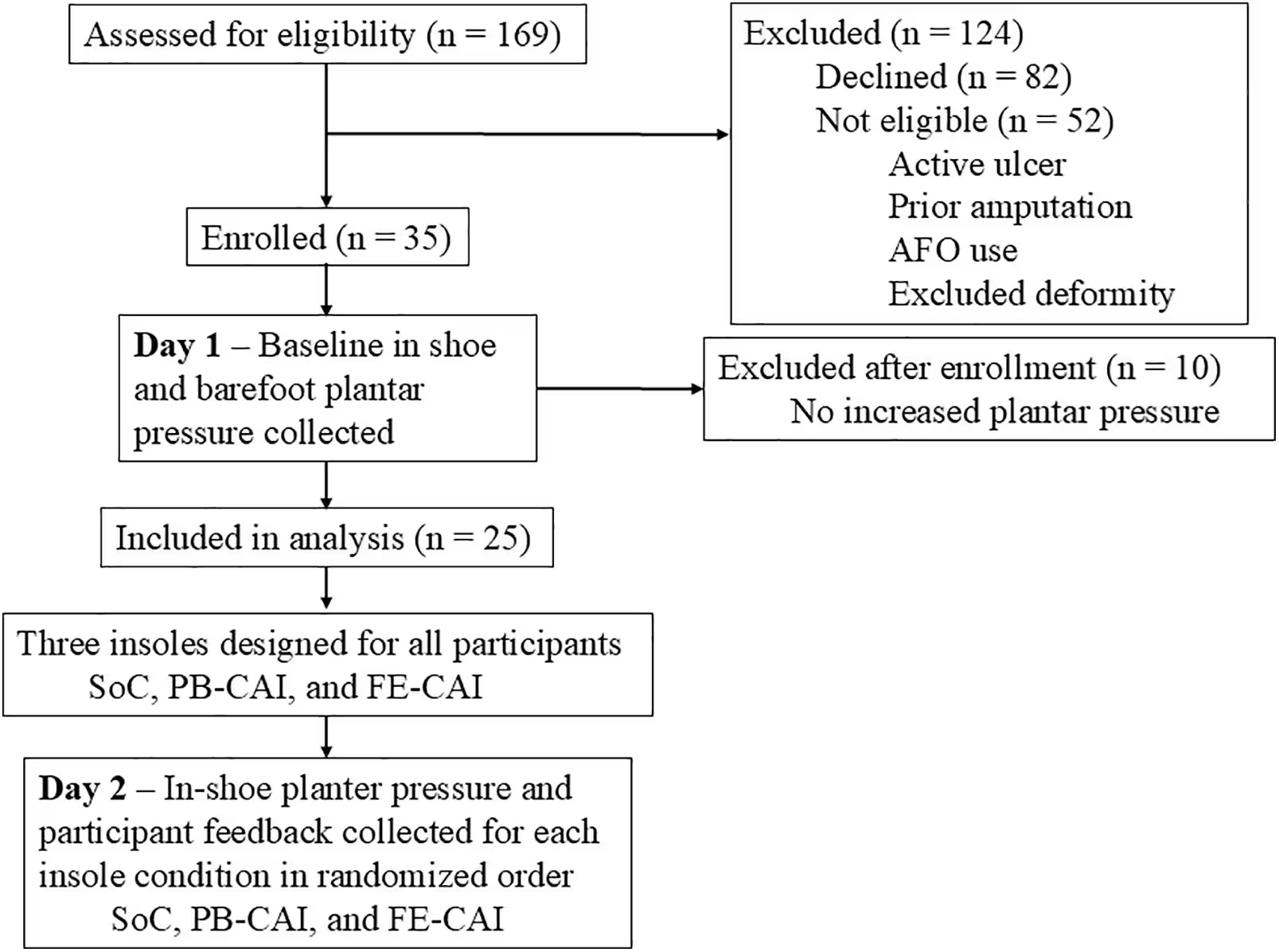
Both 3D-printed designs significantly outperformed standard care inserts in reducing peak plantar pressure within targeted regions of interest. Specifically, the computer-simulated insoles achieved a 35 percent reduction in peak pressure compared to walking without inserts, while pressure-based insoles achieved a 33 percent reduction. Standard hospital inserts achieved a more modest 14 percent reduction. Furthermore, the computer-simulated design demonstrated a unique ability to reduce pressure not only in the primary high-risk zones but also across adjacent foot tissues without causing unwanted pressure spikes nearby.
Patient Comfort and Preferences Reveal Key Trade-offs
Despite the superior mechanical performance of the computer-simulated inserts, participant feedback revealed important insights regarding everyday usability and comfort. When asked to choose their favorite device, 40 percent of participants selected the pressure-based 3D-printed insert, 36 percent preferred the standard foam insert, and 24 percent favored the computer-simulated design.
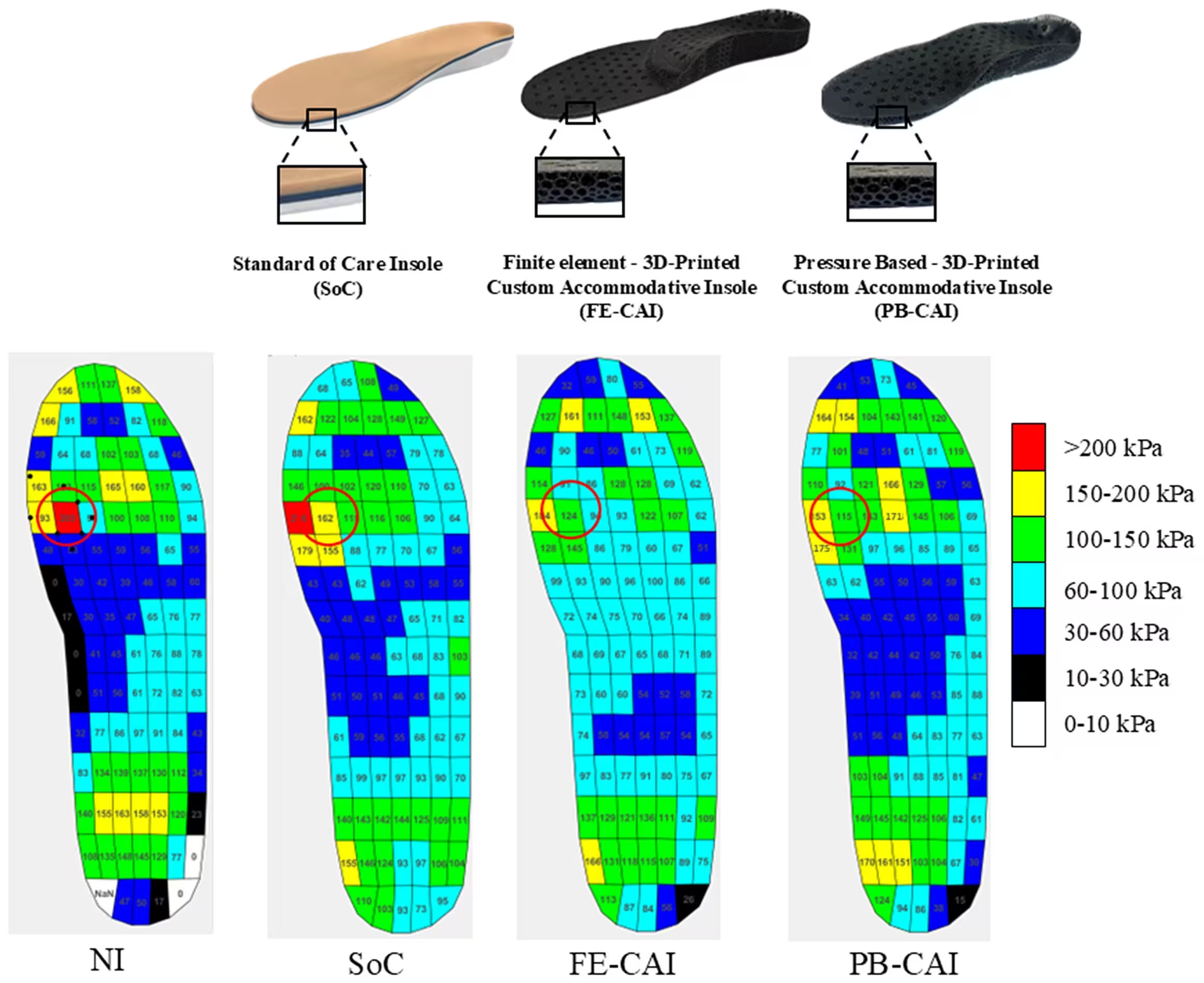
Participants frequently praised the pressure-based inserts for their overall comfort, arch support, and pleasant underfoot feel. Conversely, some users reported discomfort associated with the mechanical metatarsal bars utilized in the computer-simulated inserts to achieve offloading. All insert types occasionally contributed to sensations of heel slippage or altered stability, highlighting the ongoing challenge of balancing rigorous biomechanical offloading with intuitive patient comfort.
Limitations and Future Directions in Foot Care
The study authors noted several limitations in their investigation, including potential measurement variability caused by minor shifting of pressure sensors inside the shoes during walking trials. Additionally, the research evaluated short-term walking sessions rather than long-term daily wear, meaning the sustained durability and real-world ulcer prevention rates of the 3D-printed inserts remain to be tested over extended periods. Future engineering efforts will focus on refining lattice stiffness gradients to smooth transitions between offloading zones and improving overall shoe fit to maximize both medical efficacy and patient compliance.
The research was published in PLOS One on November 19, 2026.
This article has been fact checked for accuracy, with information verified against reputable sources. Learn more about us and our editorial process.
Last reviewed on .
Article history
- Latest version
Reference(s)
- Muir, Brittney C.., et al. “Improving offloading in diabetic feet: 3D-printed custom accommodative insoles outperform standard of care.” PLOS One, vol. 21, no. 11, November 19, 2026, pp. e0363325 Public Library of Science (PLoS), doi: 10.1371/journal.pone.0363325. <https://doi.org/10.1371/journal.pone.0363325>.
Cite this page:
- Posted by Farah Siddiqui