AI-Powered Quantum Networks Simulate 1024 Strongly Correlated Sites
Physicists combine deep learning with tensor networks to crack complex electron behavior at unprecedented scales.
Physicists have developed a new computational method that bridges artificial neural networks with quantum tensor networks to simulate complex electron systems with unprecedented scale and precision. Strongly correlated electrons, which are particles whose collective behavior cannot be understood by examining individual interactions alone, govern fascinating phenomena like high-temperature superconductivity. However, modeling them accurately on computers has remained a monumental roadblock in computational physics because the required mathematical representations grow exponentially complex.
In a study published on the arXiv preprint server, researchers Runze Chi, Ao Chen, and Garnet Kin-Lic Chan introduced neural-network Gaussian projected entangled-pair states, abbreviated as NN-GPEPS. This architecture combines the local geometric structure of tensor networks with the pattern-matching power of deep learning. When applied to the two-dimensional Hubbard model at an interaction strength of $U/t = 8$ with 1/8 hole doping, the method achieved state-of-the-art variational energies across massive lattices containing up to 1024 sites.
How Neural Networks Meet Quantum Tensor Networks
To capture the peculiar quantum rules obeyed by electrons known as fermions, physicists must account for complex mathematical sign changes when particles swap positions. Traditional neural network approaches often rely on long-range correlation matrices that require an overwhelming amount of computational data, scaling as $O(N^2)$ with system size. Meanwhile, modern neural architectures like convolutional neural networks naturally output local features that scale more efficiently as $O(N)$.
The newly proposed framework resolves this mismatch by restricting the system to a locally entangled subspace of Gaussian states. Instead of calculating sprawling global matrices, the neural network generates configuration-dependent local pairing matrices at each lattice site. These local pieces are then stitched together using exact tensor network contractions.
Exact Contractions and Low Computational Costs
The breakthrough of the new technique lies in its computational efficiency. Evaluating quantum amplitudes in two dimensions typically incurs heavy exponential costs. However, because of the underlying Gaussian tensor structure, the authors showed that the contraction cost can be performed exactly with a polynomial scaling of $O(N^{3/2})$ on two-dimensional lattices.
Benchmark tests conducted on NVIDIA A100 graphics processing units revealed that for a $64 \times 64$ grid containing 4096 sites, the Gaussian tensor network contraction ran roughly an order of magnitude faster than standard dense Pfaffian and determinant evaluations. This speed advantage allows researchers to probe much larger quantum systems than previously possible without sacrificing mathematical rigor.
Unveiling Stripe Patterns and Future Horizons
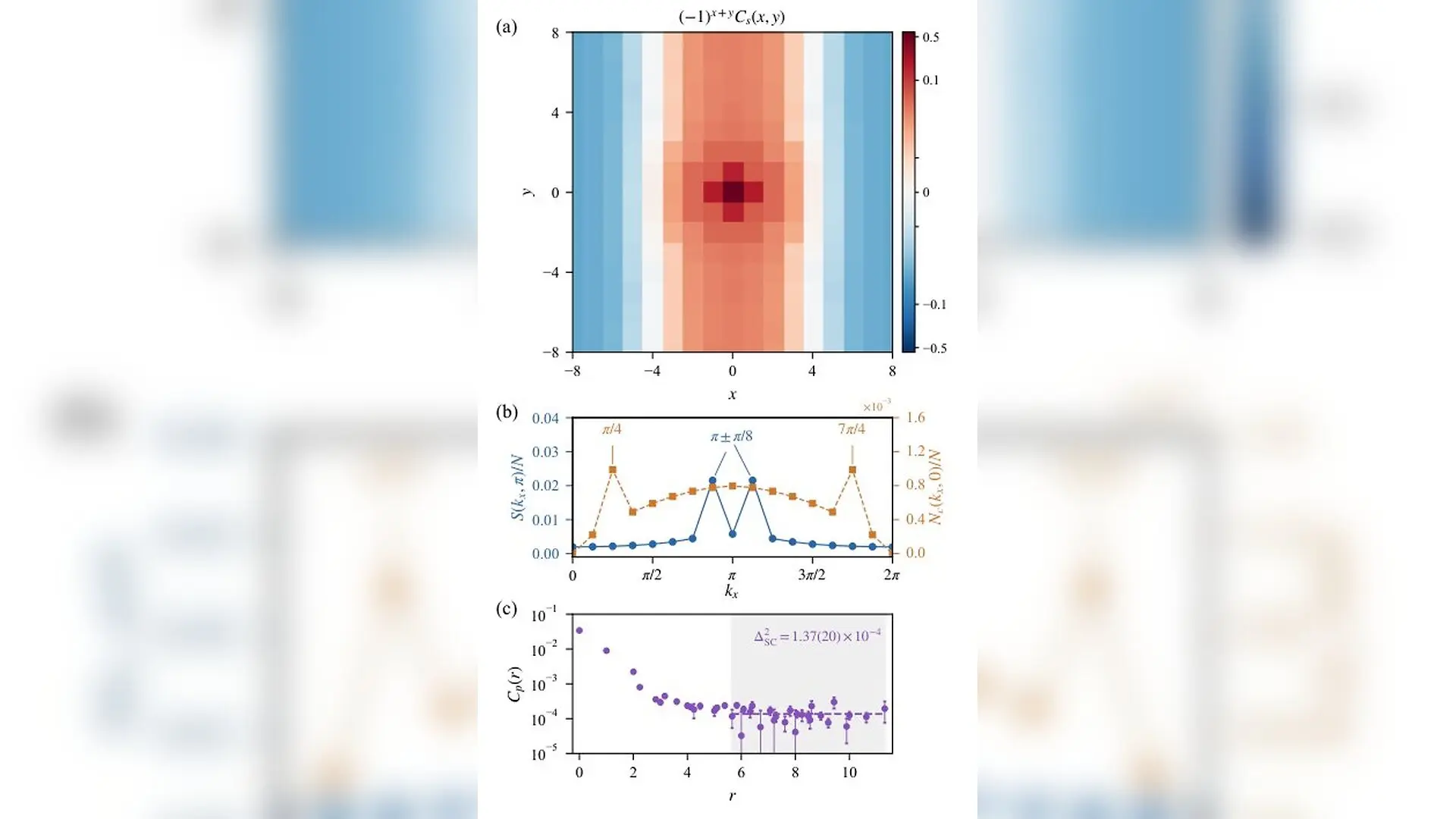
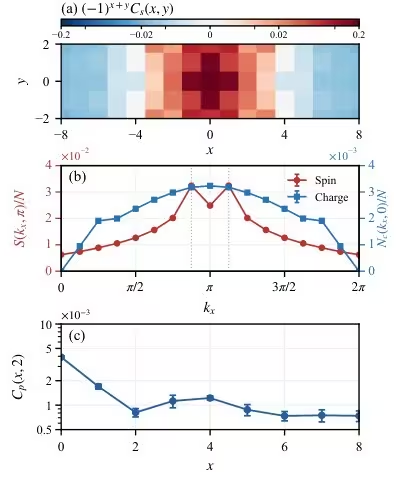
When the team tested the NN-GPEPS architecture on $16 \times 16$ square lattices, the simulations successfully resolved intricate stripe patterns in both spin and charge distributions, matching previous high-end theoretical predictions. Furthermore, transferring the optimized parameters directly to a larger $32 \times 32$ lattice without any additional training yielded highly competitive energies.
While the detected pair correlations show promising finite-distance signals, the authors note that establishing true superconducting long-range order will require scaling up to even larger lattice sizes. Nevertheless, the work demonstrates a powerful bridge between machine learning and quantum many-body physics, offering a scalable route toward solving longstanding phase diagrams in condensed matter physics.
The study was posted to the arXiv preprint server on November 19, 2026.
This article has been fact checked for accuracy, with information verified against reputable sources. Learn more about us and our editorial process.
Last reviewed on .
Article history
- Latest version
Reference(s)
- Chi, Runze. “Scalable Simulation of Strongly Correlated Fermions with Neural Gaussian Tensor Networks.” arXiv.org <http://arxiv.org/abs/2611.26604v1>.
- Posted by Deepak Malhotra