New Laser Technique Maps Hidden Velocity Fields Inside Quantum Superfluids
By splitting and interfering ultra-cold atomic clouds, physicists have directly visualized quantum whirlpools and rapid rarefaction waves.
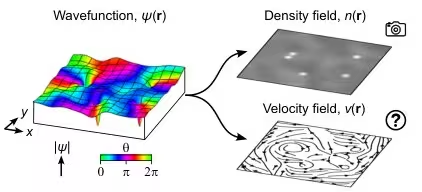
Physicists have developed a new interferometric technique to map the local velocity field of an atomic superfluid in two dimensions with micrometer-scale resolution. While taking pictures of a quantum fluid’s density has long been routine, tracking the precise speed and direction of every moving pocket of atoms has remained a major hurdle. The new approach overcomes this challenge by using tailored laser pulses to interfere a superfluid cloud with a slightly shifted copy of itself, translating internal phase shifts directly into visible fringe patterns.
The research team, based at the University of Cambridge, successfully applied their velocimetry method to two classic benchmark scenarios in fluid dynamics. First, they watched how a one-dimensional quantum expansion known as a Riemann rarefaction wave evolves over time, and second, they mapped out the swirling currents around individual quantum whirlpools known as quantized vortices. The findings are available on the arXiv preprint server, offering a fresh experimental lens for studying complex quantum turbulence and hydrodynamic behaviors.
How Laser Beams Turn Quantum Phase Into Visible Fringes
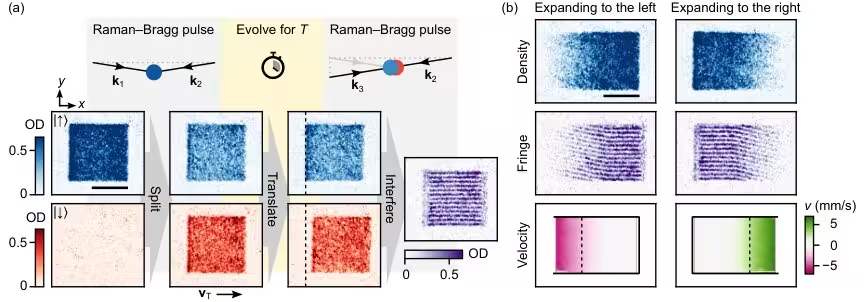
At the heart of the experiment are atomic Bose-Einstein condensates, which are ultra-cold clouds of potassium-39 atoms cooled down until millions of them act as a single macroscopic quantum entity. To measure how fast this fluid moves, the researchers split off a secondary copy of the condensate using specialized light pulses known as Raman-Bragg beam splitters. This first pulse imparts a controlled momentum kick, sending the duplicate cloud moving at roughly 25 millimeters per second along a specific direction.
After a brief holding time of 150 microseconds, a second laser pulse brings the two clouds back into interference. Because the quantum mechanical phase of the fluid varies depending on its local velocity, the resulting overlap creates a fringe pattern that bends and shifts in response to local flows. By analyzing these fringes with a Fourier-transform algorithm, the authors reconstructed the full two-dimensional velocity profile with a spatial resolution of about one micrometer.
Watching 1D Rarefaction Waves Expand Into Vacuum
To test the reliability of their technique, the researchers investigated what happens when a confined box trap is suddenly opened on one side, allowing the uniform atomic gas to rush outward into a vacuum. This creates a one-dimensional Riemann rarefaction wave, a textbook nonlinear hydrodynamic flow where theoretical models predict that density and velocity profiles should collapse onto universal scaling curves.
When the team plotted their measured velocity and density data against a dimensionless similarity variable that combines position, time, and the local speed of sound, the experimental points matched the theoretical curves with high fidelity. The initial speed of sound in the box was measured at roughly 3.4 millimeters per second, serving as the benchmark scale for the expanding front.
Mapping Quanta of Circulation Around Tiny Whirlpools
Beyond straight-line expansions, the team turned their attention to rotational phenomena by creating single quantum vortices at the center of their box trap using a mechanical stirring method akin to a tiny chopstick. In a classical fluid, a vortex can spin at any arbitrary rate, but in a quantum superfluid, circulation is strictly constrained to discrete multiples of Planck’s constant divided by the atomic mass.
By adapting their laser setup to measure both horizontal and vertical velocity components, the researchers mapped out the complete two-dimensional quiver plots around the vortices. Their azimuthally averaged speed measurements closely followed the predicted inverse-radius decay curve. Furthermore, by integrating the velocity field around closed contours, they confirmed that the circulation matches the theoretical quantum of rotation when the path encloses a vortex, and drops to zero elsewhere.
The authors suggest that this direct local velocimetry could soon be paired with optical box traps to investigate more intricate geometries, such as superflows moving past obstacles or through narrow channels connecting different reservoirs. These capabilities could eventually shed light on complex phenomena like quantum turbulence and the dynamics of interacting vortex pairs.
The study was posted to the arXiv preprint server on November 19, 2026.
This article has been fact checked for accuracy, with information verified against reputable sources. Learn more about us and our editorial process.
Last reviewed on .
Article history
- Latest version
Reference(s)
- Zhang, Yansheng. “Local velocimetry for atomic superfluids: from Riemann rarefaction waves to quantized vortices.” arXiv.org <http://arxiv.org/abs/2611.26608v1>.
Cite this page:
- Posted by Aisha Ahmed