Engineers Reveal Massive 58 Kilometer Starship Design for a One Way Trip to the Stars
Could humanity survive a 16-generation voyage across the stars? Chrysalis explores the harsh realities of life aboard a massive 58-kilometer starship.
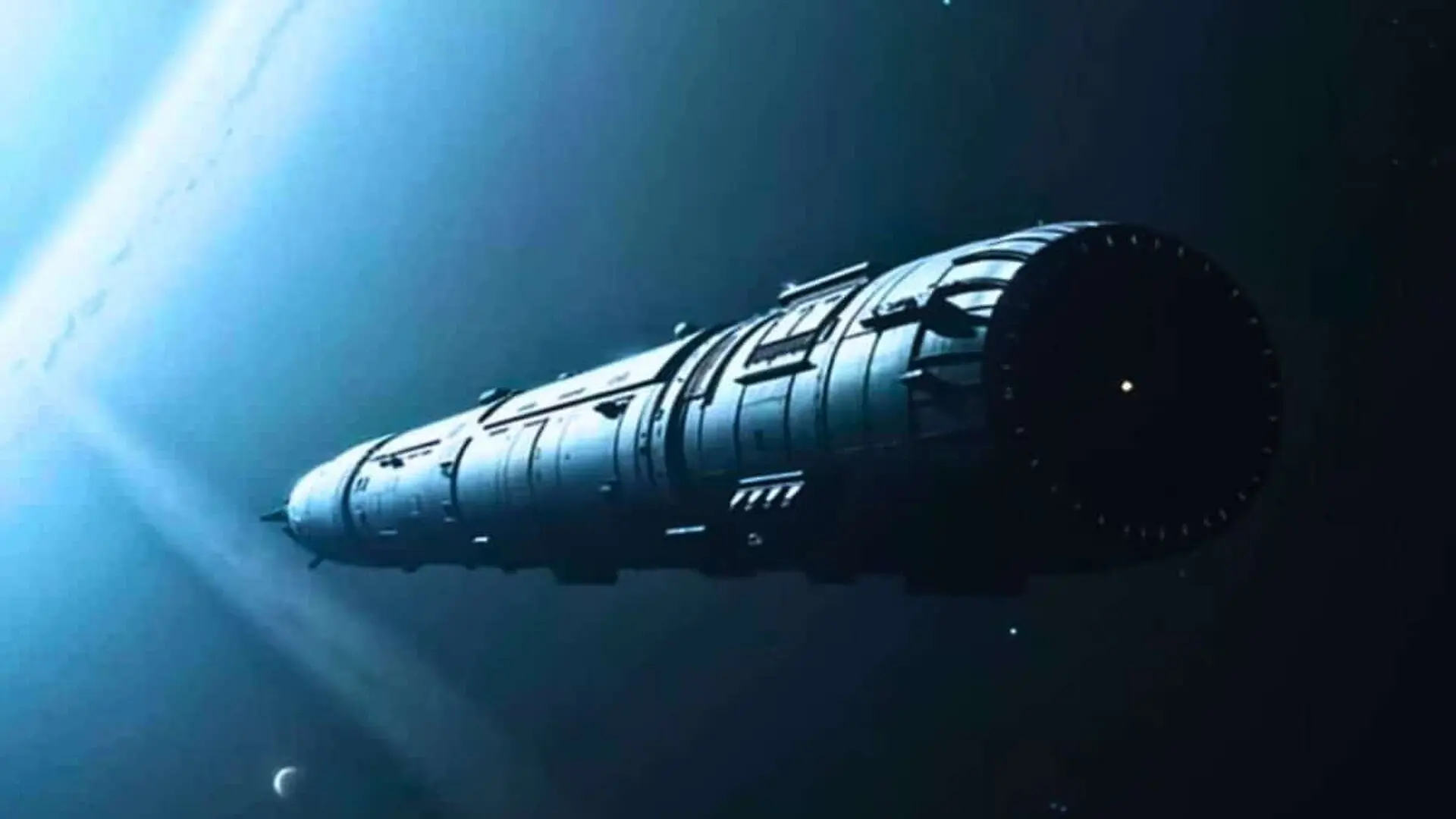
Imagine a journey where the travelers boarding the vessel are destined to never see their home planet again. Their children, and their children’s children, will grow up, age, and pass away within the confines of a metal hull, traversing the dark expanse of space. By the time the ship reaches a potentially habitable destination, sixteen generations of humanity will have lived and died in transit.
This stark reality serves as the foundation for Chrysalis, the winning entry of the 2025 Project Hyperion international design competition. The challenge went far beyond basic propulsion or life support systems, requiring participants to engineer a self-sustaining civilization capable of surviving centuries in a vacuum. The resulting proposal spans hundreds of pages, detailing everything from agricultural cycles and water reclamation to the intricacies of governance and social structures.
The significance of the Chrysalis design lies not in its ability to provide a complete solution, but in its rigorous identification of the immense obstacles humanity must overcome to make such a mission viable.
Engineering Gravity and Scale
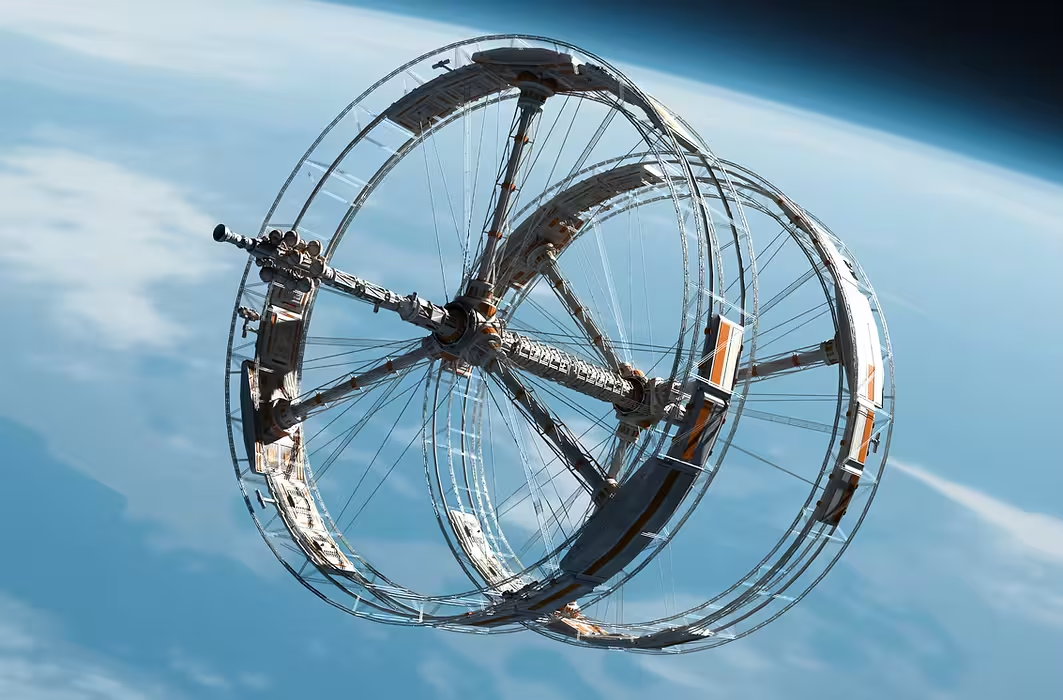
The primary constraint of the vessel is the physics of artificial gravity. To simulate Earth-like conditions, the ship must rotate to generate centrifugal force. However, as noted by aerospace engineer John Page, rotating a smaller structure at high speeds creates a dangerous gravitational gradient between a person’s head and feet, leading to blood pooling and disorientation.
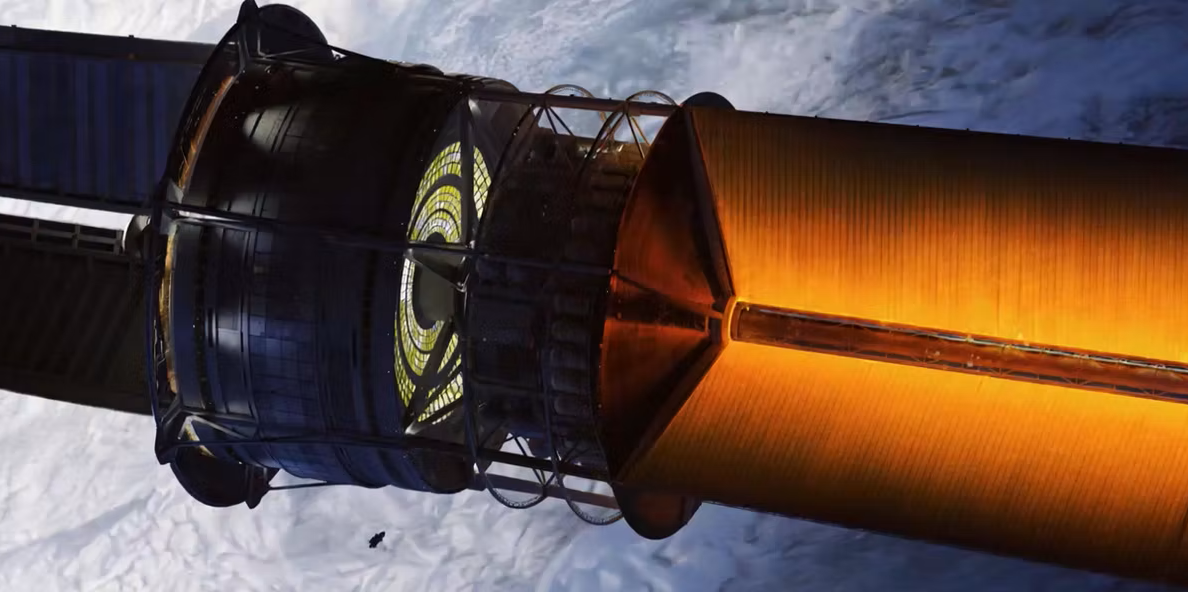
The Chrysalis solution is sheer size. To achieve 0.9g at a manageable rotation speed, the team designed a nested cylinder structure measuring 58 kilometers in length. By rotating the outer and inner shells in opposite directions, the design aims to dampen structural vibrations. Given the sheer scale, the team proposes that construction take place at the Earth-Moon Lagrange points, which offer a stable gravitational environment to minimize the energy required for assembly.
The Technological Horizon
For propulsion, the design leans on a Direct Fusion Drive fueled by deuterium and helium-3, allowing for a mission profile of one year of acceleration, four centuries of coasting, and a final year of deceleration. As of 2026, however, such a reactor remains purely theoretical.
Beyond propulsion, the vessel faces severe hurdles in radiation shielding and ecological closure. Current manufacturing cannot provide the level of shielding required to protect a crew from cosmic rays over hundreds of years, nor is there an existing system capable of maintaining a perfectly closed-loop ecosystem. Historical attempts at self-contained environments, such as the Biosphere 2 project, highlighted the extreme volatility of such systems, even over short durations. Chrysalis assumes these gaps will be filled by future research rather than current technology.
Sustaining a Society Across Centuries
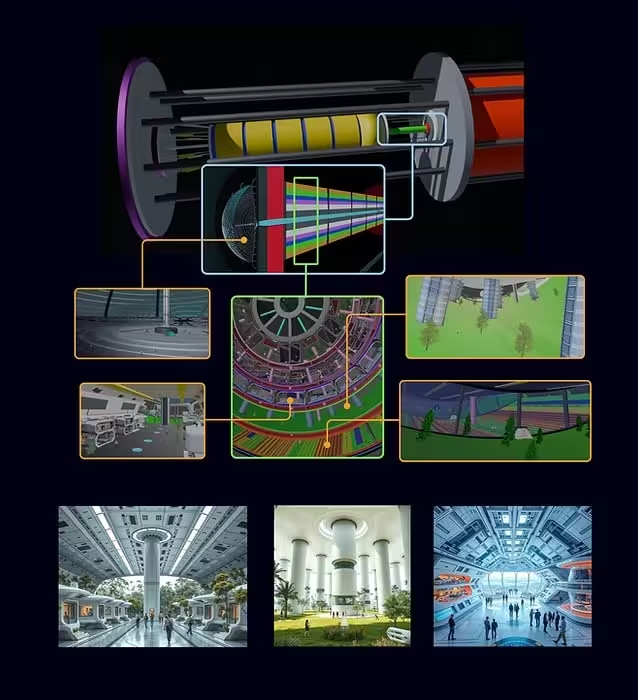
Perhaps the most complex element of the proposal is the preservation of social stability. The Chrysalis team envisions a society structured around collective child-rearing and AI-assisted governance, with crew selection modeled on the psychological resilience found in Antarctic overwintering teams.
Yet, this raises a profound existential question: would generations born in deep space, having adapted entirely to the ship, still possess the desire to colonize a new planet? With no precedent for multi-generational isolation, the team acknowledges that social cohesion remains a vast, unknown variable. The Chrysalis project does not claim to have the answers; instead, it provides a vital, detailed roadmap of the questions we must eventually solve if humanity is to become an interstellar species.
This article has been fact checked for accuracy, with information verified against reputable sources. Learn more about us and our editorial process.
Last reviewed on .
Article history
- Latest version
Reference(s)
- “1dff9e 8d7edb7a1e4d437aaba660ad2171c2aa.” <https://www.projecthyperion.org/_files/ugd/1dff9e_8d7edb7a1e4d437aaba660ad2171c2aa.pdf>.
- “1dff9e C8c0097a17cc4badbf28f47479482d0ef000 20250731 204032.” <https://www.universetoday.com/article_images/1dff9e_c8c0097a17cc4badbf28f47479482d0ef000_20250731_204032.png>.
Cite this page:
- Posted by Farah Siddiqui