Math Model Reveals How Infant Brain Chemistry Drives Sleep Evolution
New computational simulations map the physiological shifts that transform polyphasic infant nappers into consolidated nightly sleepers.

Infants sleep in scattered fragments while adults enjoy consolidated nights, and a mathematical study reveals how shifting brain chemical speeds drive this transformation during early childhood. The research points to a changing homeostatic drive, which is the internal sleep pressure that builds up during wakefulness, as the primary physiological engine behind why babies transition from polyphasic nappers into single-bout nightly sleepers by age five.
Mathematical Models Map Infant Brain Chemistry
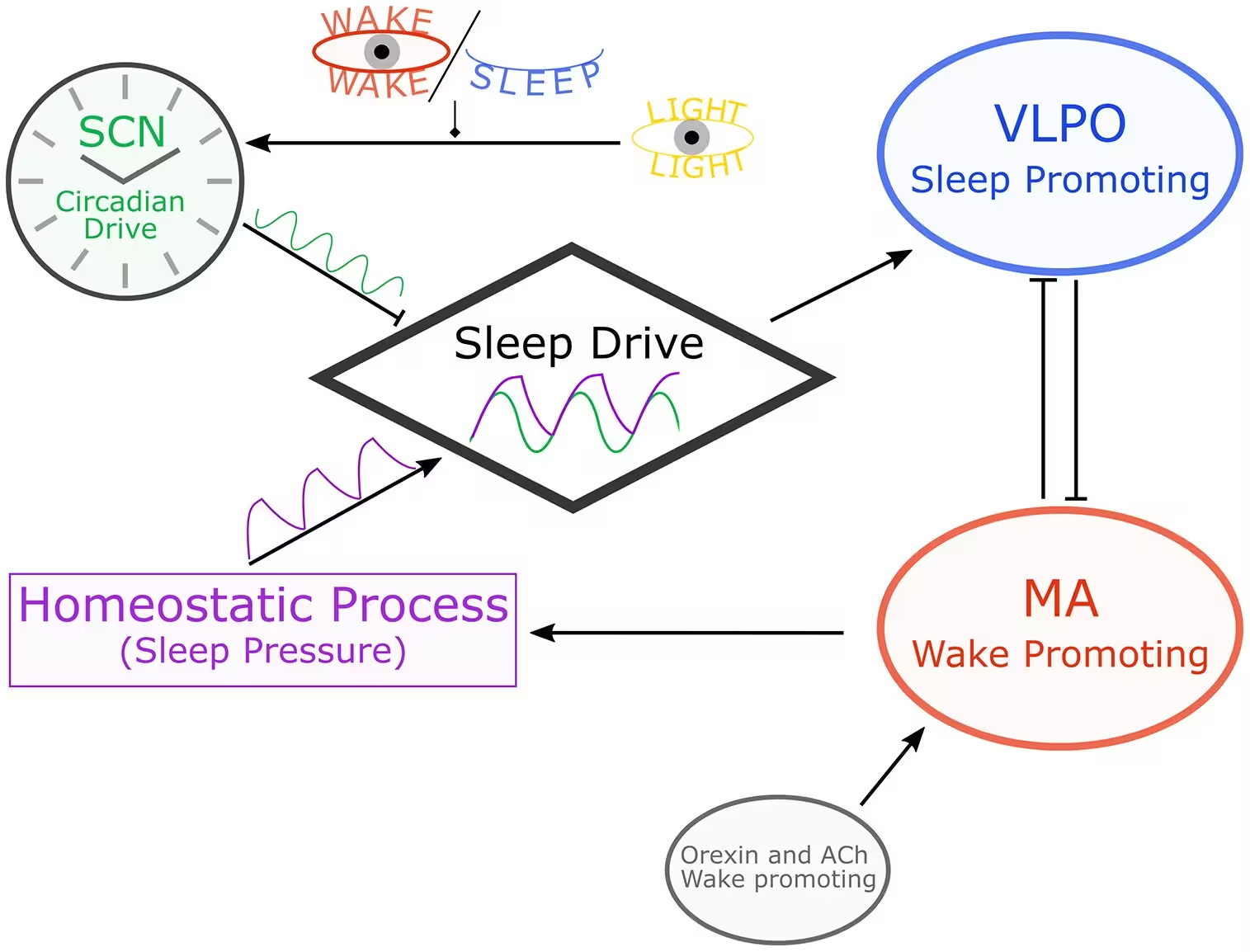
To understand the biological underpinnings of infant rest, researchers adapted an established neural mass framework originally designed to simulate adult sleep regulation. This model governs the interactions between the ventrolateral preoptic nucleus, a brain region that promotes sleep, and the monoaminergic group, which promotes wakefulness. The study was published in PLOS Computational Biology, detailing how the researchers applied a Bayesian statistical approach to estimate age-specific probability distributions for biophysical parameters across seven distinct developmental stages ranging from one month to five years old.
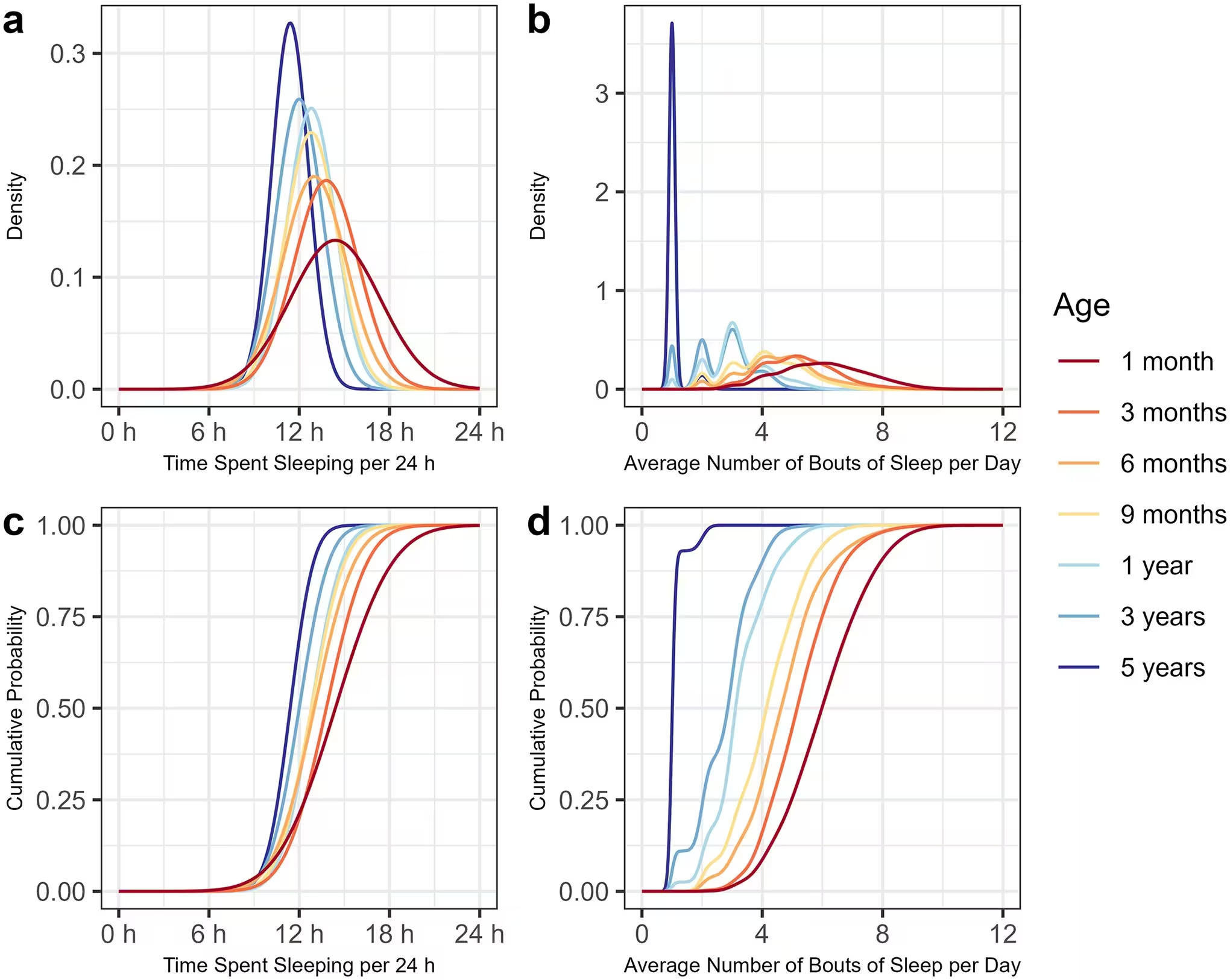
Rather than assuming every child sleeps identically, the team fitted population-level data concerning average daily sleep durations and total sleep bouts per day. The two critical parameters examined were the rate of homeostatic sleep pressure increase driven by the wake-promoting brain regions, known as mu-h-m, and the time scale governing how fast those chemical somnogens clear from the brain, represented by chi. By adjusting these variables, the mathematical simulation successfully reproduced the broad diversity of sleep behaviors observed across human populations during early development.
How Brain Pressure Alters Napping Habits
The parameter estimates revealed a wide distribution of high central values for the sleep pressure accumulation rate during the first nine months of life, which then narrowed and shifted lower as children aged. Meanwhile, the time scale parameter for somnogen clearance increased steadily, hitting upper adult boundaries once children reached monophasic sleep patterns around one year of age and beyond. This suggests that the physiological mechanism clearing sleep-inducing chemicals becomes significantly faster as the central nervous system matures.
Bifurcation analysis of the differential equations demonstrated that decreasing the clearance time scale results in abrupt transitions from consolidated sleep into multiple daily bouts. When children drop a nap, the model shows that naps do not merely merge together, but rather disappear entirely at distinct clock times. This mirrors real-world developmental milestones where toddlers drop a morning or afternoon nap while preserving the remaining rest periods.
Testing Synthetic Populations Against Real Childhood Data
As a strict test of validity, the model was evaluated against independent clinical datasets that it was not explicitly trained to match, including parent-reported sleep diary distributions. Synthetic populations generated by the model successfully captured the shift from skewed distributions of numerous short daytime naps at one month of age to a clear bimodal distribution of longer sleep bouts by the end of the first year. Furthermore, the simulated schedules correctly placed longer sleep bouts during evening hours while scattering shorter bouts throughout the day.
However, the model also exposed limitations regarding circadian entrainment. A small proportion of simulated one-year-olds failed to properly synchronize with a 24-hour solar cycle, resulting in displaced sleep episodes starting late at night. The authors note that adjusting the circadian phase response parameter closer to adult levels in future work could resolve these timing mismatches. Ultimately, this computational framework provides a robust baseline for investigating sleep disorders and neurological conditions where atypical sleep patterns serve as early clinical indicators.
The research was published in PLOS Computational Biology on November 20, 2026.
This article has been fact checked for accuracy, with information verified against reputable sources. Learn more about us and our editorial process.
Last reviewed on .
Article history
- Latest version
Reference(s)
- Webb, Lachlan., et al. “Inferring population-level physiologically based model parameters for sleep in infancy and young childhood.” PLOS Computational Biology, vol. 22, no. 11, November 20, 2026, pp. e1014960 Public Library of Science (PLoS), doi: 10.1371/journal.pcbi.1014960. <https://doi.org/10.1371/journal.pcbi.1014960>.
Cite this page:
- Posted by Farah Siddiqui