Why Over 30 Percent of Women in a South African Region Face Hidden Parasitic Health Risks
A new survey reveals how symptom duration, economic factors, and traditional healing shape care for a neglected tropical disease.
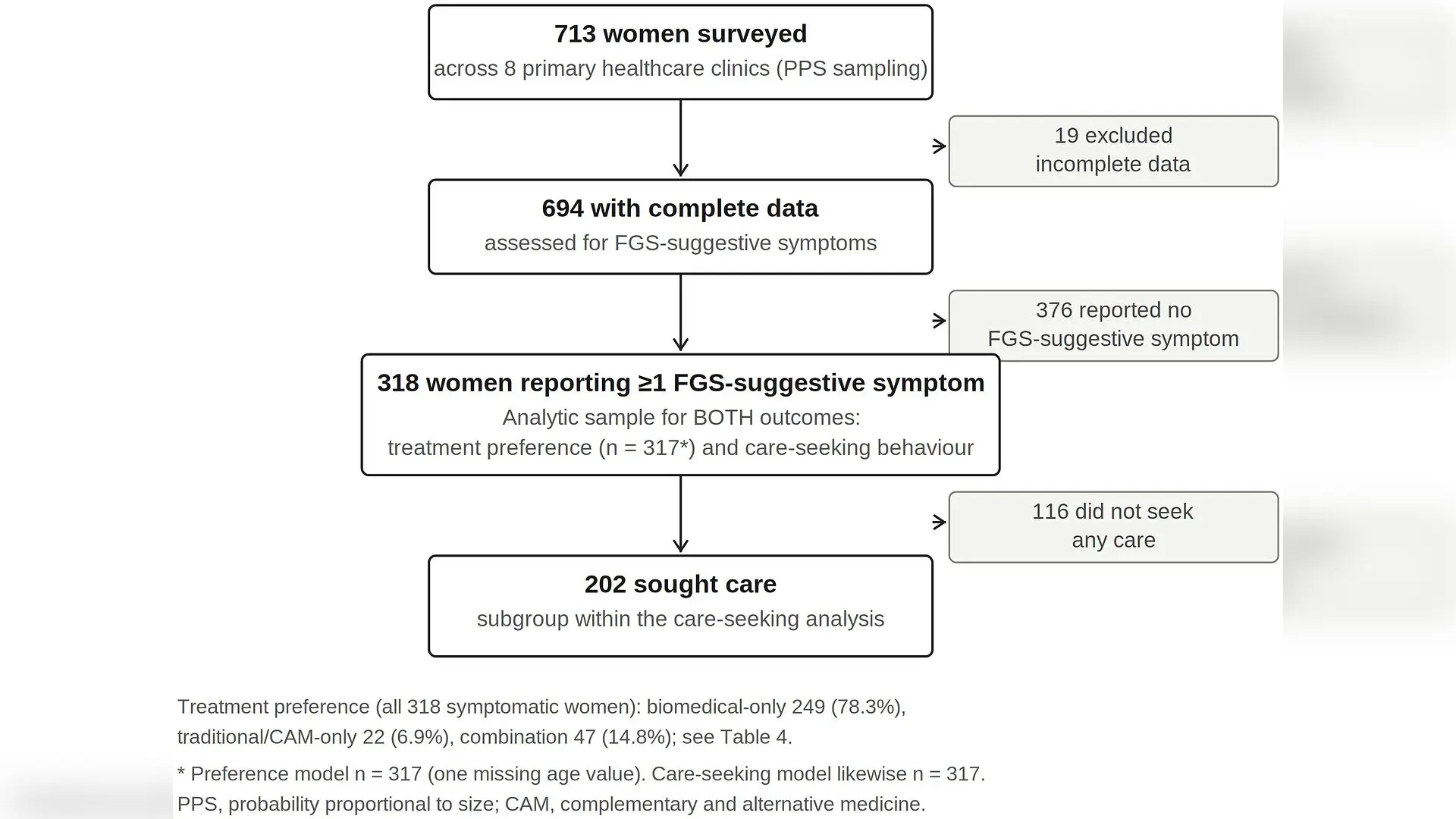
Nearly a third of young women living in a rural South African region report genital symptoms linked to a neglected parasitic disease, yet most navigate a complex maze of traditional and modern health options without knowing the cause, according to a study published in PLOS Global Public Health.
Female genital schistosomiasis affects millions of women across sub-Saharan Africa. The chronic condition develops when parasitic worms trapped in freshwater infect reproductive tissues, creating lesions that cause pain, bleeding, and significantly elevate the risk of acquiring HIV. Researchers surveyed 694 women aged 18 to 49 across eight primary healthcare clinics in the iLembe District of KwaZulu-Natal, South Africa, to understand what drives their decisions when seeking medical help.
What Pushes Patients to Finally Visit a Clinic?
The survey revealed that out of 318 symptomatic participants, roughly 64 percent sought professional care while 36 percent did not. Statistical models showed that the decision to see a healthcare provider depended heavily on how long symptoms lasted and how many different complaints a woman experienced. Patients living with symptoms for one week or longer were more than three times as likely to seek care compared to those with shorter durations. Each additional symptom reported further multiplied the likelihood of a clinic visit, suggesting that individuals frequently normalize mild discomfort and only act when distress accumulates.
Disease awareness was strikingly low across the cohort. Only 21.7 percent of the women had heard of schistosomiasis prior to the study, and the vast majority relied on mass media or healthcare workers for their health information. Women who already understood the disease were significantly less likely to rely exclusively on traditional or alternative remedies.
Traditional Medicine and Economic Realities
While nearly 78 percent of symptomatic women preferred modern biomedical care alone, roughly 22 percent favored traditional, complementary, and alternative medicine either by itself or combined with clinic visits. Employment status played a major role in shaping these choices. Women engaged in informal work were nearly nine times as likely to prefer traditional or alternative care alone compared to unemployed individuals, likely reflecting economic hurdles and flexible payment arrangements offered by traditional healers.
Furthermore, women who reported water-contact activities outside of routine bathing, such as farming, washing clothes, or swimming in natural bodies of water, were more than three times as likely to prefer a combination of both traditional and biomedical care pathways. This points to ongoing environmental exposure driving continuous efforts to find relief through multiple healing systems.
Study Limitations and Next Steps
The authors noted important limitations to consider. The study relied entirely on self-reported symptoms without clinical, serological, or molecular confirmation. Because genital schistosomiasis shares clinical overlap with sexually transmitted infections, pelvic inflammatory disease, and urinary tract infections, the patient group undoubtedly included individuals with other conditions. Additionally, as a facility-based survey, the findings capture only those who reached a clinic, missing individuals entirely cut off from formal healthcare.
The investigators emphasize that these findings highlight an urgent need to integrate screening and provider training into routine sexual and reproductive healthcare. Addressing low public awareness and bridging the gap between modern clinics and traditional practitioners could help women secure timely diagnoses before chronic complications take root.
The research was published in PLOS Global Public Health on November 20, 2026.
This article has been fact checked for accuracy, with information verified against reputable sources. Learn more about us and our editorial process.
Last reviewed on .
Article history
- Latest version
Reference(s)
- Shongwe, Sinegugu., et al. “Health-seeking behaviour and treatment preferences among women reporting symptoms suggestive of female genital schistosomiasis in KwaZulu-Natal, South Africa: A facility-based cross-sectional study.” PLOS Global Public Health, vol. 6, no. 11, November 20, 2026, pp. e0007218 Public Library of Science (PLoS), doi: 10.1371/journal.pgph.0007218. <https://doi.org/10.1371/journal.pgph.0007218>.
Cite this page:
- Posted by David Anderson