New Algorithm Learns Factory Defect Detection On The Fly Without Forgetting
A novel neural network framework combines adaptive resonance theory with statistical covariance modeling to spot microscopic manufacturing flaws.

Catching tiny factory flaws before items ship is a constant puzzle for manufacturers, especially when defective products are extremely rare. A new computer algorithm can spot microscopic scratches and missing parts by organizing normal product patterns into smart memory categories, learning new items on the fly without forgetting old ones.
How Fuzzy Adaptive Resonance Theory Spots Factory Flaws
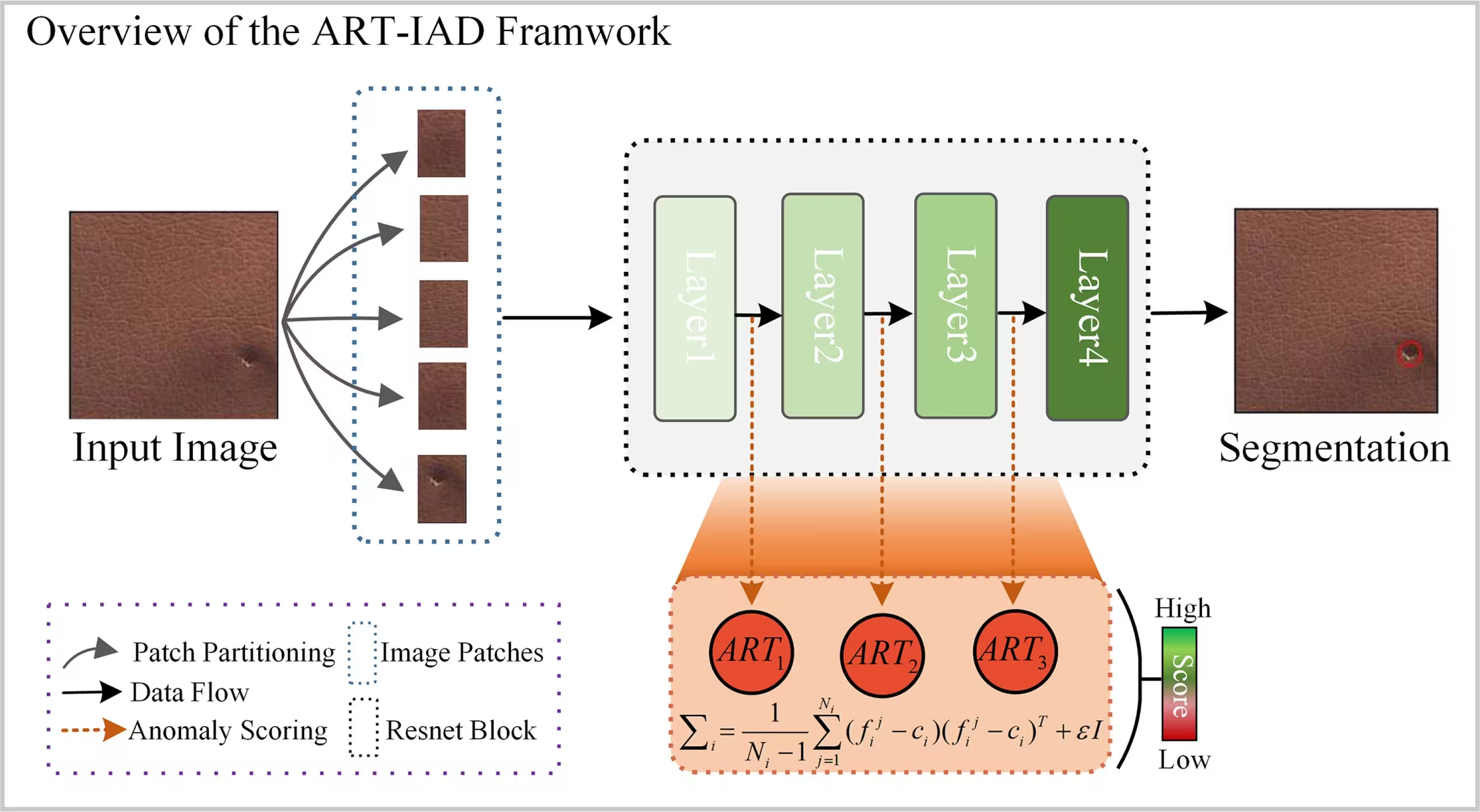
Engineers usually train quality control software using only flawless items, teaching computers what normal looks like so they can flag anything that deviates. Traditional memory banks struggle because they must store thousands of reference images or suffer from signal interference when combining different layers of visual data. To solve this, researchers built an online patch-based framework called ART-IAD that treats distinct neural network layers as independent views and groups image patches using Adaptive Resonance Theory, a classic neuroscience-inspired machine learning approach.
As described in a study published in PLOS One, the algorithm streams normal training patches through a competitive matching process governed by a vigilance parameter. When an incoming patch matches an existing prototype closely enough, that prototype updates its weight statistics. If the patch differs too much, the system creates a brand new prototype node rather than distorting an existing one. This stability and plasticity mechanism allows the model to absorb new variations without wiping out previous learning.
Why Full Covariance Statistics Improve Defect Localization
Instead of relying on simple Euclidean distances that treat every feature dimension equally, the authors compute a full covariance matrix for each prototype node. This mathematical step tracks the variance and cross-dimensional correlations of normal patches, enabling the system to calculate a Mahalanobis distance score. By normalizing feature deviations according to local prototype variance, the algorithm assigns higher scores to genuine structural anomalies while ignoring common variations.
The team tested their approach on the MVTec Anomaly Detection benchmark and the Visual Anomaly dataset. On the MVTec benchmark, ART-IAD achieved an average image-level area under the receiver operating characteristic curve of 99.4 percent and a pixel-level score of 98.2 percent, outperforming several established memory-bank and reconstruction-based baselines. Furthermore, streaming experiments demonstrated that the model can learn new product categories sequentially with a negligible forgetting rate, showing promise for dynamic factory assembly lines where product designs change frequently.
The research was published in PLOS One on November 20, 2026.
This article has been fact checked for accuracy, with information verified against reputable sources. Learn more about us and our editorial process.
Last reviewed on .
Article history
- Latest version
Reference(s)
- Zhu, Yingwen., et al. “Online unsupervised industrial anomaly detection with adaptive resonance patch prototype memory and multi-level views.” PLOS One, vol. 21, no. 11, November 20, 2026, pp. e0362092 Public Library of Science (PLoS), doi: 10.1371/journal.pone.0362092. <https://doi.org/10.1371/journal.pone.0362092>.
Cite this page:
- Posted by Rabia Shah