Triangular Lattices Force Quantum Particles Into Robust Vortex States
Simulations of quantum particles on different atomic ladders reveal that geometric frustration prevents standard phase collapse and locks in vortex states.
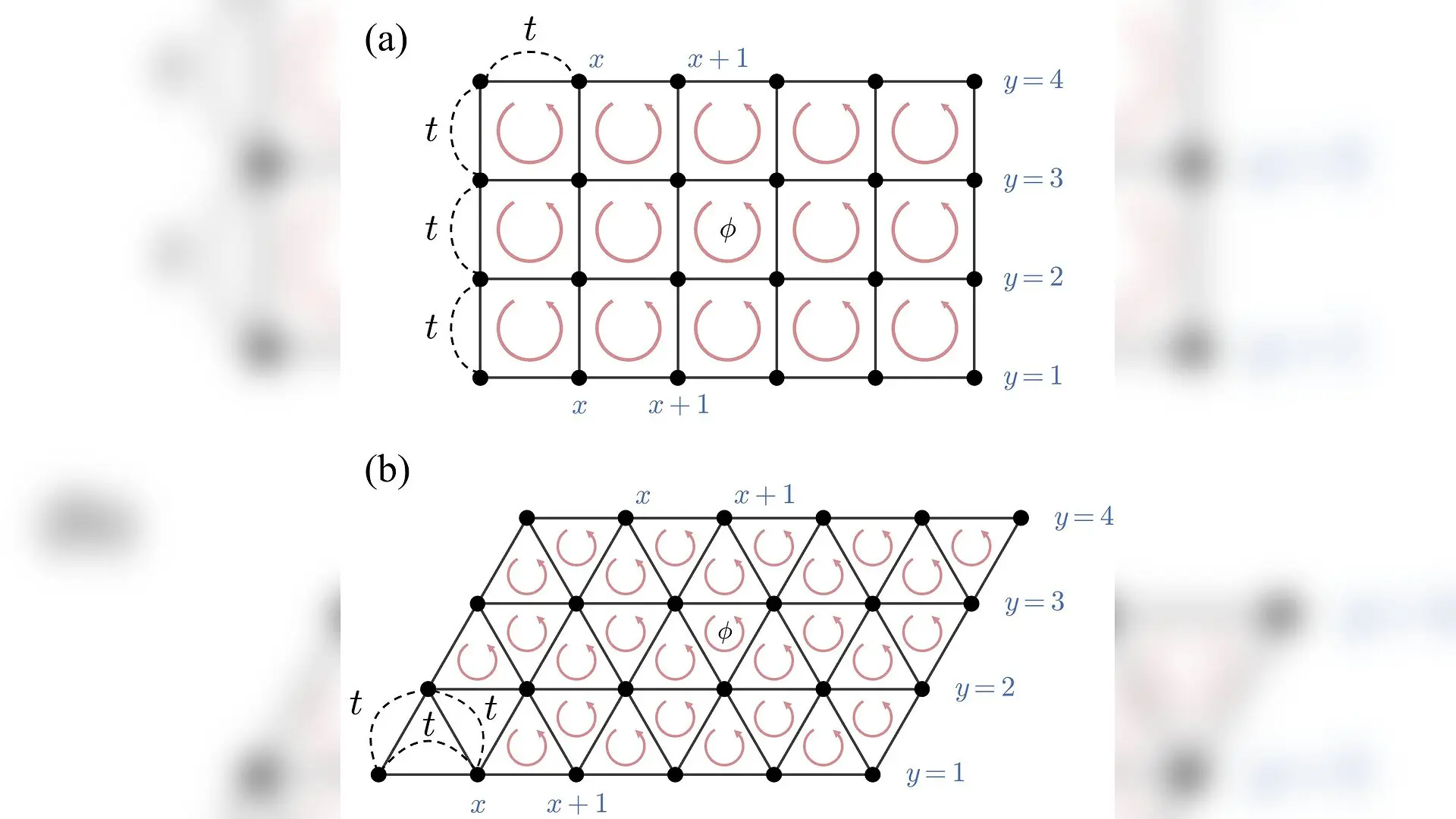
When strongly interacting quantum particles are subjected to an artificial magnetic field, their response depends heavily on the underlying atomic grid, behaving very differently on square frameworks compared to triangular ones. Superfluids and superconductors are traditionally split into two distinct categories based on how they handle magnetic flux, with Type-I materials abruptly letting go of their shielding state and Type-II materials allowing magnetic whirlpools to pierce through their bulk. While this behavior is well documented in solid-state physics, researchers have increasingly turned to synthetic quantum systems like cold atoms trapped in optical lattices to watch these phases emerge from scratch.
To understand what shapes these quantum responses, Takayuki Yokoyama and Yasuhiro Tada investigated the extended Bose-Hubbard model on ladder geometries containing two to four legs, using advanced numerical techniques to simulate particle interactions under a uniform magnetic flux. Their findings are available on the arXiv preprint server and reveal a striking split in how lattice architecture dictates magnetic behavior.
How Do Repulsive Interactions Alter Quantum Vortex Phases?
In standard settings without particle repulsion, pushing a magnetic flux through a bosonic ladder initially induces a diamagnetic edge current known as the Meissner-like phase, which eventually gives way to a vortex-like phase where magnetic flux penetrates the interior. However, when the authors introduced a nearest-neighbor repulsion parameter, the square and triangular ladders diverged dramatically in their behavior.
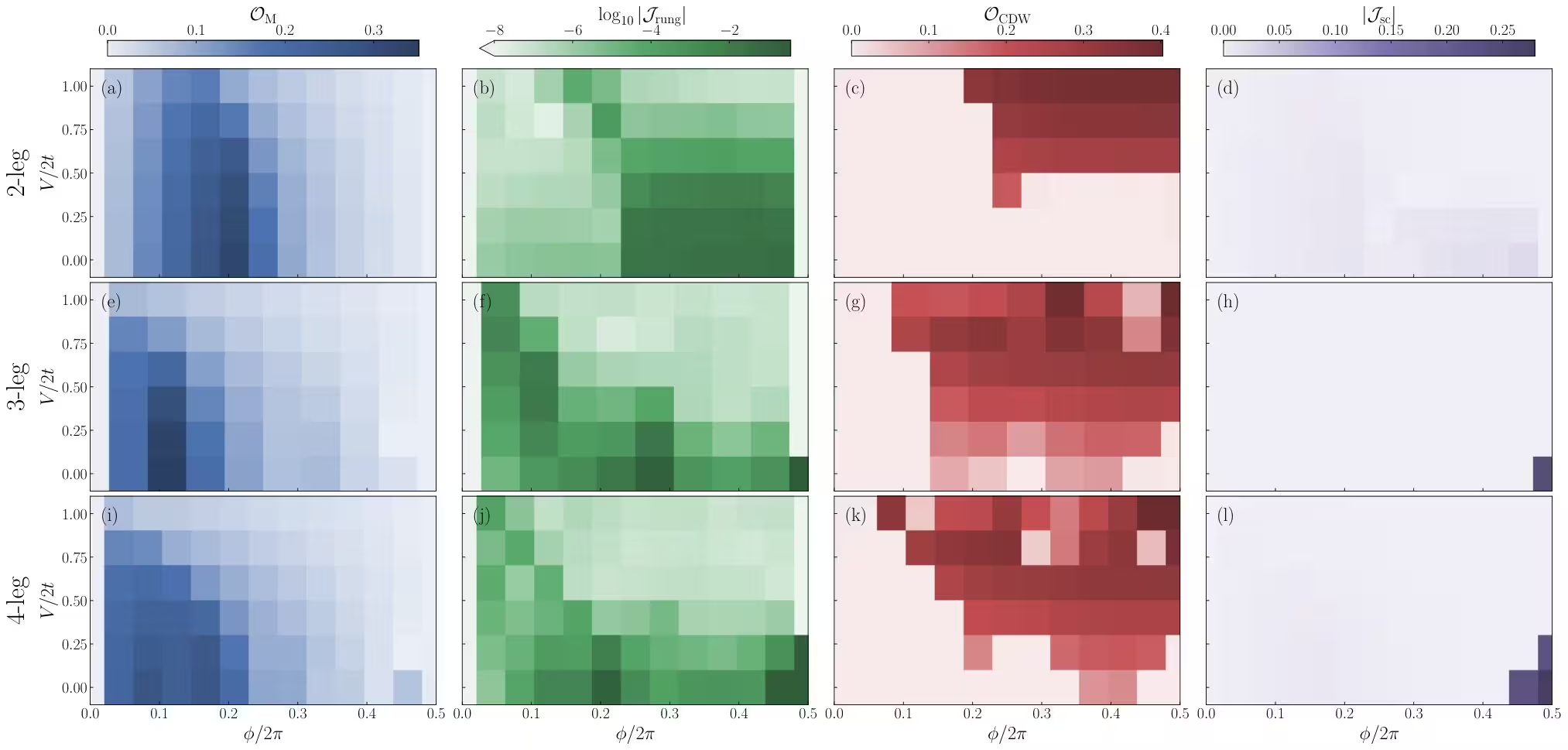
On square ladders, the vortex phase was found to be exceptionally fragile, restricted almost entirely to a tiny window near zero interaction. As soon as repulsion was turned up, the vortex phase vanished, replaced directly by a charge-density-wave order where particle concentrations alternate between neighboring sites in a checkerboard pattern. Because this transition bypasses the vortex state entirely, the square lattice setup exhibits a Type-I-like response.
Why Does Geometric Frustration Protect Vortex States?
The situation looked completely different on triangular ladders, where diagonal bonds introduce a phenomenon known as geometric frustration, which prevents particles from easily settling into simple ordered arrangements. Across the triangular ladder simulations, the vortex phase remained remarkably robust against particle repulsion, persisting across a wide range of magnetic flux values without giving way to density waves.
This persistence means that triangular systems maintain a Type-II-like response regardless of interaction strength. The researchers suggest that geometric frustration suppresses the competing charge-density-wave order, forcing the system to accommodate the incoming magnetic flux through widespread vortex formation rather than direct phase collapse.
What Do These Simulations Mean for Two-Dimensional Materials?
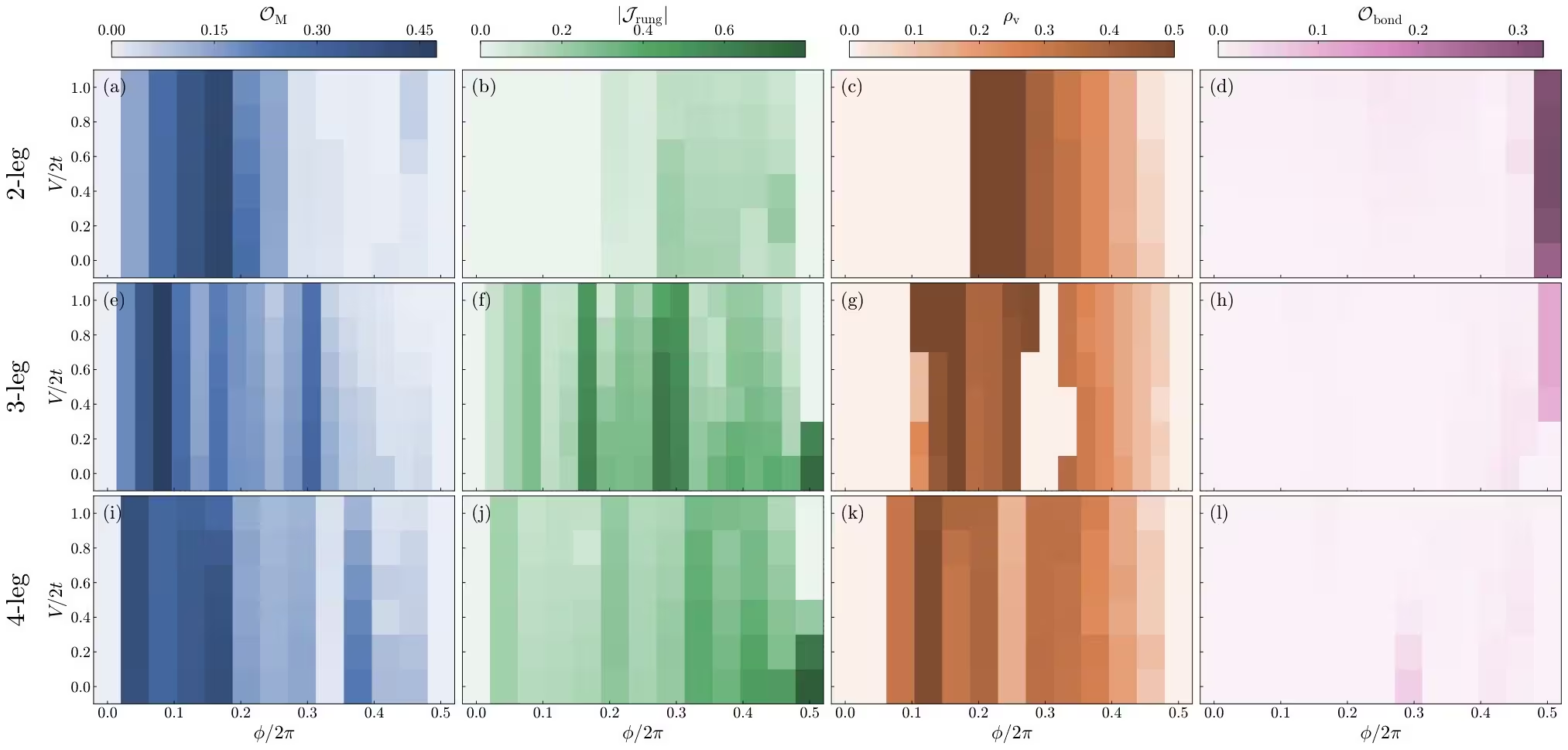
By extrapolating their ladder calculations to full two-dimensional lattices, the authors propose distinct phase diagrams for square and triangular geometries. On square lattices, moderate repulsion coupled with magnetic flux triggers an ordering effect reminiscent of magnetic catalysis, where the field actively promotes density wave formation by enhancing particle interactions.
Conversely, the triangular lattice resists this direct transformation, pointing to a deeper connection between lattice geometry, particle interactions, and quantum phase classification. While these insights are derived from numerical models of synthetic atomic systems, they offer a fresh theoretical lens for interpreting how unconventional superconductors and frustrated quantum magnets respond to magnetic fields.
The study was posted to the arXiv preprint server on November 20, 2026.
This article has been fact checked for accuracy, with information verified against reputable sources. Learn more about us and our editorial process.
Last reviewed on .
Article history
- Latest version
Reference(s)
- Yokoyama, Takayuki. “Lattice-geometry dependence of Type-I and Type-II magnetic flux responses in strongly correlated bosons.” arXiv.org <http://arxiv.org/abs/2611.27749v1>.
- Posted by John Williams