Robot AI Learns Permanent Fixes From Just a Few Human Corrections
A new framework uses visual reasoning and logic to turn a handful of human interventions into transferable safety rules for robotic arms.
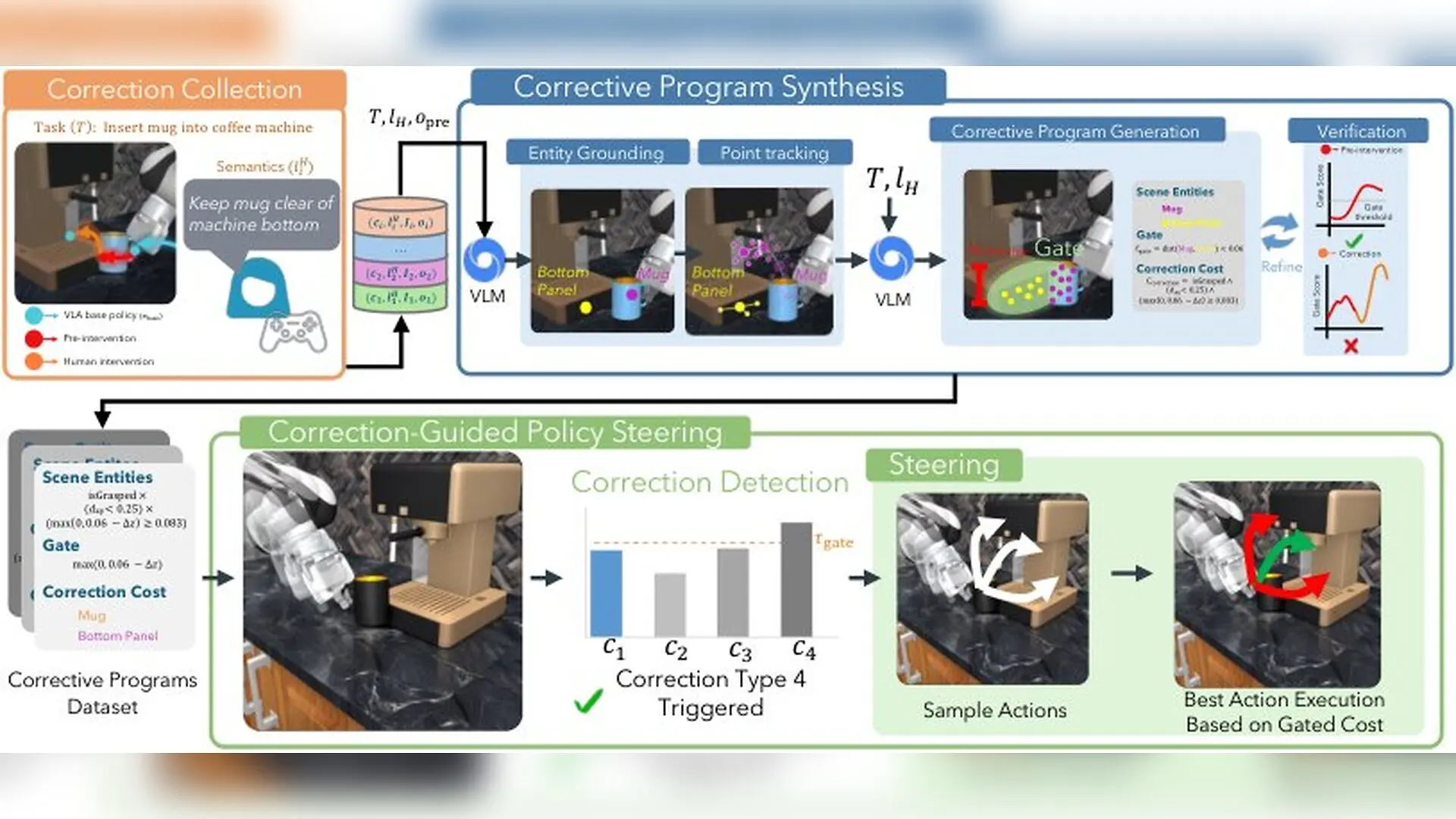
Robotic arms powered by artificial intelligence can sort groceries or tidy up kitchens, yet they frequently stumble when encountering a misplaced mug or a stubborn appliance lid. Teaching these general-purpose systems to recover from mistakes typically demands dozens or even hundreds of corrective demonstrations, a slow and data-intensive procedure. A team of roboticists has now introduced a method that allows a robot to learn how to fix its errors from as few as five to eight human interventions, applying those lessons instantly to entirely new scenes and object arrangements without retraining its core brain.
The new technique, named OOPSIERECOVER, was detailed in a study available on the arXiv preprint server by researchers Arpit Bahety, Skand Peri, Sriniket Ambatipudi, Chen Xu, Haruki Nishimura, Masha Itkina, and Roberto Martín-Martín from The University of Texas at Austin and the Toyota Research Institute. Instead of forcing a robot to memorize exact corrective movements, the framework uses a reasoning approach called abduction. When a human steps in to take over a failing task, the system combines visual observations with spoken descriptions to deduce the underlying physical principle behind the correction.
Translating Human Interventions Into Reusable Code
When a human operator grabs a robot’s controls to prevent a collision or adjust a clumsy grip, they are solving a specific geometric problem. For instance, if a robot tries to place a mug into a coffee machine and tilts it dangerously close to the housing, a human will steer it away and might explain that the mug needs to be kept upright. Traditional robot learning treats this whole sequence as raw training data, trying to imitate the exact motor actions taken during the rescue. Because those physical movements are tied to one specific desk setup, they rarely work when the mug is placed a few centimeters to the left.
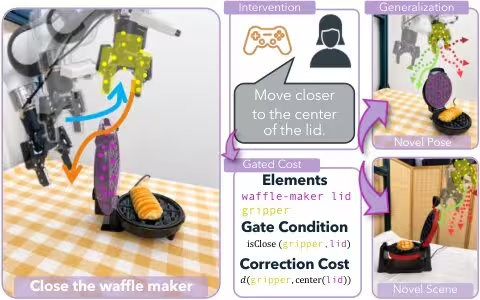
OOPSIERECOVER separates the human-controlled rescue into semantic components rather than raw joystick commands. Using a vision-language model, which is a type of artificial intelligence that connects images with text, the framework identifies the relevant objects in the scene, such as the mug and the bottom panel of the machine. It tracks these objects as 3D point sets across time, capturing their spatial relationships during both the failure and the human rescue. From this data, the system synthesizes a programmatic rule consisting of a gate condition, which decides when a correction is relevant, and a cost function, which steers the robot away from undesirable states while preserving overall task progress.
Rigorous Testing in Simulation and Real-World Kitchens
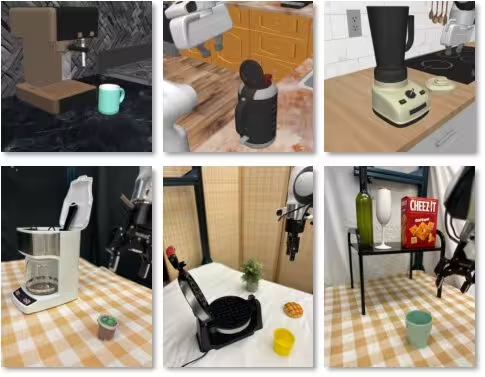
The research team evaluated their framework across three distinct tasks in simulation using the RoboCasa benchmark, as well as three real-world tasks using mobile manipulation hardware from the DROID dataset. These real challenges included putting away baked goods, loading coffee pods, and shelving items, which frequently suffer from misaligned grasps and dropped objects. Across both simulated and physical environments, the researchers tested the system against established baselines, including standard fine-tuning methods and active imitation learning approaches.
In real-world experiments involving 20 rollouts per task across varying levels of scene complexity, OOPSIERECOVER improved task progress from 35.1 percent to 61.0 percent, marking a 74 percent relative improvement over the next-best baseline. In controlled scaling tests on the coffee mug task, the framework reached an 84 percent success rate with just eight corrections and saturated without performance degradation as more data was added. In contrast, standard human-gated imitation learning required three times as many corrections to achieve only a 28 percent success rate.
Understanding Current Boundaries and Limitations
Despite these performance gains, the authors note several limitations in their current approach. Because the correction programs rely entirely on geometric relationships between visual point sets, the framework cannot directly encode unobserved physical properties or contact forces, such as how firmly an object is squeezed. Furthermore, the system depends heavily on reliable object tracking and depth perception, meaning errors in computer vision can affect when steering is triggered. The authors suggest that future work could distill these semantic correction programs into more direct image-to-action policy refinements, potentially bridging the gap between high-level reasoning and low-level motor control.
The study was posted to the arXiv preprint server on November 5, 2026.
This article has been fact checked for accuracy, with information verified against reputable sources. Learn more about us and our editorial process.
Last reviewed on .
Article history
- Latest version
Reference(s)
- Bahety, Arpit. “OopsieRecover: Learning Transferable VLA Corrections from Semantic Interventions.” arXiv.org <http://arxiv.org/abs/2611.08462v1>.
Cite this page:
- Posted by James Whitmore