New AI Technique Translates Hidden User Profiles Into Plain English
Researchers show that sparse autoencoders can decode complex behavioral vectors into interpretable modes, unlocking natural language search and system auditing without retraining.
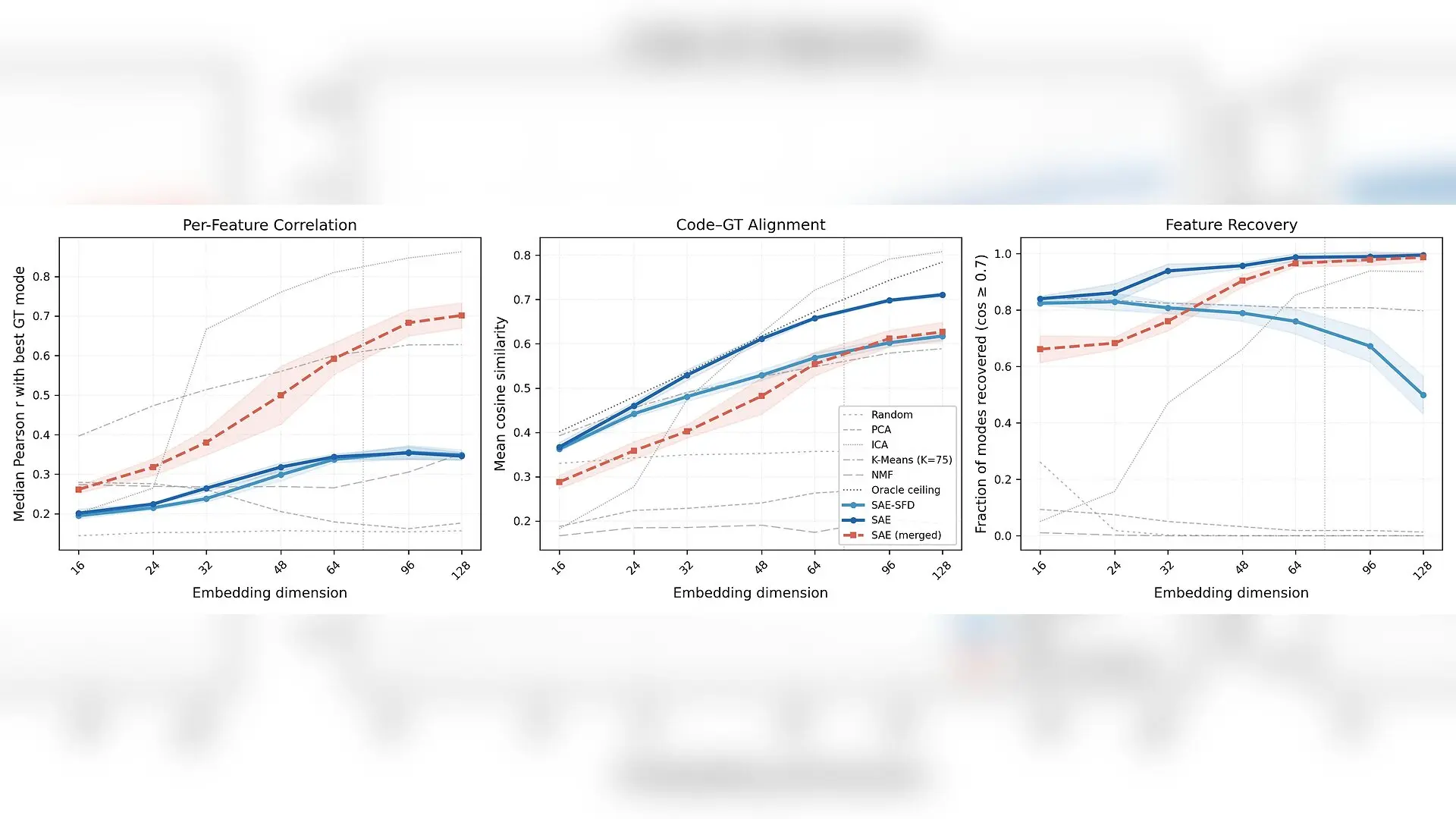
User behavior models can now be translated into everyday human language without retraining underlying algorithms, thanks to a new interpretability framework. Researchers from Amazon demonstrated that complex numerical user profiles, known as embeddings, naturally organize into transparent overlapping behavioral patterns.
Modern recommendation and personalization engines rely heavily on user embeddings, which are dense vectors encoding millions of historical interactions like purchases, ratings, and clicks. While these compressed numerical representations capture rich behavioral signals, they remain entirely opaque. Engineers and auditors cannot easily inspect why a specific recommendation was triggered, audit what sensitive traits a profile holds, or query the system using natural language searches.
Unlocking Dense Neural Profiles Through Sparse Dictionary Learning
To solve this transparency gap, the study authors investigated whether the superposition hypothesis from mechanistic interpretability applies to behavioral modeling. The researchers propose that user profiles operate as sparse superpositions of distinct, interpretable behavioral modes, such as being both a devoted pet owner and an active home chef simultaneously. By applying sparse autoencoders, which are specialized neural networks designed to discover sparse dictionary representations, the team successfully extracted these hidden modes from pre-trained representations without modifying the upstream system.
The method decomposes user vectors into overcomplete dictionaries where individual dictionary columns represent concrete behavioral traits. The study examined multiple configurations, including synthetic shopping data containing 75 ground-truth modes across 100,000 simulated users, alongside real-world evaluations on Open e-commerce purchase histories and MovieLens movie ratings. Detailed experimental setups and validation metrics are published in the arXiv preprint server, detailing how the approach isolates meaningful latent concepts.
Better Coverage and Reduced Redundancy Across Real-World Datasets
When evaluated against classical baseline methods like Principal Component Analysis, Independent Component Analysis, and K-Means encoding, the sparse autoencoder approach demonstrated superior performance on several key fronts. On synthetic datasets with known ground-truth modes, the sparse autoencoder recovered significantly more true behavioral modes than traditional linear techniques, which are often constrained by forced orthogonality or clustering limits.
In real-world tests involving thousands of users, the extracted dictionary features enabled zero-shot natural language audience retrieval. For instance, when queried in plain English for specific audience segments, the framework successfully ranked relevant users by computing weighted activations over the recovered features. On MovieLens evaluations utilizing transformer sequential recommenders like SASRec and BERT4Rec, sparse autoencoders achieved high reconstruction fidelity, capturing 96 to 97 percent of embedding variance while covering a substantially larger fraction of true positive users compared to traditional K-Means encoding.
Navigating Transparency and Emerging Privacy Risks
Beyond search capabilities, the framework improves audience characterization by isolating distinct explanatory concepts rather than producing redundant paraphrases. When analyzing top feature sets for film franchises, the sparse autoencoder generated significantly less redundancy, ensuring that each selected vector contributed a genuinely unique behavioral explanation.
However, the researchers emphasize that making opaque numerical profiles queryable in natural language introduces significant privacy considerations. Because the recovered features carry human-readable names and descriptions, the cost of inferring sensitive personal traits, such as recent life events or demographic shifts, is substantially lowered. At the same time, the enumerable nature of these named features gives system auditors a practical mechanism to detect, exclude, or ablate sensitive behavioral directions in ways that were previously impossible with traditional dense vectors.
The study was posted to the arXiv preprint server on November 5, 2026.
This article has been fact checked for accuracy, with information verified against reputable sources. Learn more about us and our editorial process.
Last reviewed on .
Article history
- Latest version
Reference(s)
- Kozaczuk, Jonathan. “User Embeddings are Superpositions of Interpretable Behavioral Modes.” arXiv.org <http://arxiv.org/abs/2611.08487v1>.
Cite this page:
- Posted by Asif Iqbal