New AI Ecosystem Lets Autonomous Models Surpass Human Researchers
Princeton researchers turn thousands of published academic papers into executable testing grounds where artificial intelligence models can independently conduct and improve machine learning research.
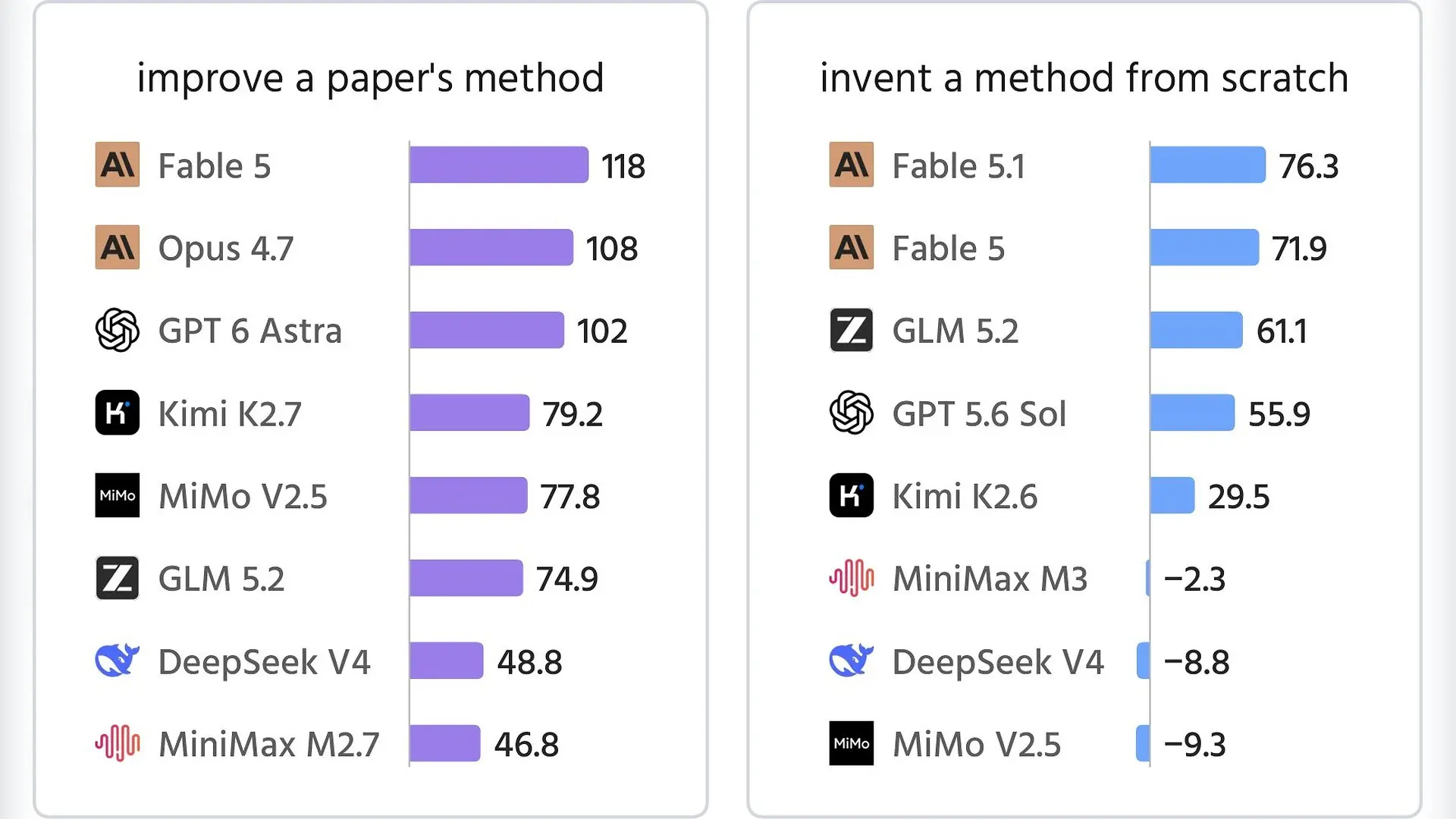
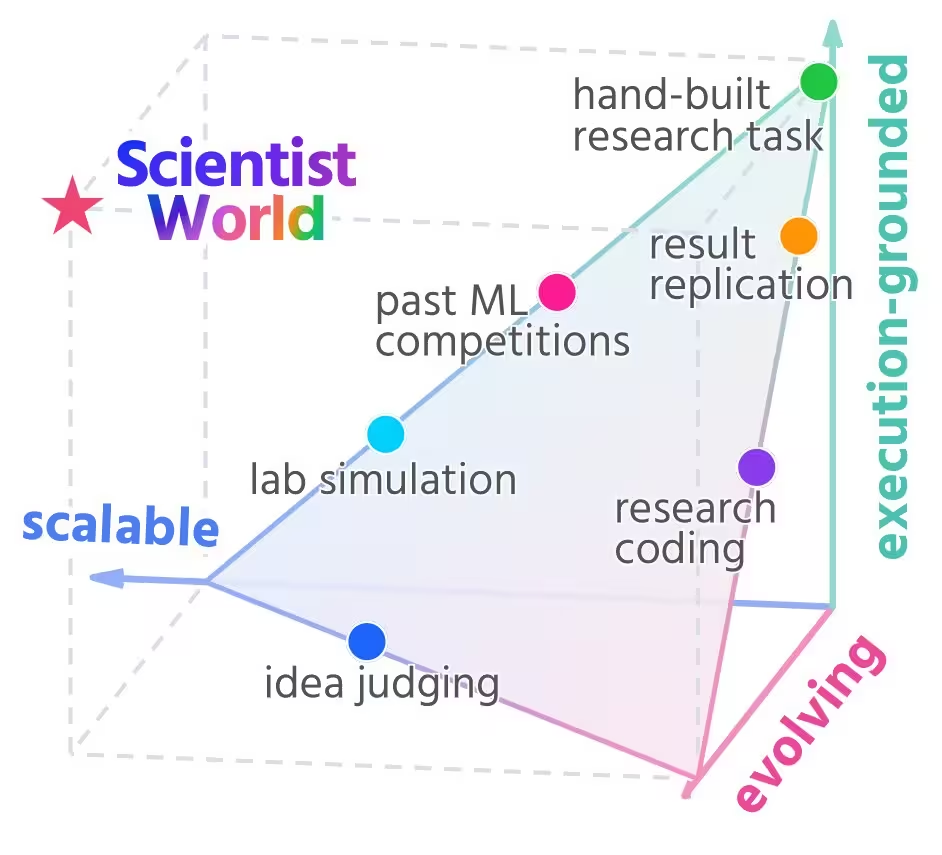
Autonomous AI agents can now outperform human researchers on complex machine learning tasks 74 percent of the time, thanks to a novel digital universe where published academic papers are transformed into interactive software environments. Developed by researchers at Princeton University, the platform named Scientist World addresses a critical bottleneck in artificial intelligence development by giving autonomous models a continuous landscape of open research questions and shared benchmarks to explore and expand.
While human scientists benefit from centuries of accumulated literature, shared ideas, and ongoing problems, artificial intelligence systems have historically lacked a runnable equivalent. Although language models can read academic papers effortlessly, they cannot natively execute experiments or test hypotheses. To bridge this gap, the study authors designed a fully automated multi-agent pipeline that ingests raw PDF papers, reproduces their core findings, packages them into self-contained code repositories, and establishes rigorous evaluation metrics without any human intervention. The work is available on the arXiv preprint server.
Turning Academic Literature Into Executable Workspaces
The newly released platform converts high-tier machine learning publications into standardized testing grounds across eight distinct technical categories, including architecture design, post-training optimization, and safety. Each generated environment operates through a strict architectural separation. The underlying problem statement, evaluation criteria, and data loaders remain entirely independent of the original author implementation. This ensures that an artificial intelligence model can approach the problem from scratch or build upon existing codebases without encountering solution leakage.
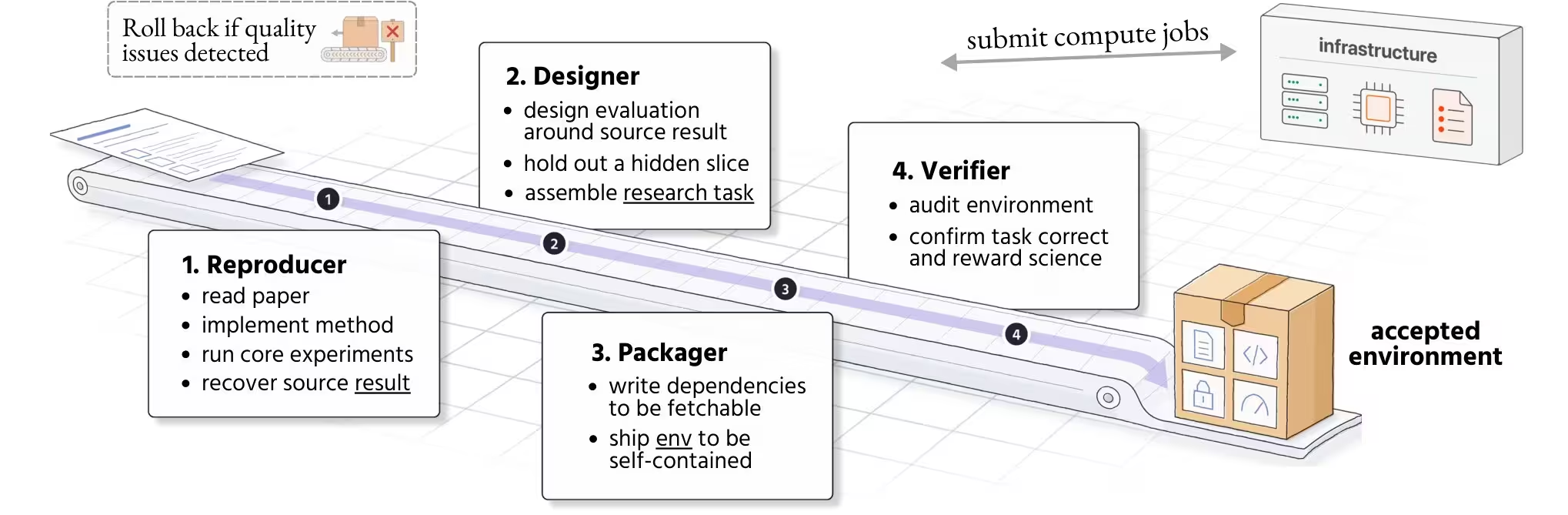
The conversion workflow relies on specialized builder agents that take turns handling different phases of environment creation. A reproducer agent executes the paper code to recover baseline results, a designer agent constructs visible training splits and hidden evaluation sets to prevent overfitting, and a packager ensures the repository can rebuild seamlessly from a fresh software clone. Finally, an independent verifier audits the complete workspace to guarantee structural integrity and scientific validity.
Evaluating Frontier Models Across Diverse Research Tasks
When tested on these standardized environments, modern artificial intelligence models demonstrated impressive capabilities in advancing machine learning research. The evaluation framework operates under two distinct conditions. In improve mode, models receive the reproduced baseline method and attempt to enhance performance metrics. In innovate mode, models receive only the problem definition and must design novel solutions entirely from scratch. Across rigorous trials, frontier systems successfully surpassed the reproduced human baseline in 84 percent of improvement tasks and 74 percent of innovation tasks.
Interestingly, the evaluation data revealed that research success does not correlate with raw computational expenditure. Statistical analysis across numerous trials demonstrated that additional GPU hours and extended agent turns accounted for virtually zero variance in final performance scores. The models that achieved superior results won through methodological insight and creativity rather than brute-force computation.
Training Smaller Language Models Through Experimental Feedback
Beyond functioning as a benchmarking suite, Scientist World serves as a training gym for smaller artificial intelligence architectures. The research team captured approximately 6,400 hours of research traces, documenting every successful experiment, trial-and-error adjustment, and failure encountered by the evaluating agents. By utilizing this extensive collection of developmental histories, the authors fine-tuned a compact 8-billion-parameter model using supervised learning and reinforcement techniques based strictly on measured experimental outcomes.
When paired with a fixed execution engine, the trained compact model achieved performance levels matching much larger frontier cohorts in research ideation tasks. This indicates that structured execution environments can successfully bootstrap smaller intelligence systems into capable scientific assistants. By continuously ingesting new academic publications, the platform provides a sustainable ecosystem where artificial intelligence can autonomously discover, test, and expand the boundaries of machine learning research.
The study was posted to the arXiv preprint server on November 5, 2026.
This article has been fact checked for accuracy, with information verified against reputable sources. Learn more about us and our editorial process.
Last reviewed on .
Article history
- Latest version
Reference(s)
- Lu, Taiming. “Scientist World: Grow a Research World for AI-Scientists.” arXiv.org <http://arxiv.org/abs/2611.08478v1>.
Cite this page:
- Posted by Asif Iqbal