New AI Swarm Architecture Evaluates Hundreds of Programs in Minutes
By bypassing text generation and communicating in latent space, low-cost agent swarms outperform larger models on complex mathematical discovery tasks.
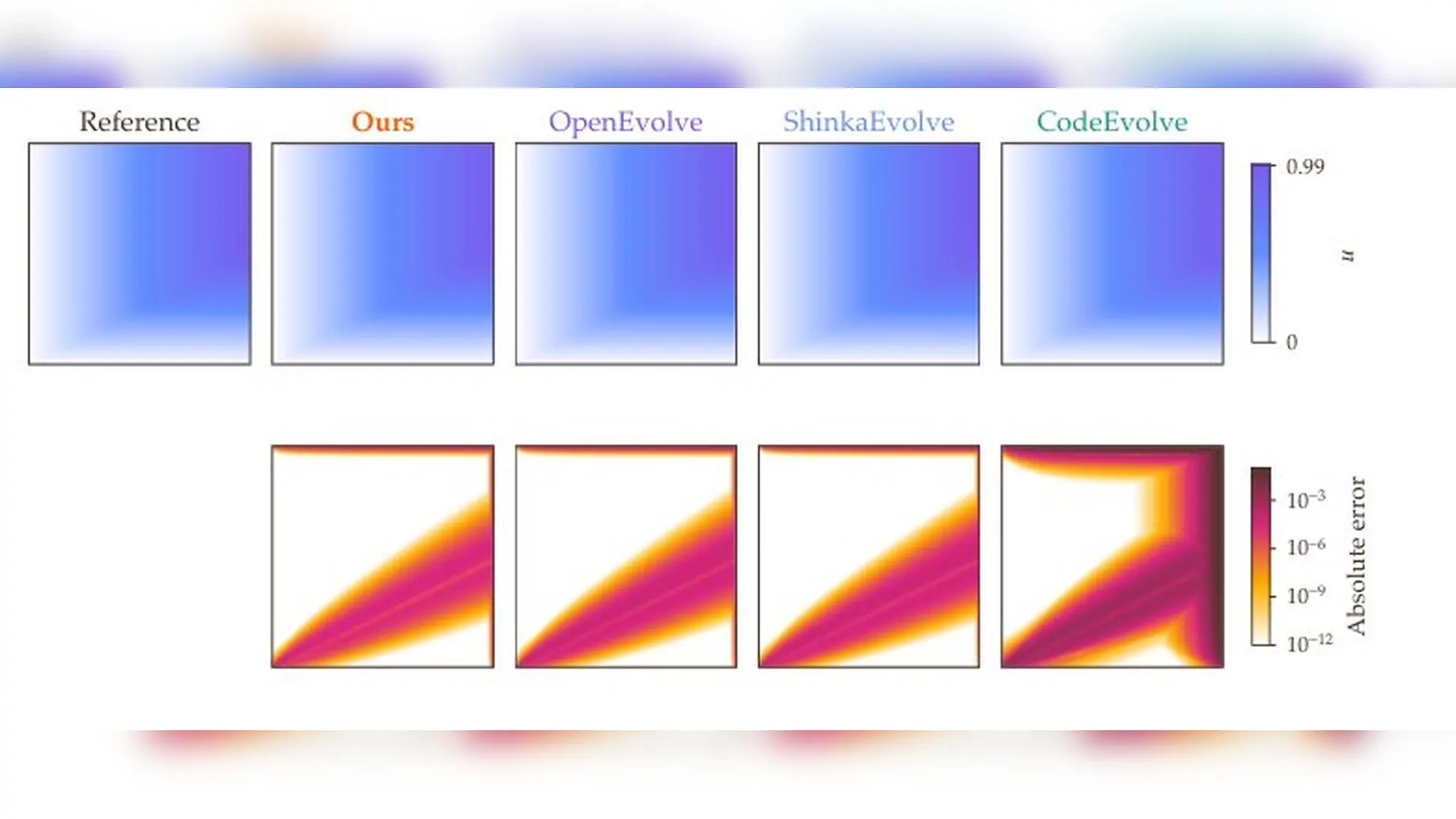
A new artificial intelligence framework named SwarmEvolve allows a single graphics processing unit to run hundreds of collaborative AI agents simultaneously, slashing the time required to discover complex algorithms and mathematical proofs. Traditional AI-guided evolutionary search methods often stall because they force large language models to write out lengthy textual chains of thought for every iteration, creating bottlenecks that limit how many program variations can be tested.
Developed by researchers Qile Jiang and George Em Karniadakis from the Division of Applied Mathematics at Brown University, the new approach relies on low-cost agent swarms that reason entirely within a continuous embedding space without decoding text. The team detailed their findings in a study available on the arXiv preprint server, demonstrating that latent communication can dramatically accelerate automated scientific discovery.
How Latent Swarms Communicate Without Words
In standard multi-agent setups, individual programs exchange text messages or long evaluation logs that quickly bloat the context window of the language model. SwarmEvolve bypasses this limitation by passing the internal key-value caches of transformer layers directly between agents. Each round launches 10 distinct swarms comprising a total of 450 latent agents, with every swarm assigned a specific focus such as mathematical formulation, bug hunting, or exploring literature-derived methods.
As the agents process their tasks, they take 40 latent reasoning steps without generating any human-readable tokens. To prevent redundancy, a novelty filter measures the cosine distances between the agents hidden state vectors, discarding the 15 most similar trajectories and retaining the 30 most distinct perspectives. A summarizer agent then reads the combined key-value caches of the remaining agents to synthesize a single, highly refined program candidate.
Performance Benchmarks Across Complex Scientific Domains
The researchers tested SwarmEvolve against three established state-of-the-art frameworks, namely OpenEvolve, ShinkaEvolve, and CodeEvolve, across 21 challenging problems spanning packing geometry, mathematical analysis, combinatorics, and scientific computing. Each framework was allocated 60 minutes of runtime using the same hardware configurations and open-weight models from the Qwen3 family, including the 8B, 14B, and 32B-FP8 variants.
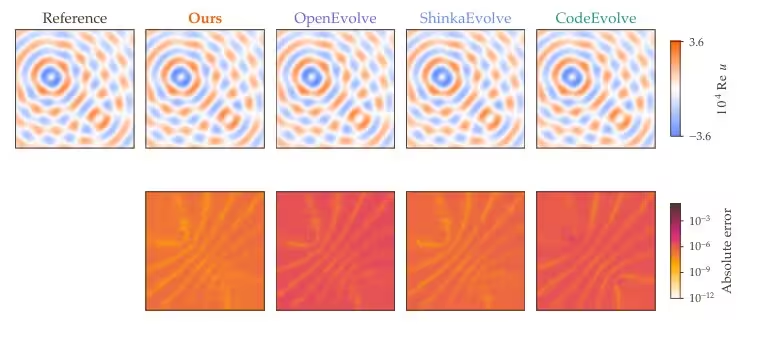
The performance gap was stark. SwarmEvolve evaluated between 5 and 13 times more candidate programs per hour than existing frameworks. Furthermore, it achieved the scores that competing systems reached in an hour within a median window of just 3 to 8 minutes. When paired with the Qwen3 8B model, SwarmEvolve surpassed the final scores of all baseline systems even when those baselines were powered by the much larger Qwen3 32B-FP8 model.
Pushing Past Previous Human and AI Limits
Beyond raw speed, the latent agent swarms successfully discovered improved solutions for open mathematical problems. Using a frozen Qwen3 8B model, SwarmEvolve exceeded constructions previously found by frontier proprietary models in AlphaEvolve, specifically matching the best known sum of radii for packing 26 circles in a square and improving bounds on autocorrelation inequalities.
The authors note that the architecture does have limitations, primarily because all latent agents and summarizers must currently share a single underlying language model to ensure compatible key-value structures. Future work could integrate learned translations between different model spaces or incorporate compressed latent messaging to allow even broader scaling across distributed hardware clusters.
The study was posted to the arXiv preprint server on November 5, 2026.
This article has been fact checked for accuracy, with information verified against reputable sources. Learn more about us and our editorial process.
Last reviewed on .
Article history
- Latest version
Reference(s)
- Jiang, Qile. “SwarmEvolve: Latent Agent Swarms for Evolutionary Discovery and Optimization.” arXiv.org <http://arxiv.org/abs/2611.08483v1>.
Cite this page:
- Posted by James Whitmore