New Tiny Robot Uses Physics to Hop and Swim With Incredible Efficiency
Engineers have developed a clever new design that allows miniaturized robots to hop or swim, overcoming traditional limits on size and power output.
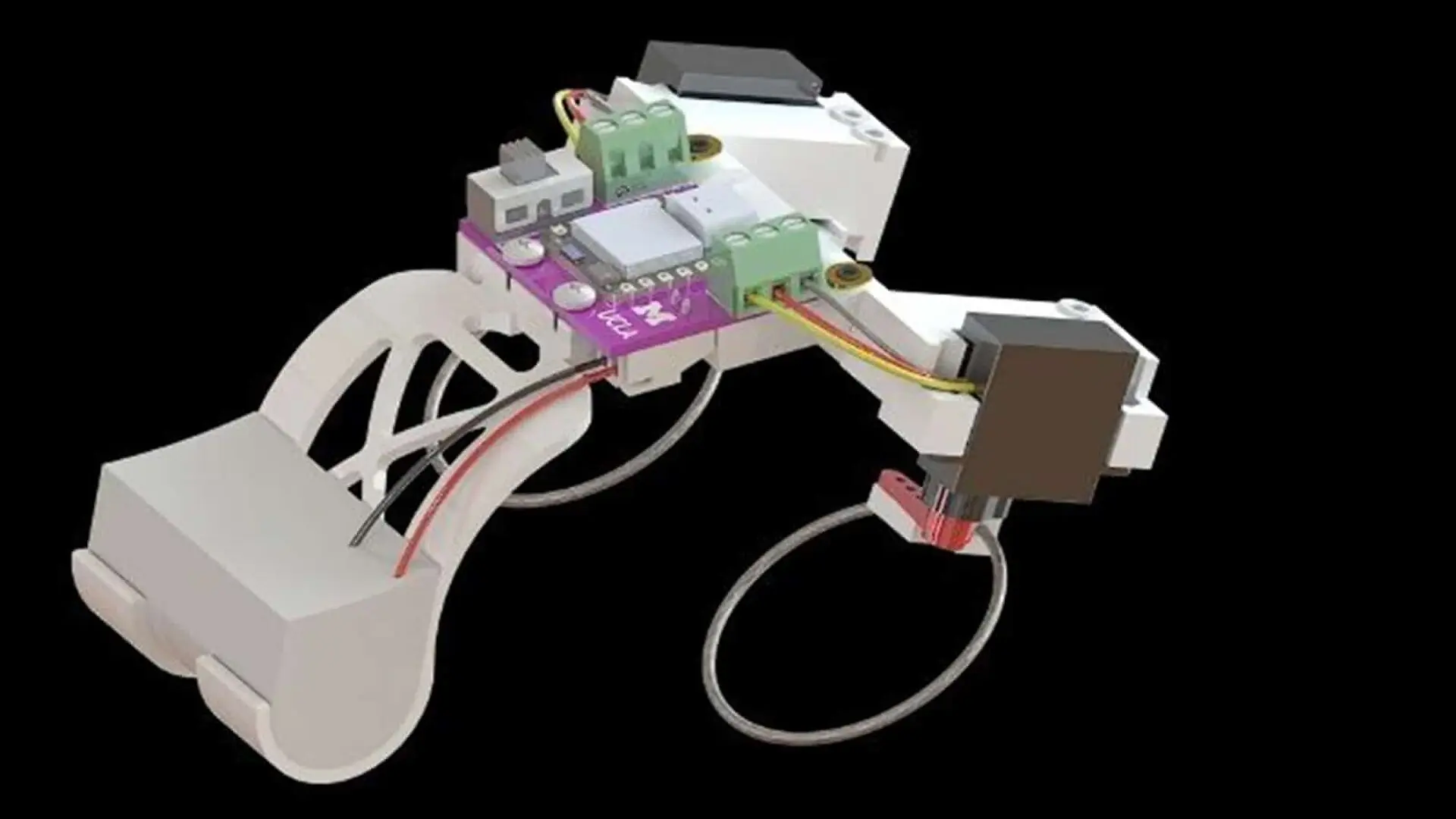
Engineers have developed a novel propulsion technique for miniature robots that mimics the explosive energy of a spring, allowing small devices to leap across obstacles and navigate aquatic environments with minimal power consumption. By leveraging the physics of bent and twisted elastic rods, researchers have unlocked a way to transform subtle motor inputs into high-intensity bursts of movement.
The findings, detailed in Science Advances, suggest that the secret to efficient robotic movement lies not in complex motor systems, but in the intelligent application of structural mechanics. The project was a collaborative effort led by Khalid Jawed, an associate professor of mechanical and aerospace engineering at UCLA, and Xiaonan (Sean) Huang, an assistant professor of robotics at the University of Michigan.
Engineering Explosive Motion Through Geometry
The core of the innovation rests on a phenomenon where a flexible rod, when subjected to specific combinations of bending and twisting, reaches a critical instability. While most materials deform gradually under stress, the team discovered that specific helical configurations cause these rods to store significant elastic energy and then release it in a sudden, violent snap. This snap generates the force necessary for propulsion.
By utilizing computer modeling, the researchers identified the optimal helical geometry—resembling a segment of a coiled spring—to maximize this energy discharge. Because the performance of the rod depends on its geometric configuration rather than its absolute size, the design principles are highly scalable. This versatility could eventually lead to the development of micro-robots measuring only a few millimeters in width, potentially overcoming the power limitations that currently hinder such small-scale machines.
“The broader opportunity is to let the mechanics of the robot do some of the work that would otherwise require larger motors or more complicated control,” explained Huang. “By programming when an elastic structure stores and rapidly releases energy, we can give small robots access to powerful, repeatable motions without continuously demanding high output from the motor.”
Versatility in Real-World Conditions
To demonstrate the effectiveness of this mechanism, the team constructed a prototype equipped with two snapping rods at its rear. Connected to a modest motor, the rods twist until they reach their snapping threshold, at which point the stored energy is discharged to propel the robot forward. This process allows the device to reset and cycle through hops continuously.
“Once we could predict when a rod would snap, we could use that sudden release of energy to turn a simple motor movement into a powerful push that sends the robot hopping forward,” said Dezhong Tong, a University of Michigan postdoctoral scholar and co-lead author of the study.
The resulting frog-like robot demonstrated remarkable adaptability during testing. Weighing approximately 0.25 pounds, the prototype successfully traversed diverse terrain, including wood, glass, sand, grass, and even soft leather. When outfitted with paddle attachments, the robot proved capable of swimming. Its agility extended to navigating around obstacles, and the team even demonstrated an automated navigation system using light sensors to guide the robot toward a specific target. Clocking in at a speed of roughly three body lengths per second, the robot’s performance is comparable to that of a hatchling loggerhead turtle.
Looking ahead, the researchers believe this approach will be vital for robots tasked with operating in complex, cluttered, or difficult-to-reach environments where agility is paramount. The study included researchers from the University of Michigan, Vassar College, and Newcastle University, with primary funding provided by the National Science Foundation.
This article has been fact checked for accuracy, with information verified against reputable sources. Learn more about us and our editorial process.
Last reviewed on .
Article history
- Latest version
Reference(s)
- Tong, Dezhong., et al. “Geometry-controlled instability pathway selection in elastic helices enables fast, efficient robotic locomotion.” Science Advances, vol. 12, no. 38, September 18, 2026 American Association for the Advancement of Science (AAAS), doi: 10.1126/sciadv.aeh2779. <https://doi.org/10.1126/sciadv.aeh2779>.
Cite this page:
- Posted by Asif Iqbal