Scientists Finally Discover How Hermit Crabs Stunt Their Growth To Fit In Tiny Shells
Scientists have finally uncovered the hidden mechanism behind long-standing observations of mysterious growth slowdowns in various systems.
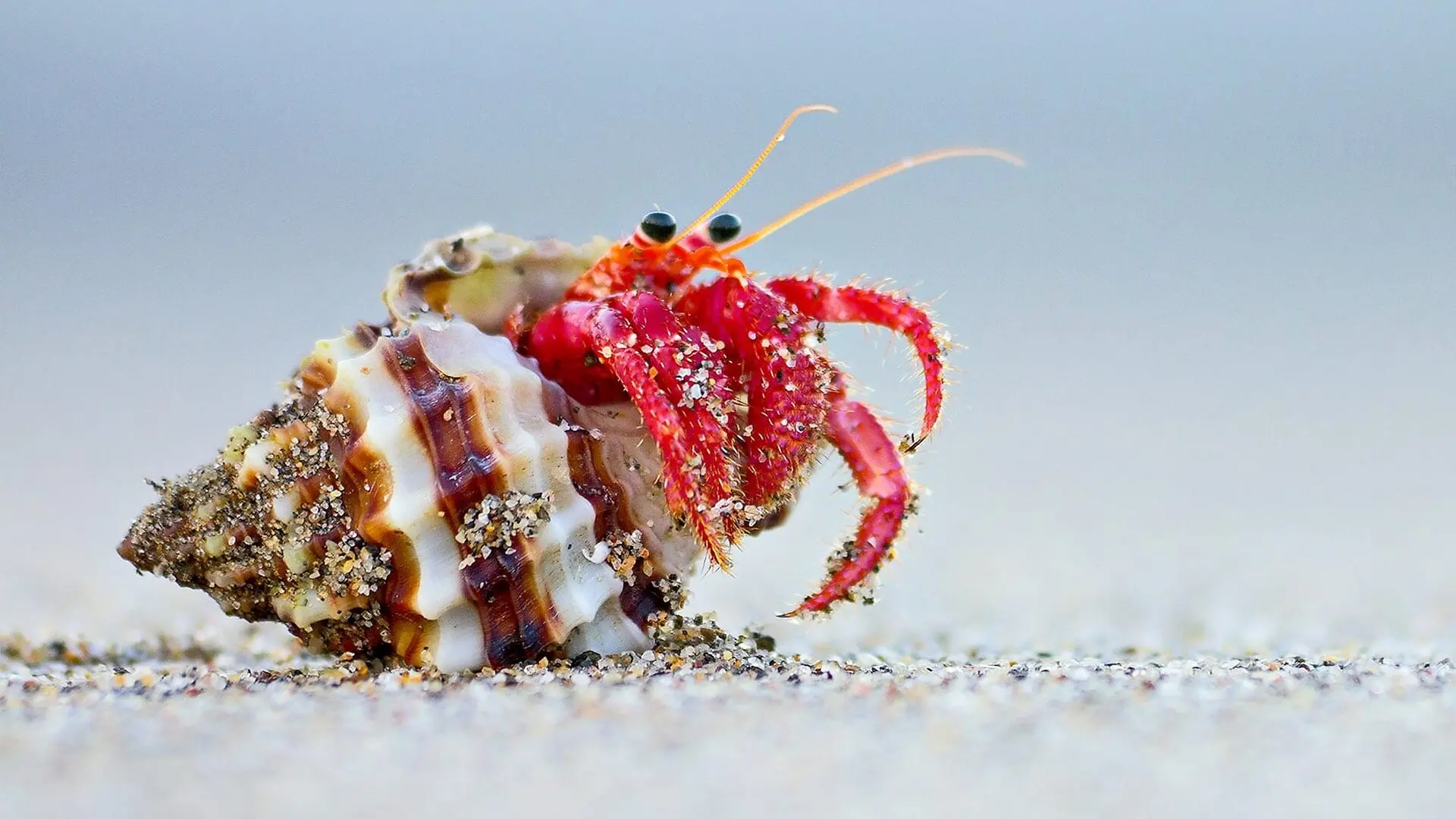
Hermit crabs have long fascinated biologists with their ability to manage their physical size in response to the limited housing options available to them. Because these crustaceans rely on discarded snail shells for protection, their survival is intrinsically tied to finding a home that fits. When the perfect shell remains elusive, the crabs manage to restrict their own physical expansion, a phenomenon researchers have observed for decades without fully understanding the underlying biology.
Beyond Appetite: How Crabs Manage Physical Stature
New evidence published in the journal Invertebrate Biology suggests that the secret to this growth control is not found in the amount of food the crabs ingest, but rather in how they process it. By comparing the behavior and waste production of hermit crabs housed in appropriately sized shells against those forced to occupy undersized ones, scientists have uncovered a sophisticated internal mechanism for growth regulation.
The study, led by Caitlin Ball during her graduate work at Tufts University, reveals that crabs inhabiting cramped quarters do not necessarily reduce their food intake. Instead, they appear to pass food through their digestive systems with less efficiency. The researchers observed that these crabs defecated more frequently, indicating that they were effectively bypassing the absorption of vital nutrients rather than converting them into new body tissue.
“For years, people observed the growth slowdown but couldn’t identify the mechanism,” says Phil Starks, an associate professor of biology at Tufts and the senior author of the study. “What we’re seeing is consistent with something subtle—the crabs appear to regulate growth by adjusting nutrient assimilation.”
A Fundamental Shift in Understanding Biological Growth
This discovery challenges the common assumption that an animal’s size is primarily a function of caloric consumption. By demonstrating that hermit crabs can actively modulate their own metabolism to accommodate structural constraints, the research highlights a broader biological principle: growth regulation can occur at the level of nutrient assimilation rather than appetite alone.
While the researchers caution against drawing direct parallels to human metabolic conditions, the findings provide a compelling look at how energy processing varies across the animal kingdom. The study suggests that the way an organism absorbs, stores, and expends energy is far more dynamic than a simple calculation of intake versus output.
“Across animals—including humans—body mass isn’t determined solely by how much food is consumed,” Starks explains. “Intake and growth aren’t the same thing.”
For experts like coauthor and professor emeritus Jan Pechenik, the findings represent a major step forward in invertebrate research. By identifying that the adjustment occurs during the digestive process, the team has provided a clear path for future studies to examine the physiological signaling that allows a hermit crab to “decide” to grow more slowly.
“It’s exciting because the study answers a question about hermit crab growth that’s been sitting there for a while,” says Pechenik. “We knew the pattern. Now we have opened the door to explore evidence for how it might work.”
This article has been fact checked for accuracy, with information verified against reputable sources. Learn more about us and our editorial process.
Last reviewed on .
Article history
- Latest version
Reference(s)
- Ball, Caitlin E.., et al. “Small shells, slower growth: Experimental evidence consistent with nutrient elimination in Pagurus longicarpus.” Invertebrate Biology, vol. 144, no. 4, December 1, 2025 The American Microscopical Society, doi: 10.71161/ivb.144.4.2025.00022. <https://doi.org/10.71161/ivb.144.4.2025.00022>.
Cite this page:
- Posted by Asif Iqbal