Molecular Structure Breaks Universality in Screening Behavior of Electrolyte Solutions
Machine-learned density functional theory reveals that solvent polarity and ion architecture reshape electrostatic screening, challenging universal scaling laws.
Concentrated saltwater and ionic fluids do not follow a single universal scaling law because molecular details of their solvents and ions entirely reshape how electric charges screen across microscopic distances. Researchers discovered that factors such as solvent attraction and molecular polarity fundamentally alter electrostatic decay behavior rather than conforming to simplified theoretical predictions.
Electrostatic screening dictates how electric charges interact over large distances in liquid solutions, serving as a vital mechanism for technologies like supercapacitors, colloidal stability, and soft material actuators. In dilute solutions, classical theories successfully describe this screening using only macroscopic properties like ionic strength, temperature, and dielectric constant. However, experiments on concentrated electrolytes have sparked intense debate by reporting an apparently universal scaling law where screening length scales steeply with ion size.
To investigate whether this universality holds up, Anna T. Bui from Stanford University and her colleagues utilized machine-learned classical density functional theory to compute numerically exact decay lengths across a diverse hierarchy of electrolyte models. The study is available on the arXiv preprint server and outlines how molecular complexity changes the rules of fluid correlations. Traditional liquid state theories typically treat ions as charged hard spheres in a structureless continuum, missing the intricate molecular architecture of real solvents.
How Do Solvent Molecules Break Universal Screening Behavior?
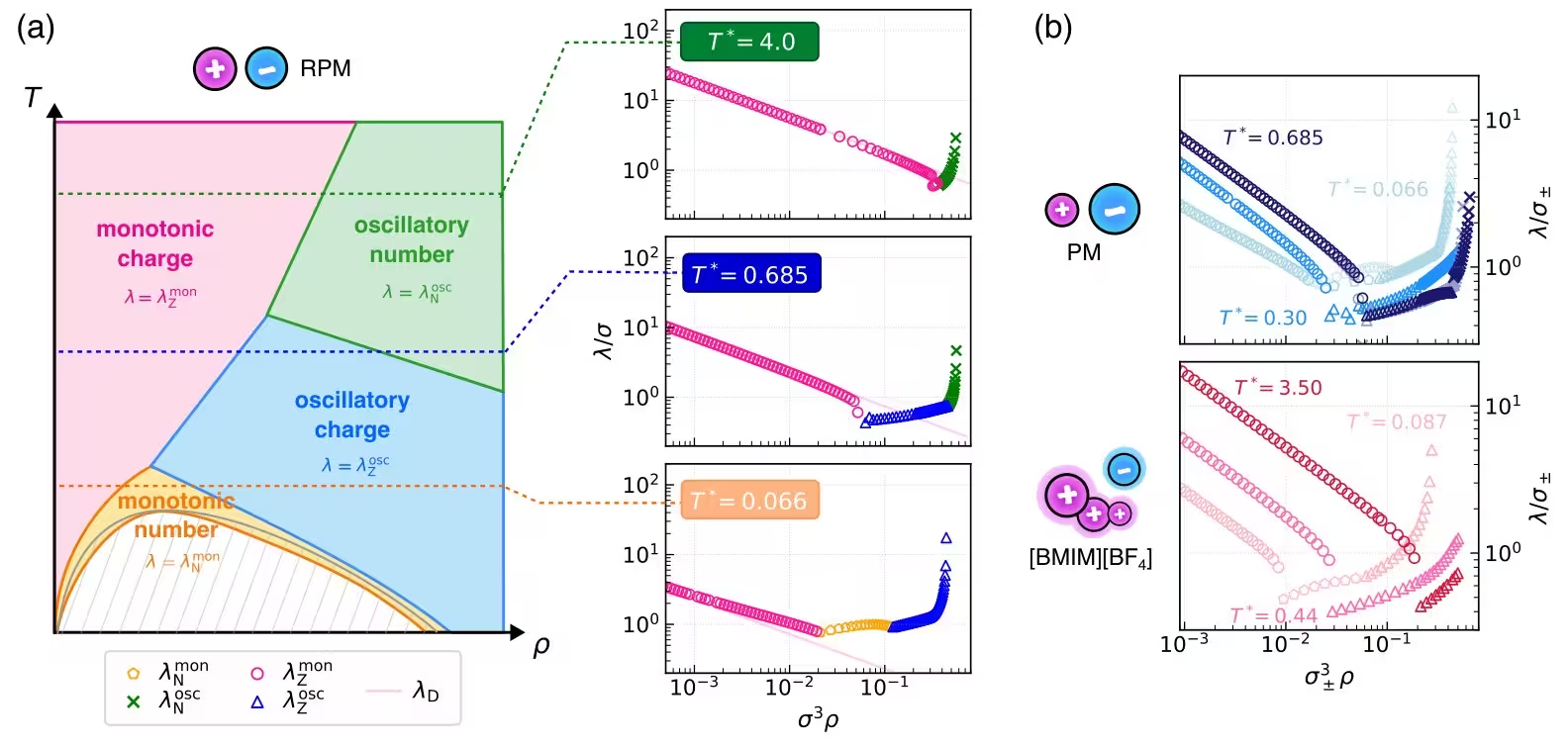
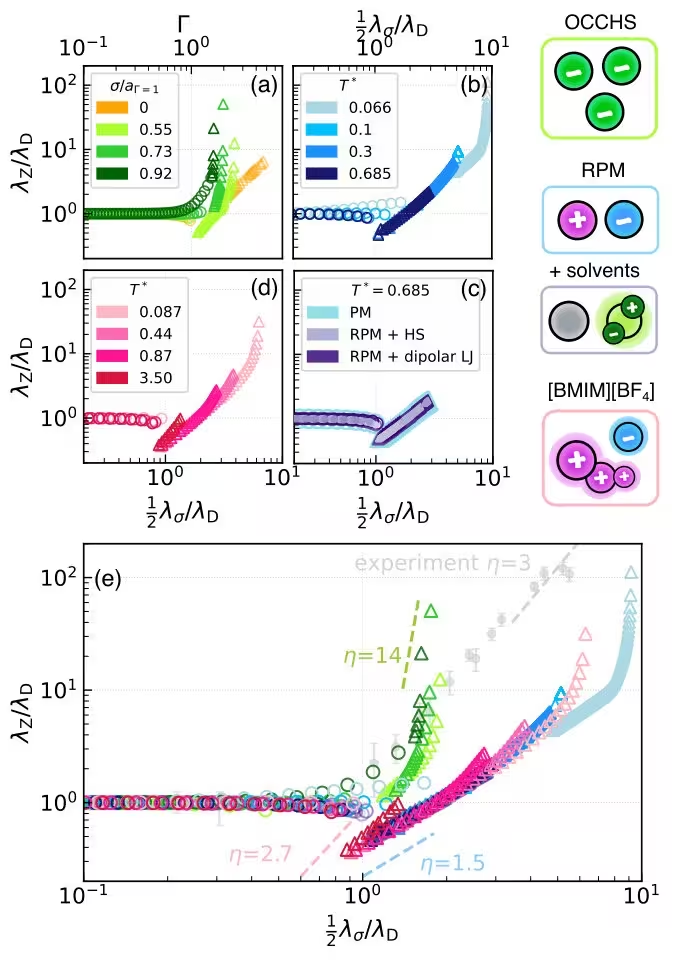
By systematically introducing explicit solvent degrees of freedom into their models, the authors isolated the individual influences of solvent size, dispersion interactions, and polarity. They found that solvent attraction introduces an entirely new monotonic decay mode, while solvent polarity produces re-entrant behavior across specific densities. Furthermore, ionic structure alone drastically shifts screening length exponents, meaning no single scaling law describes screening universally across these systems.
The analysis also examined charge density correlations in isolation, revealing that screening lengths can exceed standard Debye lengths by one to two orders of magnitude at high concentrations. Yet, the specific concentrations required to trigger this rapid increase depend entirely on the underlying molecular model. This strong dependence suggests that the large screening lengths observed in experiments are not anomalous on their own, but rather a natural consequence of high-concentration physics.
What Does This Mean for the Future of Energy Storage Materials?
These findings challenge equilibrium interpretations of experimentally observed universality and lend indirect support to recent suggestions that nonequilibrium effects might play a major role in surface force measurements. Because concentrated electrolytes are central to advanced energy storage devices, understanding how molecular packing and polarity dictate screening behavior provides a roadmap for designing better ionic liquids and specialized solvents.
Ultimately, the work demonstrates that electrostatic screening must be treated as a specific molecular property of an ion-solvent system rather than a universal constant. By bypassing the computational hurdles of traditional integral equation theories and molecular simulations, neural functional theory opens a reliable pathway toward predicting microscopic behavior in complex liquid environments.
The study was posted to the arXiv preprint server on November 20, 2026.
This article has been fact checked for accuracy, with information verified against reputable sources. Learn more about us and our editorial process.
Last reviewed on .
Article history
- Latest version
Reference(s)
- Bui, Anna. “Molecular structure breaks universality in screening behavior of electrolyte solutions.” arXiv.org <http://arxiv.org/abs/2611.27955v1>.
Cite this page:
- Posted by Aisha Ahmed