Two-Dimensional Electrons Surprise Physicists With Unprecedented Heat Transport Surge
Glancing electron collisions create a localized thermal dressing that pushes thermoelectric power far beyond standard hydrodynamic limits.
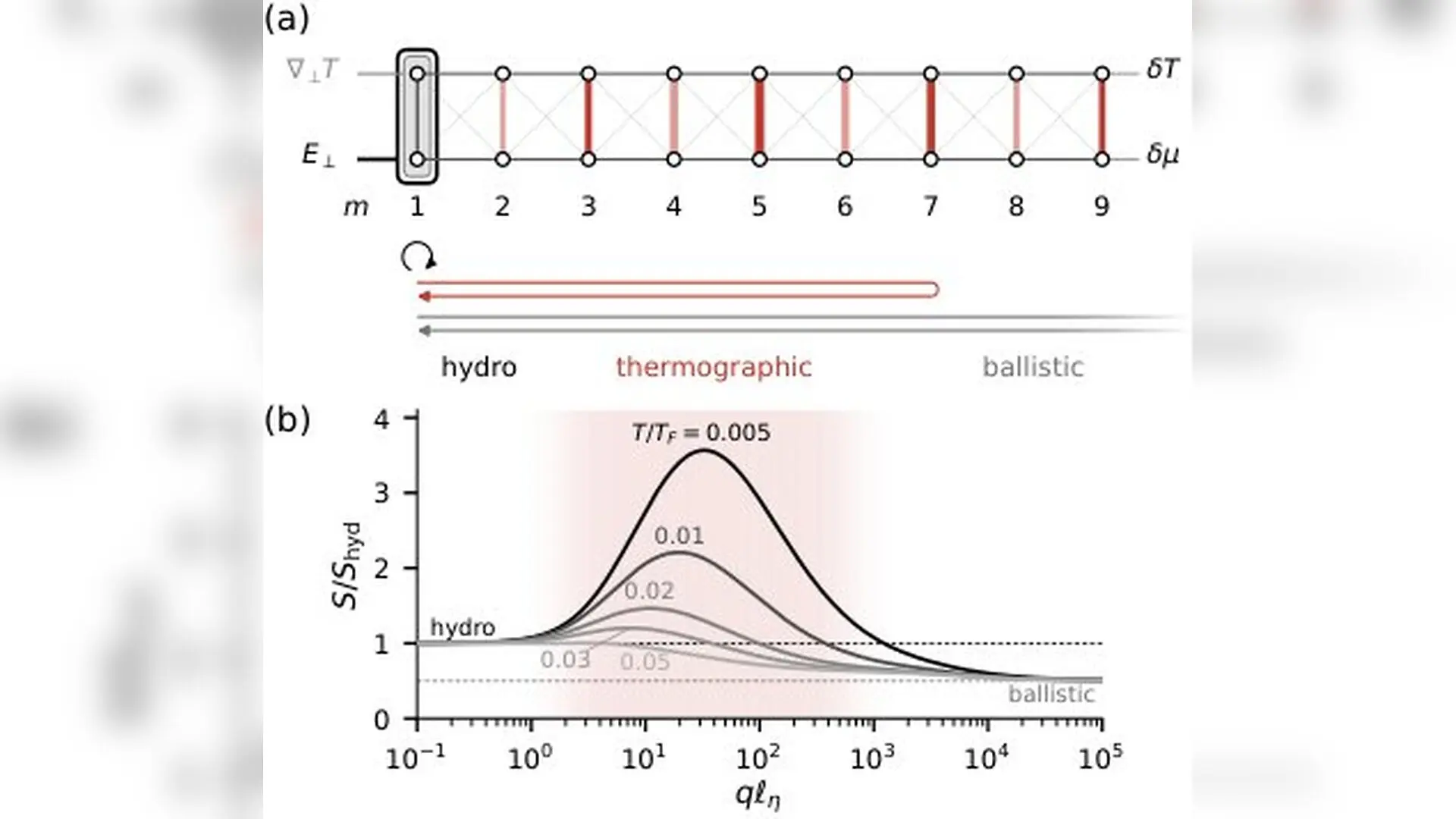
When electricity flows through a two-dimensional sheet of electrons at very low temperatures, it can carry more heat than standard physical laws predict. Johannes Hofmann from Gothenburg University reports this unexpected thermoelectric boost in a study available on the arXiv preprint server.
In ordinary metals, the thermoelectric power, which measures how much entropy is dragged along by an electrical current, sits at a steady baseline value known as the hydrodynamic limit. In two-dimensional Fermi liquids, however, pushing electrons through narrow channels causes the thermoelectric voltage to overshoot this standard baseline by a large margin.
What is thermal dressing and why does it cause an overshoot?
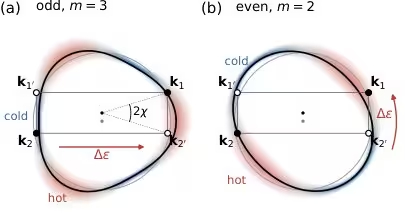
The culprit behind this thermal surge is near-collinear scattering, a process where electrons travel in nearly parallel or antiparallel directions and bounce off each other. Unlike ordinary collisions that simply randomize momentum, these glancing interactions transfer energy across the Fermi surface, which is the boundary separating occupied and unoccupied quantum energy states in momentum space.
This energy transfer creates a localized temperature change in the quasiparticle distribution, a phenomenon the author calls thermal dressing. Regions of the Fermi surface with an excess of quasiparticles become hotter, while depleted regions grow colder. This localized heating biases future collisions forward, protecting certain deformed states from decaying and driving up the thermoelectric response.
How does the geometry of narrow channels unlock this behavior?
The overshoot only appears at specific wave vectors linked to confinement, such as when electrons flow through narrow channels of a few micrometers wide. As the wave vector increases, the electrical current couples to higher angular harmonics of the Fermi-surface deformation. These higher modes carry the thermal dressing, lifting the thermopower far above its usual value.
At very low temperatures, the excess thermopower decreases only logarithmically as one over the natural logarithm of the Fermi temperature divided by the actual temperature, rather than dropping linearly as standard Fermi liquid theory expects. The author calculates that in ultrahigh-mobility gallium arsenide devices cooled to a fraction of a Kelvin, this excess thermoelectric signal could reach up to one microvolt per Kelvin.
What are the limitations and future prospects for testing this theory?
While the theoretical model relies on a constant interaction potential and assumes clean samples, the findings suggest that the thermopower overshoot is robust against moderate short-range disorder. Impurities damp the effect, but the required sample quality is less stringent than what is needed for tomographic transport regimes studied in recent years.
Experimental confirmation could come from advanced thermocouple setups using high-mobility semiconductor heterostructures or ultracold quantum gases. These platforms offer clean environments to observe how electron fluids handle heat when spatial confinement forces collective modes to interact in unexpected ways.
The study was posted to the arXiv preprint server on November 20, 2026.
This article has been fact checked for accuracy, with information verified against reputable sources. Learn more about us and our editorial process.
Last reviewed on .
Article history
- Latest version
Reference(s)
- Hofmann, Johannes. “Thermopower overshoot from collinear scattering in two-dimensional Fermi liquids.” arXiv.org <http://arxiv.org/abs/2611.27981v1>.
Cite this page:
- Posted by John Williams