Neutrino Disappearance Can Reveal Time Reversal Violation In Asymmetric Matter
Physics

Neutrino Disappearance Can Reveal Time Reversal Violation In Asymmetric Matter

A mathematical flaw in traditional tests hid the fact that muon and tau neutrino survival probabilities carry genuine symmetry-violating signals.
By Nida Rehman
Published:
Email this Article
Neutrino Disappearance Can Reveal Time Reversal Violation In Asymmetric Matter
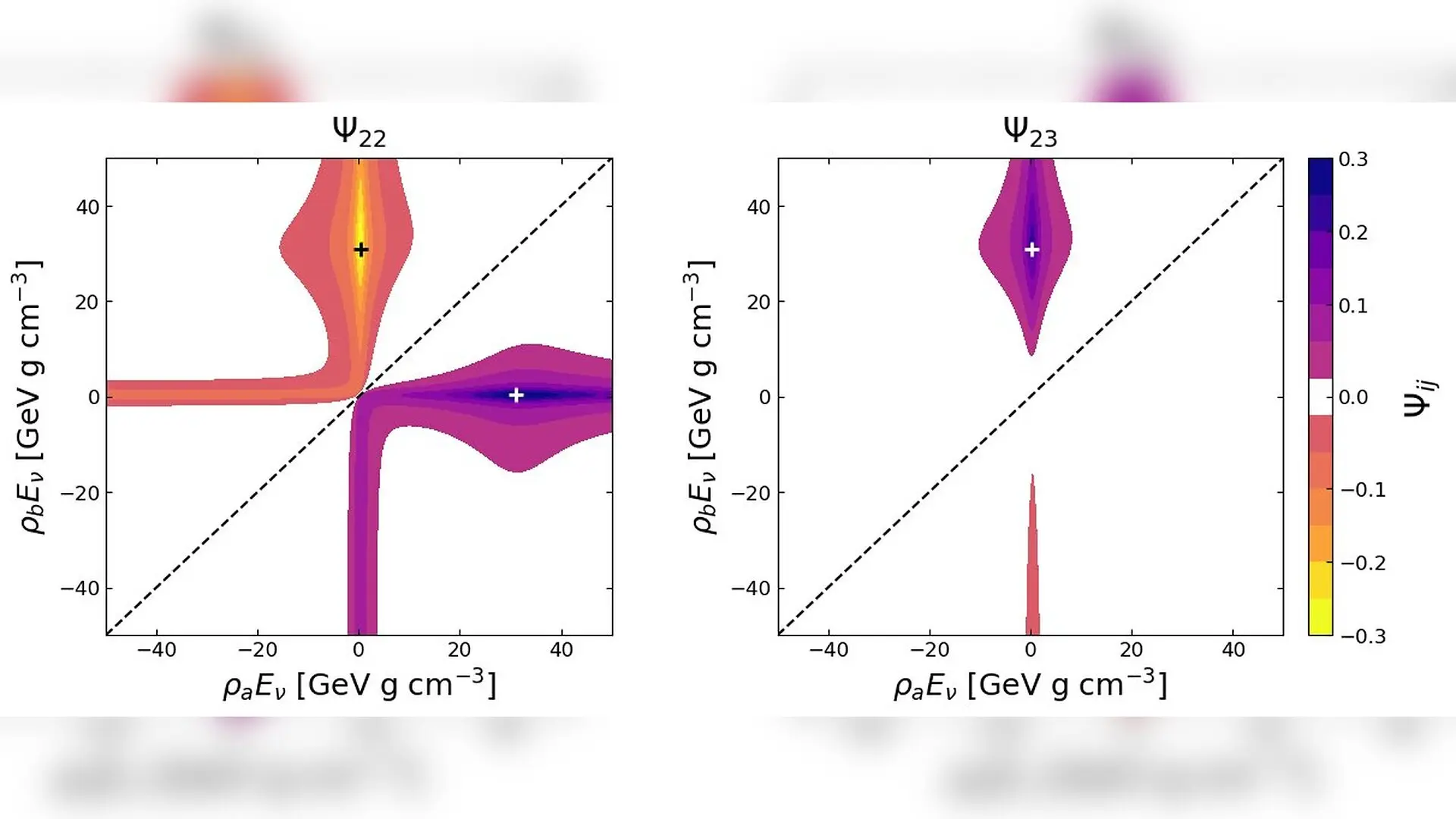
Terms that multiply the oscillation factors in the asymmetry S~32−S~23\widetilde{S}_{32}-\widetilde{S}_{23}, which determines the size of the leading T/CP-violating contribution in Pμ​μP_{\mu\mu}, as a function of the product ρ​Eν\rho E_{\nu} for each one of the two layers of constant density. The peaks of the terms are found close to the solar and atmospheric resonances, marked by plus signs. When ρa=ρb\rho_{a}=\rho_{b}, along the dashed black line, the profile is symmetric and S~32=S~23\widetilde{S}_{32}=\widetilde{S}_{23}, thus all terms must be exactly zero. Gabriela Barenboim et al. / arXiv

Subatomic ghost particles called neutrinos can undergo time-reversal violation even when they disappear rather than changing into other types, overturning a decades-old consensus in physics. While textbooks traditionally state that this foundational symmetry violation vanishes entirely in disappearance channels, a new study demonstrates that this belief rests on a mathematical illusion.

Physicists have long assumed that comparing a neutrino oscillation process to its reversed counterpart yields zero change when the initial and final flavors are identical. Gabriela Barenboim from the Universitat de València and Stephen J. Parke from the Fermi National Accelerator Laboratory, alongside Alberto Sánchez Vargas, investigated this assumption in research available on the arXiv preprint server. Their work reveals that standard calculations use an improper test, which merely swaps particle labels while leaving the external environment static. When time reversal is performed properly in asymmetric environments, the survival probabilities of muon neutrinos and tau neutrinos reveal genuine time-reversal violation.

Why Do Disappearances Hide Symmetry Violations?

Neutrinos come in three main flavors, namely electron, muon, and tau types, and they transform into one another as they travel through space and matter. To test whether the laws of physics look different backward in time, researchers examine how particles transition between states. In symmetric matter profiles, such as uniform density media, an improper test that only swaps the start and end flavors happens to give the correct answer. However, real planetary bodies present asymmetric density profiles where matter changes along the path.
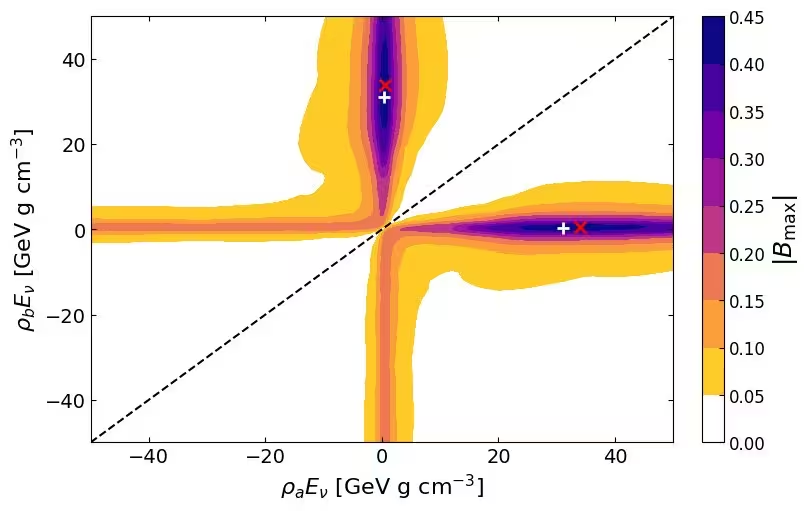
Figure 4: Maximum size of the sin⁡δ\sin\delta term in Pμ​μP_{\mu\mu}, the coefficient BB, as a function of ρ​Eν\rho E_{\nu} in two layers of constant density, after maximizing it over any pair of propagation lengths, LaL_{a} and LbL_{b}. The effect is larger when one of the layers is close to the solar resonance (ρ​Eν∼0.34​GeV​g​cm−3\rho E_{\nu}\sim 0.34~\rm{GeV\,g\,cm^{-3}}) and the other one is close to the atmospheric resonance (ρ​Eν∼31​GeV​g​cm−3\rho E_{\nu}\sim 31~\rm{GeV\,g\,cm^{-3}}), marked by white plus signs. In particular, the global maximum is |B|∼0.4\absolutevalue{B}\sim 0.4 (red crosses) found for ρa​Eν≈0.7​GeV​g​cm−3\rho_{a}E_{\nu}\approx 0.7~\rm{GeV\,g\,cm^{-3}}, ρb​Eν≈34​GeV​g​cm−3\rho_{b}E_{\nu}\approx 34~\rm{GeV\,g\,cm^{-3}}. For an energy of 11 GeV, the path lengths that yield the maximum BB correspond to La≈21 000L_{a}\approx 21\,000 km and Lb≈830L_{b}\approx 830 km. When ρa=ρb\rho_{a}=\rho_{b}, along the dashed black line, the profile is symmetric and BB must be exactly zer
Maximum size of the sin⁡δ\sin\delta term in Pμ​μP_{\mu\mu}, the coefficient BB, as a function of ρ​Eν\rho E_{\nu} in two layers of constant density, after maximizing it over any pair of propagation lengths, LaL_{a} and LbL_{b}. The effect is larger when one of the layers is close to the solar resonance (ρ​Eν∼0.34​GeV​g​cm−3\rho E_{\nu}\sim 0.34~\rm{GeV\,g\,cm^{-3}}) and the other one is close to the atmospheric resonance (ρ​Eν∼31​GeV​g​cm−3\rho E_{\nu}\sim 31~\rm{GeV\,g\,cm^{-3}}), marked by white plus signs. In particular, the global maximum is |B|∼0.4\absolutevalue{B}\sim 0.4 (red crosses) found for ρa​Eν≈0.7​GeV​g​cm−3\rho_{a}E_{\nu}\approx 0.7~\rm{GeV\,g\,cm^{-3}}, ρb​Eν≈34​GeV​g​cm−3\rho_{b}E_{\nu}\approx 34~\rm{GeV\,g\,cm^{-3}}. For an energy of 11 GeV, the path lengths that yield the maximum BB correspond to La≈21 000L_{a}\approx 21\,000 km and Lb≈830L_{b}\approx 830 km. When ρa=ρb\rho_{a}=\rho_{b}, along the dashed black line, the profile is symmetric and BB must be exactly zer Credit: Gabriela Barenboim et al. / arXiv

A proper time reversal requires not only swapping the initial and final neutrino flavors but also completely reversing the trajectory and the density profile of the matter traversed. When this rigorous definition is applied, the muon and tau neutrino survival channels carry a term dependent on the sine of the Dirac charge-parity violating phase. This term is non-zero in asymmetric matter, meaning disappearance channels are indeed sensitive to fundamental symmetry violations.

Can Current Experiments Measure This Hidden Effect?

The researchers evaluated whether upcoming large-scale facilities like the Deep Underground Neutrino Experiment in the United States and the Hyper-Kamiokande detector in Japan could spot this phenomenon. Unfortunately, the calculations show that the time-reversal violating terms are suppressed to roughly one part in ten million at the peak operating energies of these detectors. Both facilities operate with baseline configurations and matter density asymmetries that are far too small to reveal the effect clearly.

The analysis indicates that observing this disappearance anomaly requires extreme configurations with very long path lengths and dramatic density variations. Specifically, the authors calculated that an optimal setup pairs a low-density region close to the solar resonance scale with a high-density region close to the atmospheric resonance scale. Such conditions generate a large asymmetry that amplifies the symmetry-violating signal significantly.
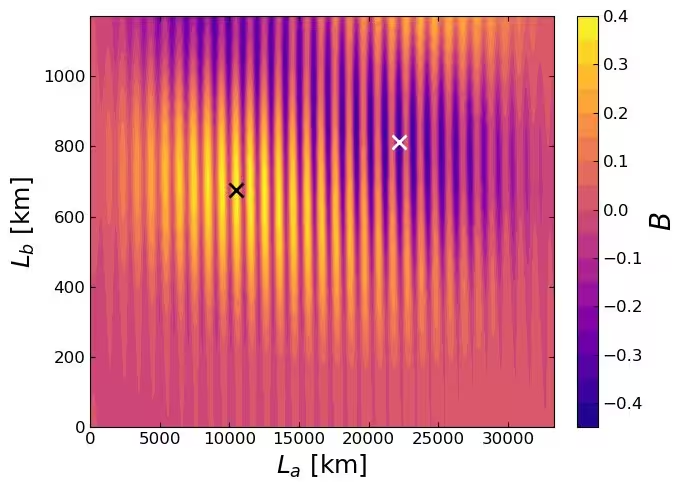
Figure 5: Size of BB in Pμ​μP_{\mu\mu} as a function of the propagation lengths {La,Lb}\{L_{a},L_{b}\} for the configuration that maximizes BB: ρa​Eν≈0.7​GeV​g​cm−3\rho_{a}E_{\nu}\approx 0.7~\rm{GeV\,g\,cm^{-3}}, ρb​Eν≈34​GeV​g​cm−3\rho_{b}E_{\nu}\approx 34~\rm{GeV\,g\,cm^{-3}}, close to the solar and atmospheric resonance values. The energy has chosen to be Eν=1​GeVE_{\nu}=1~\rm{GeV}. LaL_{a} must be close to the oscillation length L21oscL_{21}^{\rm osc} to make BB sizable. The crosses indicate the location of the maximum values of |B||B| for each of the two regions. The values of the path lengths at these two maximums are given by (La,Lb)≈(10 500,700)(L_{a},L_{b})\,\approx\,(10\,500,~700) km and (21 000,830)(21\,000,~830) km.
Size of BB in Pμ​μP_{\mu\mu} as a function of the propagation lengths {La,Lb}\{L_{a},L_{b}\} for the configuration that maximizes BB: ρa​Eν≈0.7​GeV​g​cm−3\rho_{a}E_{\nu}\approx 0.7~\rm{GeV\,g\,cm^{-3}}, ρb​Eν≈34​GeV​g​cm−3\rho_{b}E_{\nu}\approx 34~\rm{GeV\,g\,cm^{-3}}, close to the solar and atmospheric resonance values. The energy has chosen to be Eν=1​GeVE_{\nu}=1~\rm{GeV}. LaL_{a} must be close to the oscillation length L21oscL_{21}^{\rm osc} to make BB sizable. The crosses indicate the location of the maximum values of |B||B| for each of the two regions. The values of the path lengths at these two maximums are given by (La,Lb)≈(10 500,700)(L_{a},L_{b})\,\approx\,(10\,500,~700) km and (21 000,830)(21\,000,~830) km. Credit: Gabriela Barenboim et al. / arXiv

What Would a Future Setup Need to Succeed?

To achieve the necessary asymmetry and baselines, physicists would need to look beyond traditional underground laboratories situated on the Earth’s crust. The study models two futuristic scenarios to demonstrate how the effect could theoretically be captured. One concept involves firing a high-energy neutrino beam through the entire diameter of the Earth to a detector stationed in a geostationary orbit on the opposite side. Another concept places a powerful particle source on the Moon to shower multiple detectors across the Earth.

These futuristic arrangements yield large symmetry-violating coefficients reaching up to sixty percent of the baseline signal magnitude. Furthermore, the calculations show that such an Earth-to-satellite experiment would exhibit high sensitivity to the internal density structure of the Earth’s core and mantle. While these proposals remain far beyond current construction capabilities, they prove that disappearance channels are fundamentally capable of probing subatomic symmetries once thought invisible.

The study was posted to the arXiv preprint server on November 20, 2026.

Fact Checked

This article has been fact checked for accuracy, with information verified against reputable sources. Learn more about us and our editorial process.

Last reviewed on .

Article history

  • Latest version

Reference(s)

  1. Barenboim, Gabriela. “Is Neutrino Disappearance Sensitive to T-Violation for Asymmetric Matter Profiles ?.” arXiv.org <http://arxiv.org/abs/2611.27985v1>.

Cite this page:

Rehman, Nida. “Neutrino Disappearance Can Reveal Time Reversal Violation In Asymmetric Matter.” BioScience. BioScience ISSN 2521-5760, 23 November 2026. <https://www.bioscience.com.pk/en/subject/physics/is-neutrino-disappearance-sensitive-to-t-violation-for-asymmetric-matter-profiles>. Rehman, N. (2026, November 23). “Neutrino Disappearance Can Reveal Time Reversal Violation In Asymmetric Matter.” BioScience. ISSN 2521-5760. Retrieved November 23, 2026 from https://www.bioscience.com.pk/en/subject/physics/is-neutrino-disappearance-sensitive-to-t-violation-for-asymmetric-matter-profiles Rehman, Nida. “Neutrino Disappearance Can Reveal Time Reversal Violation In Asymmetric Matter.” BioScience. ISSN 2521-5760. https://www.bioscience.com.pk/en/subject/physics/is-neutrino-disappearance-sensitive-to-t-violation-for-asymmetric-matter-profiles (accessed November 23, 2026).
End of the article