Classic Fluid Simulation Method Proven Reliable for Chaotic Random Flows
A new mathematical analysis shows that Chorin’s projection method can track turbulent fluids driven by random noise without requiring smooth initial states.
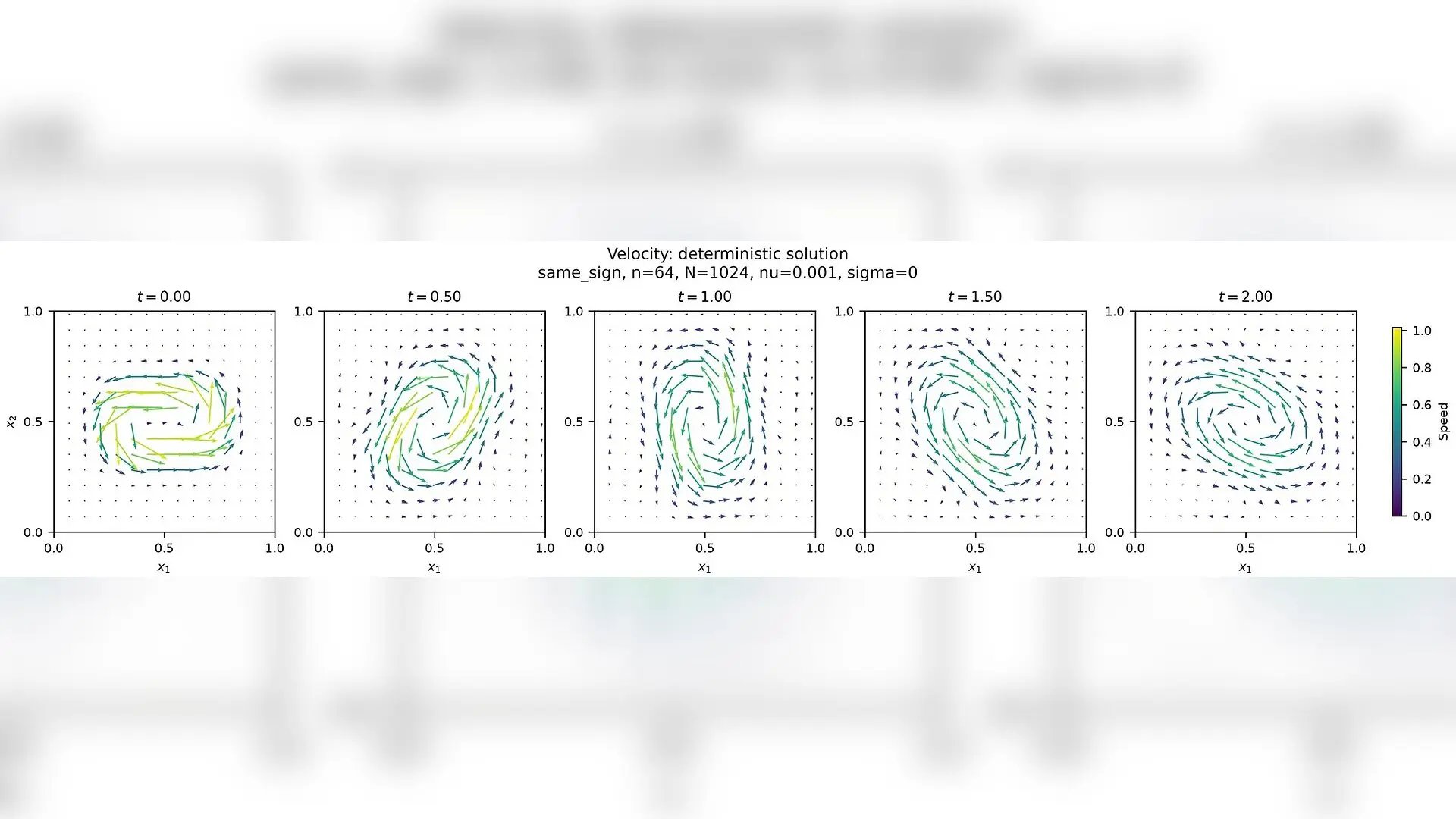
When turbulent fluids dance with random, unpredictable forces, predicting their motion becomes one of mathematics’ most stubborn riddles. Now, a new computational analysis shows how a classic splitting technique can track these chaotic systems reliably across both two and three dimensions, even when starting from rough initial states.
How Can Splitting Complex Fluid Equations Keep Simulations Stable?
To simulate how liquids and gases flow under random environmental jolts, researchers often rely on the stochastic incompressible Navier–Stokes equations, which couple fluid velocity and pressure while respecting an unyielding rule that the fluid cannot be compressed. Because handling both advection and the incompressibility constraint simultaneously requires immense computational power, numerical analysts frequently use fractional step methods pioneered decades ago by Alexandre Chorin and Roger Temam. These schemes split each time step into two simpler parts: first calculating an intermediate velocity field that accounts for convection, diffusion, and random forces, and then applying a projection step to enforce the divergence-free constraint.
While these projection methods are popular for their speed and modularity, proving that they converge to genuine mathematical solutions without assuming the fluid remains perfectly smooth has remained an open challenge, particularly in the presence of multiplicative noise. Franziska Weber from the University of California, Berkeley, recently analyzed this problem in a study available on the arXiv preprint server, focusing on a fully discrete finite element version of Chorin’s projection method operating on bounded domains with homogeneous Dirichlet boundary conditions.
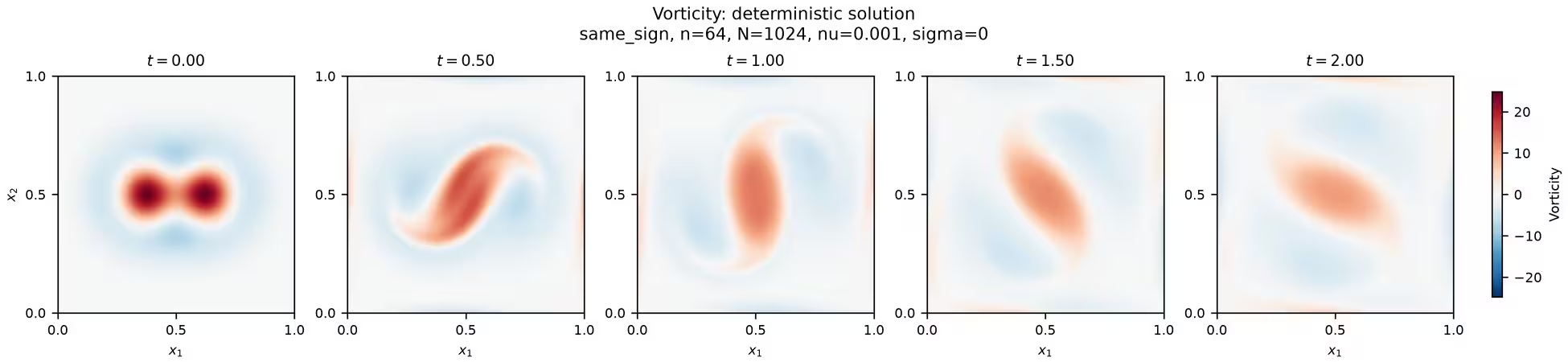
What Happens When Estimates Are Distributed Across Two Velocity Fields?
The core difficulty in analyzing projection schemes stems from a mathematical tug-of-war between the intermediate velocity field and the corrected velocity field. The intermediate velocity satisfies favorable energy bounds and spatial gradients, but it fails to satisfy the divergence-free condition and lacks direct control over its time increments. Conversely, the corrected velocity is discretely divergence-free and possesses the necessary temporal bounds for compactness, but its direct energy estimates are confined to bounded intervals.
To bridge this gap, the author utilized Aldous’ criterion to establish the tightness of probability laws for the time interpolants of the projected velocity approximations in a dual Sobolev space. By carefully exploiting the numerical dissipation inherent in the scheme, the analysis shows that the difference between the intermediate and corrected velocity sequences vanishes in probability as the time step and mesh size approach zero. This machinery enables the use of the Skorokhod representation theorem to extract almost surely convergent subsequences on a new probability space, recovering strong convergence in Lebesgue space without demanding unproven smoothness from the limiting fluid flow.
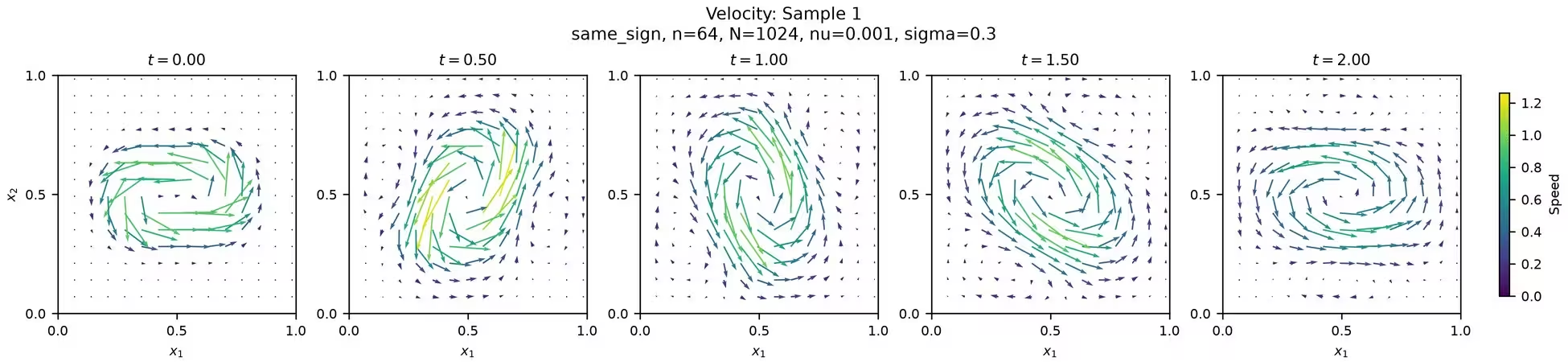
What Are the Limits and Catch of This Convergence Proof?
Although the mathematical framework successfully proves convergence to a martingale solution in two and three dimensions under mild initial data assumptions, it requires a strict coupling condition between spatial and temporal discretization parameters, specifically that the mesh size raised to twice the sum of the finite element approximation order and the Stokes elliptic regularity index must grow smaller than the time step.
The author notes that this coupling condition is primarily required to control pressure terms that arise because standard finite element interpolants do not automatically preserve divergence-free properties. For specific element pairs possessing a suitable local Fortin operator, this restriction might be bypassed, pointing toward even more efficient algorithms for future fluid dynamics simulations.
The study was posted to the arXiv preprint server on November 20, 2026.
This article has been fact checked for accuracy, with information verified against reputable sources. Learn more about us and our editorial process.
Last reviewed on .
Article history
- Latest version
Reference(s)
- Weber, Franziska. “Convergence of a finite element Chorin projection method for the stochastic Navier--Stokes equations.” arXiv.org <http://arxiv.org/abs/2611.27969v1>.
- Posted by Joseph Jackson