New Mathematical Method Stops Data-Driven Models From Creating Energy Out Of Thin Air
Researchers have proved that embedding physical energy laws into mathematical models stops simulation drift, though it introduces a trade-off with short-term accuracy.
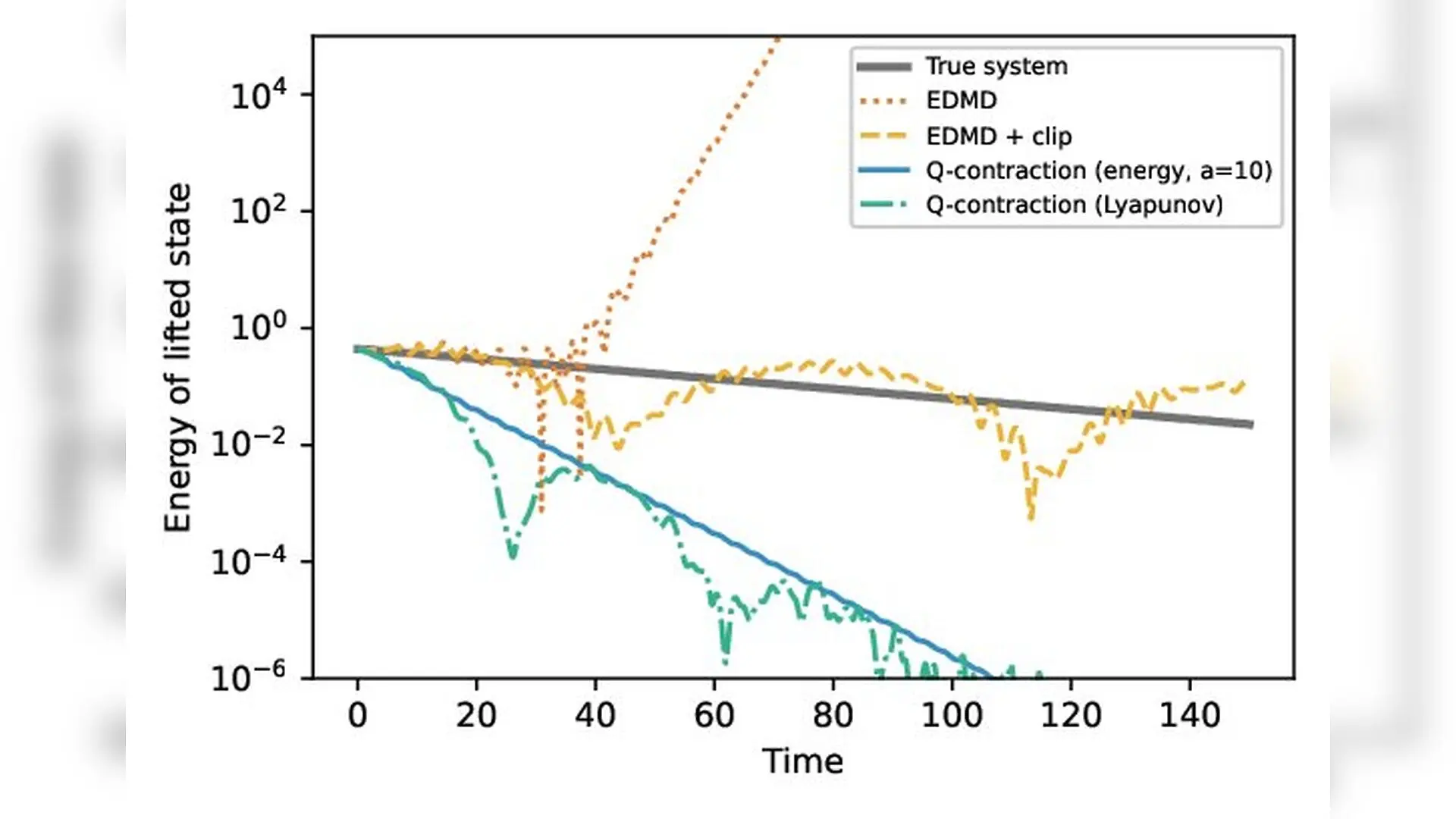
When mathematicians model complex physical systems using data alone, their computer simulations often create energy out of nothing, leading to runaway errors over time. Researchers have now solved this stability problem by embedding physical laws directly into the underlying mathematical equations, ensuring that data-driven models obey the conservation of energy.
Matthias Ehrhardt and Achraf Zinihi from the University of Wuppertal published their findings on the arXiv preprint server, detailing a new method to constrain data-driven mathematical models so they never generate spurious energy. Traditional techniques often use standard regression algorithms that treat system data as purely abstract numbers, ignoring the fundamental rules of physics that govern real-world machinery and fluid flows.
How Can Abstract Data Respect Physical Laws?
The core of the difficulty lies in a mathematical framework known as extended dynamic mode decomposition, which approximates complex nonlinear behavior using a finite list of observable measurements. While this approach is widely used for predictive control in engineering, the uncalculated least-squares matrices it generates are structurally agnostic. They do not require passivity, meaning they can easily absorb or create energy artificially during long-horizon simulations.
To fix this, the researchers focused on port-Hamiltonian systems, which are a class of mathematical models that explicitly track energy flows, inputs, and internal dissipation. By applying an implicit midpoint discretization scheme to a lifted version of these models, the authors demonstrated that energy balance, passivity, and linear invariants called Casimirs are preserved exactly across every single time step. This mathematical translation turns the chaotic drift of traditional algorithms into a controlled, stable projection.
What Happens When Energy Constraints Meet Noisy Data?
To test the new framework, the team ran numerical benchmarks on a damped pendulum and a damped rigid body, comparing unconstrained models against various constrained alternatives. In tests involving a pendulum simulated over fifty steps, standard unconstrained models frequently diverged or inflated total energy to unreasonable levels. By contrast, models restricted by the new energy-preserving constraints maintained a strict energy gain of one, meaning no artificial energy was ever created.
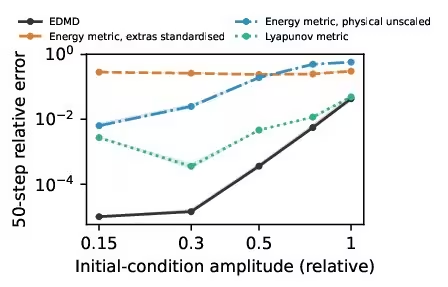
However, the researchers discovered an important trade-off involving structural bias and accuracy. When using physical energy as the storage metric, the constrained models proved less accurate than unconstrained counterparts because the mathematical transformation introduced noticeable bias. To counter this, the team tested a data-adapted metric that successfully removed most of the bias, though it sacrificed the direct physical interpretation of the internal storage functions.
Why Do Linear Invariants Matter for Long Simulations?
Another major challenge in system modeling is the preservation of quantities that should remain constant throughout a simulation, such as total angular momentum in rotational systems. In tests on a damped rigid body, standard unconstrained algorithms completely lost these conserved quantities when fed noisy data, resulting in massive drift errors. When the authors added specific linear Casimir constraints to the optimization problem, the models preserved these invariants down to solver accuracy limits without increasing the estimation error.
The study demonstrates that structure-preserving system identification can be formulated as a convex semidefinite program, making it computationally tractable for researchers using standard solvers. While physical constraints naturally limit model flexibility and can increase short-term prediction errors in certain data regimes, they provide an essential safeguard against catastrophic energy divergence in long-term forecasting and predictive control.
The study was posted to the arXiv preprint server on November 20, 2026.
This article has been fact checked for accuracy, with information verified against reputable sources. Learn more about us and our editorial process.
Last reviewed on .
Article history
- Latest version
Reference(s)
- Ehrhardt, Matthias. “Convex Structure-Preserving EDMD: Passive Koopman Matrices as $Q$-Contractions.” arXiv.org <http://arxiv.org/abs/2611.27730v1>.
Cite this page:
- Posted by Joseph Jackson