Math Puzzles Reveal Hidden Fractal Boundaries In Classic Number Systems
New research shows that the complex boundaries of the Lagrange and Markov spectra possess positive fractal dimensions and hidden gaps.

Mathematicians have solved a long-standing puzzle regarding the fine-scale structure of two famous number systems, revealing that their outer limits possess intricate fractal patterns with positive dimensions.
The research, authored by Harold Erazo from SUSTech International Center for Mathematics along with Carlos Matheus and Carlos Gustavo Moreira, was published on the arXiv preprint server (available on the arXiv preprint server). It dives into the Lagrange and Markov spectra, which are sets of numbers that measure how closely irrational numbers can be approximated by fractions, acting like a numerical measuring tape for the precision of rational numbers.
What Are the Lagrange and Markov Spectra?
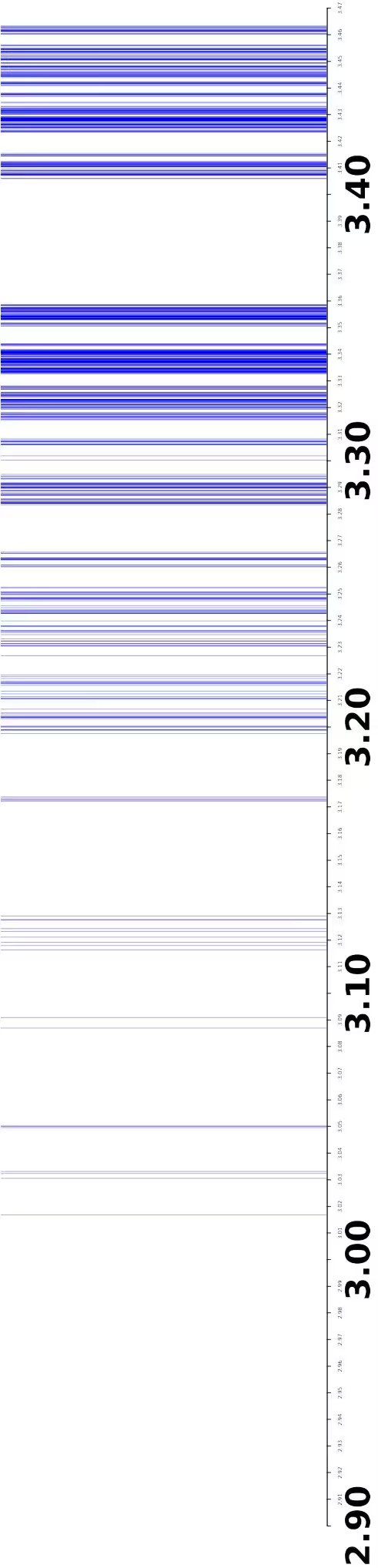
In number theory, these spectra represent the best possible approximation constants for certain classes of numbers and quadratic forms. Below a threshold of three, the two sets match completely, forming a discrete series of points that eventually clump together at three. Beyond that threshold, they transform into continuous regions filled with gaps and fractal structures.
For decades, researchers understood that these sets contained large continuous rays, such as a famous boundary established in 1975 by mathematician G. A. Freiman. However, the exact nature of the boundaries separating allowed values from forbidden gaps remained poorly understood.
How Do Cantor Sets Shape the Boundaries?
To investigate these edges, the authors used renormalization techniques, a mathematical framework that zooms in on self-similar structures to analyze how systems behave at different scales. By treating the boundaries as arithmetic sums of Cantor sets, which are fractals formed by repeatedly removing middle intervals, the team tracked how gaps nest inside one another.
The researchers proved that the topological boundaries of both spectra have positive Hausdorff dimensions, meaning they are uncountably infinite and possess a fractional geometric measurement greater than zero near key values like Hall’s ray. They also discovered a brand-new gap near 4.08, marking the first identified gap in that specific region.
Why Does This Fractal Geometry Matter?
These findings bridge number theory with dynamical systems, showing that the subtle distribution of gaps mirrors chaotic behaviors seen in geometry and bifurcation theory. By refining computational algorithms to map these elusive intervals, the study opens new pathways for exploring the unexplored territories between discrete numbers and continuous spectra.
The study was posted to the arXiv preprint server on November 20, 2026.
This article has been fact checked for accuracy, with information verified against reputable sources. Learn more about us and our editorial process.
Last reviewed on .
Article history
- Latest version
Reference(s)
- Erazo, Harold. “Boundary of the Lagrange and Markov spectra near Hall's ray.” arXiv.org <http://arxiv.org/abs/2611.27731v1>.
Cite this page:
- Posted by Rabia Shah