New Math Technique Cuts Supercomputer Processing Time in Half
Researchers prove that shortening mathematical trajectories in parallel optimization algorithms speeds up calculations without losing accuracy.
Accelerating massive mathematical calculations requires rethinking how computers tackle step-by-step optimization problems, according to a recent study. Researchers have developed a novel computational framework that skips the tedious tracking of entire solution paths, potentially cutting supercomputer processing requirements in half while boosting execution speed.
Many scientific and engineering challenges boil down to finding the lowest point on a complex mathematical landscape, a task known as optimization. Traditional computers tackle these tasks sequentially, calculating thousands of intermediate steps in a strict chain where each step depends entirely on the one before it. This sequential bottleneck creates massive wall-clock delays, meaning scientists often wait hours or days for results. Parallel processing offers a solution by splitting the workload across many processors, but standard parallel-in-time methods were originally built to simulate continuous evolution problems like weather patterns or fluid dynamics, where every single intermediate snapshot must be calculated with high precision.
Optimization problems, however, have different rules. An optimization algorithm only cares about the final destination, meaning the intermediate steps are essentially disposable stepping stones. Building upon this insight, a team of applied mathematicians consisting of Guilherme H. M. Araujo and Hans De Sterck from the University of Waterloo alongside Oliver A. Krzysik from Los Alamos National Laboratory introduced a technique called restarted multigrid reduction-in-time, or R-MGRIT, available on the arXiv preprint server. Instead of forcing parallel processors to refine one enormously long sequence of iterates from start to finish, the new multi-trajectory approach performs just a single parallel grid iteration on a trajectory, takes the resulting approximate endpoint as a fresh starting guess, and launches a brand new trajectory.

How Shortening Mathematical Trajectories Speeds Up Supercomputers
The core innovation rests on a surprising mathematical property discovered by the authors. Through rigorous asymptotic final-point analysis for linear problems, the team proved that the approximate endpoint obtained after a fixed number of standard iterations converges to the exact same limit as the multi-trajectory restarting scheme as the temporal domain grows infinitely large. In plain terms, restarting the process does not sacrifice mathematical accuracy.
More importantly, the researchers discovered that individual trajectories can be severely truncated without increasing the number of restarts required for convergence. The mathematical analysis demonstrates that the approximate solution along a single trajectory approaches its ultimate limit geometrically, meaning that compute power spent calculating points far down a long trajectory is largely wasted. By cutting each trajectory down to a fraction of its original length, programmers can shrink the number of active processors needed for full parallelization.
Testing Linear and Non-Linear Obstacle Problems
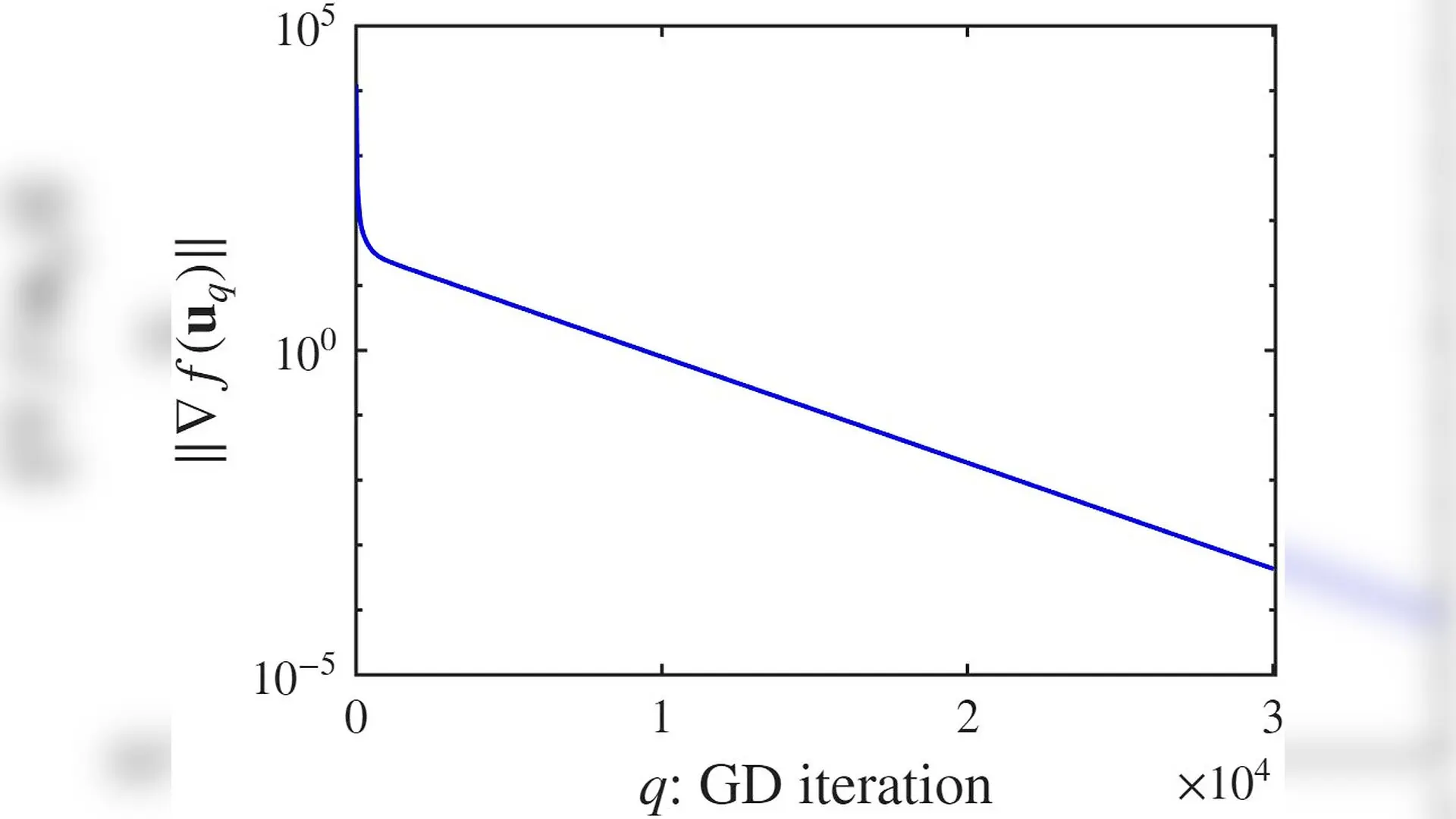
The research team tested their restarted and truncated frameworks on multiple demanding model scenarios, including standard quadratic minimization and the complex elastic obstacle problem involving non-smooth penalties. For instance, when solving quadratic optimization problems governed by one-dimensional Laplacian matrices, standard sequential gradient descent required over 30,000 individual steps. When deployed across parallel systems, the standard multigrid reduction approach achieved convergence in eight iterations, while the truncated restarted variant achieved comparable gradient reduction in fewer trajectories.
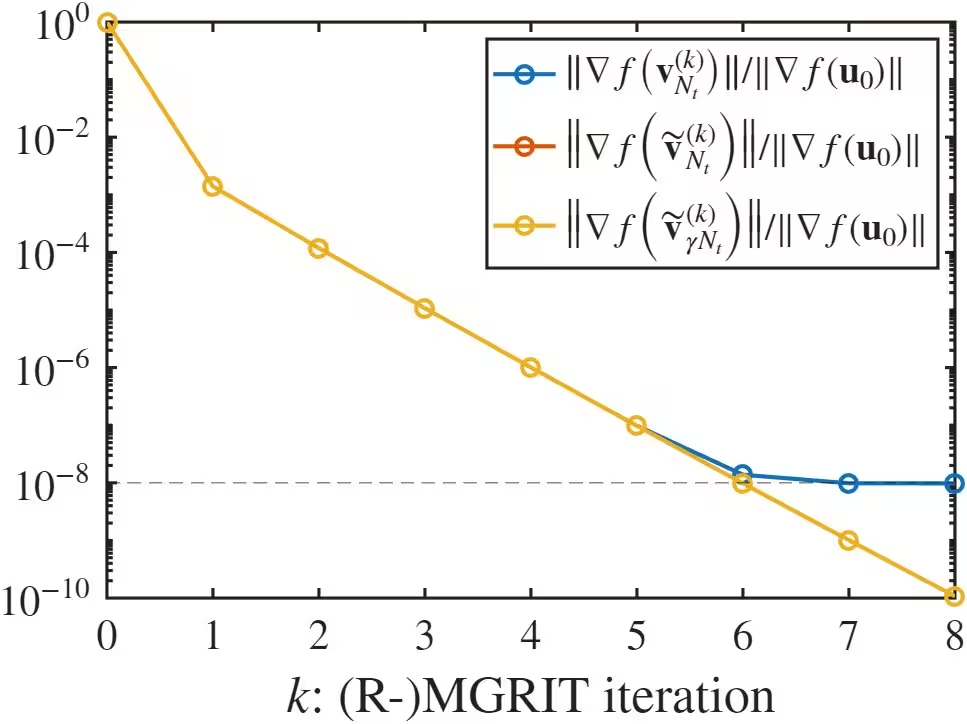
For non-linear elastic obstacle problems featuring complex physical barriers and strict convergence tolerances, the results mirrored the linear tests. The team observed that while standard methods often hit a plateau where the gradient stops shrinking, the restarted framework continues making steady progress. Furthermore, when the researchers integrated Anderson acceleration into the mix, a mathematical technique that uses historical guesses to predict better future starting points, the number of required trajectories dropped even further.
Future Implications for High-Performance Computing
The practical payoff of this mathematical refinement lies in dramatic speedup metrics. According to the team’s parallel cost analysis, truncating the time domain by a factor of 0.2 allows high-performance computing setups to double their execution speed while cutting the required processor count proportionally. This makes large-scale optimization feasible for engineering and machine learning tasks that were previously choked by sequential processing limits. Future work will expand these parallel-in-iteration principles to broader classes of optimization algorithms, pushing the boundaries of what parallel supercomputers can achieve.
The study was posted to the arXiv preprint server on November 2, 2026.
This article has been fact checked for accuracy, with information verified against reputable sources. Learn more about us and our editorial process.
Last reviewed on .
Article history
- Latest version
Reference(s)
- Araujo, Guilherme. “Multi-Trajectory Parallel-in-Iteration Optimization.” arXiv.org <http://arxiv.org/abs/2611.03621v1>.
Cite this page:
- Posted by Rabia Shah