How Two Trillion Electronvolt Ion Collisions Reveal Limits in Plasma Models
Sequential Bayesian analysis shows that distinct plasma configurations can produce identical particle suppression.
Physicists studying the soup of quarks and gluons created in high-energy lead ion collisions have found that standard analysis methods struggle to separate the properties of the expanding medium from the microscopic forces acting within it. When lead ions smash together at energies reaching two trillion seven hundred sixty billion electronvolts, they briefly melt protons and neutrons into a primordial state of matter known as a quark-gluon plasma.
Researchers within the JETSCAPE Collaboration, led by Lipei Du of the University of California, Berkeley and Lawrence Berkeley National Laboratory, explored how incorporating soft-sector constraints affects hard-probe extractions. Their study is available on the arXiv preprint server. In heavy-ion physics, soft observables constrain the bulk collective behavior of the plasma, whereas hard probes rely on energetic partons traveling through and interacting with that medium.
Why Do Conflicting Plasma Models Produce Similar Particle Suppression?
The team worked within a reduced three-parameter space to model lead-lead collisions at a center-of-mass energy of two trillion seven hundred sixty billion electronvolts per nucleon pair. They varied the initial density scale through the TRENTo normalization parameter, adjusted the transverse geometry via the nucleon width measured in femtometers, and controlled the soft-scale interaction strength using the jet-medium coupling. The hard dataset comprised seventeen distinct hadron and inclusive-jet nuclear modification factor measurements spanning two hundred six bins.
By combining medium evolution models with calculations of high-momentum hadron and jet suppression, the authors performed sequential Bayesian inference. When they constrained all parameters using hard observables alone under broad priors, the model favored a low initial normalization and a large nucleon width. However, incorporating projected soft-sector information shifted the preferred configuration significantly.
What Drives the Shift in Preferred Interaction Strengths?
The analysis revealed substantial anticorrelations between the medium properties and the jet-medium coupling. Increasing the initial density scale raises the characteristic temperature and density of the plasma, which allows comparable particle suppression to be achieved with a smaller coupling constant. This compensation mechanism means that distinct combinations of medium geometry and microscopic interaction strength can produce nearly identical net quenching effects.
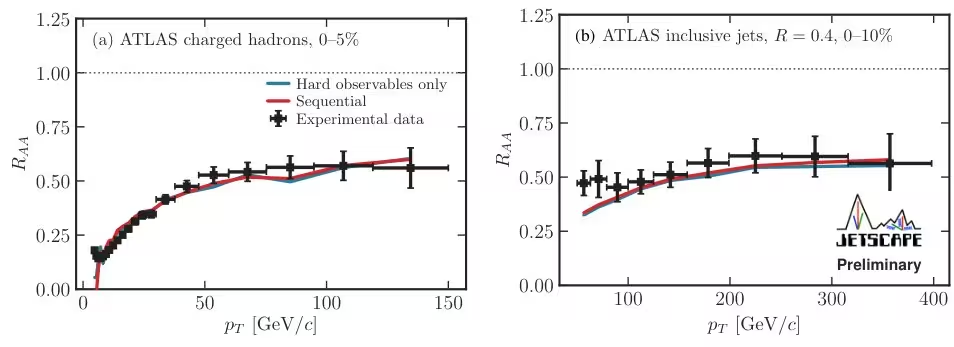
Separate sequential updates demonstrated that hadron-suppression measurements drive most of the statistical shift toward lower initial density scales and more localized coupling values. Meanwhile, the included jet measurements exerted a weaker influence on the medium posterior. The steeply falling momentum spectrum of charged hadrons makes leading-hadron suppression acutely sensitive to parton energy loss, whereas reconstructed jets can retain redistributed shower energy inside their designated cones.
Can Future Experiments Unravel Medium Evolution and Jet Interactions?
Despite substantial differences in the preferred medium parameters and coupling values between hard-only and sequential inferences, both approaches predicted similar nuclear modification factor curves across much of the measured kinematic range. The most prominent discrepancy appeared only at low transverse momentum values for charged hadrons. Because inclusive suppression averages over multiple particle production points and trajectories, standard measurements cannot easily distinguish modifications in the plasma medium from changes in microscopic interaction strength.
The authors conclude that higher-dimensional calibrations will be necessary to let fixed model parameters readjust simultaneously. Fully capturing both soft and hard observables remains a major challenge for understanding the subatomic dynamics of heavy-ion collisions.
The study was posted to the arXiv preprint server on November 20, 2026.
This article has been fact checked for accuracy, with information verified against reputable sources. Learn more about us and our editorial process.
Last reviewed on .
Article history
- Latest version
Reference(s)
- Du, L.. “Soft--hard Bayesian inference in heavy-ion collisions.” arXiv.org <http://arxiv.org/abs/2611.27971v1>.
Cite this page:
- Posted by Nida Rehman