Physicists Capture First Direct View of Strange Quantum Ripples at Fluid Edges
By confining ultracold magnetic atoms inside a sharp optical box, researchers watched a quantum liquid organize itself into periodic boundary ripples.

Physicists have captured the first direct view of density ripples at the edge of a quantum fluid, confirming a half-century-old prediction about how these strange states organize themselves. The observation reveals how microscopic interactions force atoms to arrange into periodic planes when pushed against a physical boundary.
How Do Quantum Liquids Form Ripples at Their Edges?
When a quantum fluid encounters a hard barrier, it does not simply stop like water hitting a glass wall. Instead, the sudden drop in density seeds a local organization among neighboring atoms, creating microscopic ripples that reflect an underlying tendency to crystallize into a solid. More than fifty years ago, theorists predicted that these ripples, known as rotons, should manifest as visible density waves at the fluid boundary. While researchers have previously spotted roton excitations inside bulk quantum systems like liquid helium and ultracold atomic gases, the elusive boundary manifestation had remained hidden from experimental view until now.
To capture this hidden edge behavior, Jasmine Kalia and colleagues at the Massachusetts Institute of Technology built an exquisitely controlled quantum simulator. The team used fifty thousand erbium atoms cooled down to forty-four nanokelvin, just fractions of a degree above absolute zero. Because erbium atoms are strongly magnetic, they interact over long distances in ways that mimic complex solid-state materials. The researchers confined this Bose-Einstein condensate, a state of matter where atoms act as a single macroscopic quantum wave, inside a uniform disc-shaped box with a sharp repulsive optical wall. By tuning the magnetic forces between the atoms, the team could precisely dial up the fluid’s rotonic character.
What Happens When Magnetic Forces Increase Inside the Trap?
The researchers observed a dramatic transformation as they turned up the dipolar interactions. At low interaction strengths, the fluid showed a mild density bump near the confining wall. As the dipolar parameter increased, this edge enhancement grew significantly, accompanied by thermal density fluctuations echoing throughout the bulk. When the dipolar parameter exceeded one point six, a new phenomenon emerged: the smooth boundary broke down into a periodic azimuthal density modulation with a characteristic lengthscale of about six micrometers. The findings are available on the arXiv preprint server and provide a direct window into boundary physics that was previously inaccessible in harmonically trapped gases.
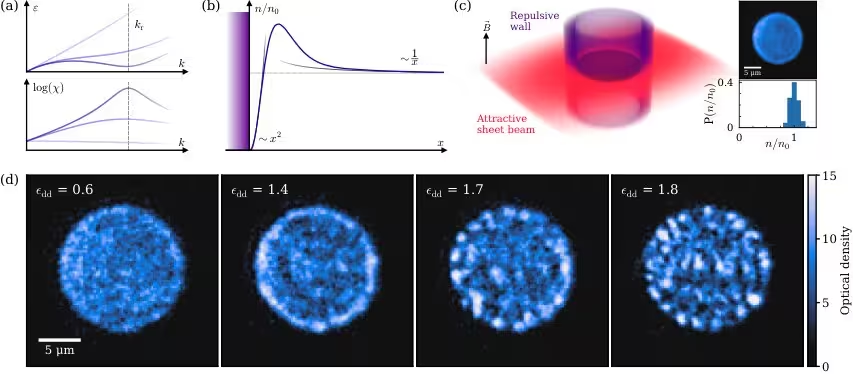
To further understand this boundary structuring, the team also studied an annular, or ring-shaped, configuration that naturally forces periodic boundary conditions. By comparing the ring geometry with the edge of the disc-shaped cloud, the authors confirmed that both systems share a common quasi-one-dimensional rotonic mode. Numerical simulations using the Gross-Pitaevskii equation, a mathematical model that describes the quantum behavior of superfluids, closely matched the observed experimental profiles without requiring any free parameters. The onset of the modulation in these simulations coincided with a shift toward an underlying droplet ground state, indicating a dynamical instability associated with imaginary roton energies.
Why Does This Discovery Matter for Future Physics Research?
The successful visualization of edge rotons bridges a long-standing gap between theoretical predictions and experimental reality in quantum mechanics. Ordinary fluids smooth out against walls, but quantum fluids with competing forces retain memory of their potential crystalline states right at the edge. The ability to engineer uniform potentials for magnetic quantum gases opens fresh avenues for studying complex transport phenomena, quantum turbulence, and critical phase transitions. Researchers can now use these box-confined setups to probe how microscopic interactions shape macroscopic boundaries without the confounding distortions of traditional magnetic traps.
The study was posted to the arXiv preprint server on November 20, 2026.
This article has been fact checked for accuracy, with information verified against reputable sources. Learn more about us and our editorial process.
Last reviewed on .
Article history
- Latest version
Reference(s)
- Kalia, Jasmine. “Observation of rotonic density enhancement at the boundary of a uniform dipolar superfluid.” arXiv.org <http://arxiv.org/abs/2611.27976v1>.
Cite this page:
- Posted by Farah Siddiqui