Quantum Liquid Puzzle Solved As Flat-Surface Particles Evade Decay Via Local Temperature Shifts
A newly calculated quantum collision integral reveals how flat-surface excitations protect themselves from rapid decay through thermal dressing.

A new theoretical analysis reveals why certain particle excitations in two-dimensional quantum liquids live much longer than previously thought, solving a long-standing puzzle in quantum physics. The study shows that these enduring quantum states protect themselves from rapid decay by locally shifting their temperature, a phenomenon the researchers call thermal dressing.
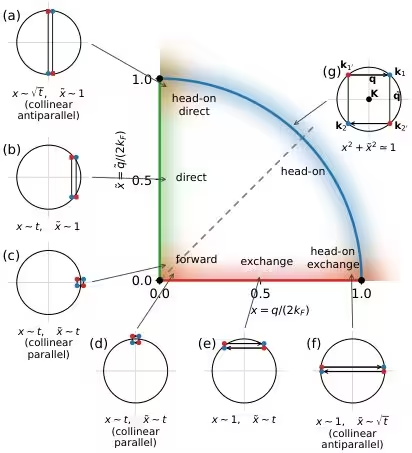
In standard three-dimensional materials, electrons and other quantum particles scatter off one another relatively quickly, losing their momentum and collective patterns. But restrict those particles to a flat, two-dimensional plane at temperatures near absolute zero, and the rules of momentum and energy conservation change dramatically. Earlier theoretical models predicted that odd-parity deformations of the Fermi surface should decay at a rate proportional to the fourth power of temperature, multiplied by a logarithmic factor of the angular harmonic index. However, when physicists tested these predictions using exact numerical calculations, the logarithmic scaling failed to appear, and the predicted decay rates were up to an order of magnitude too large.
To resolve this discrepancy, Stan Boeve and Johannes Hofmann from Gothenburg University evaluated the two-dimensional Fermi-liquid collision integral for general regular isotropic potentials, available on the arXiv preprint server at arXiv:2611.27980. Their work accounts for both logarithmic contributions and nonlogarithmic terms that previous approximations left out. The authors found that the leading logarithmic predictions require two strict mathematical limits that do not actually coincide in realistic physical systems. Specifically, corrections of relative order divided by the log of the temperature ratio are not small enough to be ignored.
How Does Local Temperature Modulation Prevent Rapid Decay?
The researchers discovered that the longest-lived odd modes consist of a rigid displacement of the Fermi surface combined with a local temperature change. This thermal adjustment allows the quasiparticles to evade collinear scattering, which would otherwise serve as their primary relaxation channel. By altering their local temperature, the states effectively dodge head-on collisions that typically sap their momentum.
Microscopically, this behavior is described by a relative dressing parameter denoted as ξ. When this parameter equals one, the mode is fully dressed and immune to collinear relaxation. For a constant interaction potential, the optimal dressing depends heavily on the angular harmonic index $m$, which tracks the complexity of the shape deformation. At smaller values of $m$, the protective dressing is strong, but as $m$ increases toward the square root of the Fermi temperature divided by the actual temperature, the protection gradually fades.
What Happens to These Long-Lived States at Larger Angular Scales?
As the angular harmonic index grows larger, the collinear protection breaks down because endpoint regions of the momentum integral begin to compete with the main logarithmic term. The authors demonstrated that the optimal dressing decreases toward zero for large $m$, turning the excitation back into an essentially rigid deformation. This crossover explains why previous asymptotic formulas overestimated the relaxation rates by significant factors.
When the team benchmarked their analytical results against exact diagonalization data for constant interactions, they found close agreement over a wide range of temperatures. The new closed-form expressions successfully describe both the slow odd modes and the faster even-parity modes to within one percent accuracy for odd rates and five percent for even rates.
Can This Quantum Protection Be Seen in Other Systems?
To test the broader applicability of their framework, Boeve and Hofmann also examined spin-polarized dipolar fermions, which are quantum gases of particles with strong magnetic or electric dipole moments interacting under tight confinement. Because dipolar interactions suppress large-angle scattering compared to the constant interaction case, the relative dressing remains much closer to full protection.
The authors suggest that these insights provide a crucial foundation for future transport calculations in two-dimensional materials, including studies of thermopower, viscosity, and thermal conductivity. While experimental setups are currently restricted to quasi-two-dimensional regimes at fractions of the Fermi temperature, these findings pave the way for a deeper understanding of how quantum fluids behave under extreme confinement.
The study was posted to the arXiv preprint server on November 20, 2026.
This article has been fact checked for accuracy, with information verified against reputable sources. Learn more about us and our editorial process.
Last reviewed on .
Article history
- Latest version
Reference(s)
- Boeve, Stan. “Structure and relaxation of long-lived odd-parity modes in two-dimensional Fermi liquids.” arXiv.org <http://arxiv.org/abs/2611.27980v1>.
Cite this page:
- Posted by Deepak Malhotra