Physicists Detect Quantum Entanglement in Massive Higgs Boson Decays for the First Time
Physicists have observed Einstein’s spooky quantum entanglement within Higgs boson decays, revealing deep connections between particles at the smallest scale.
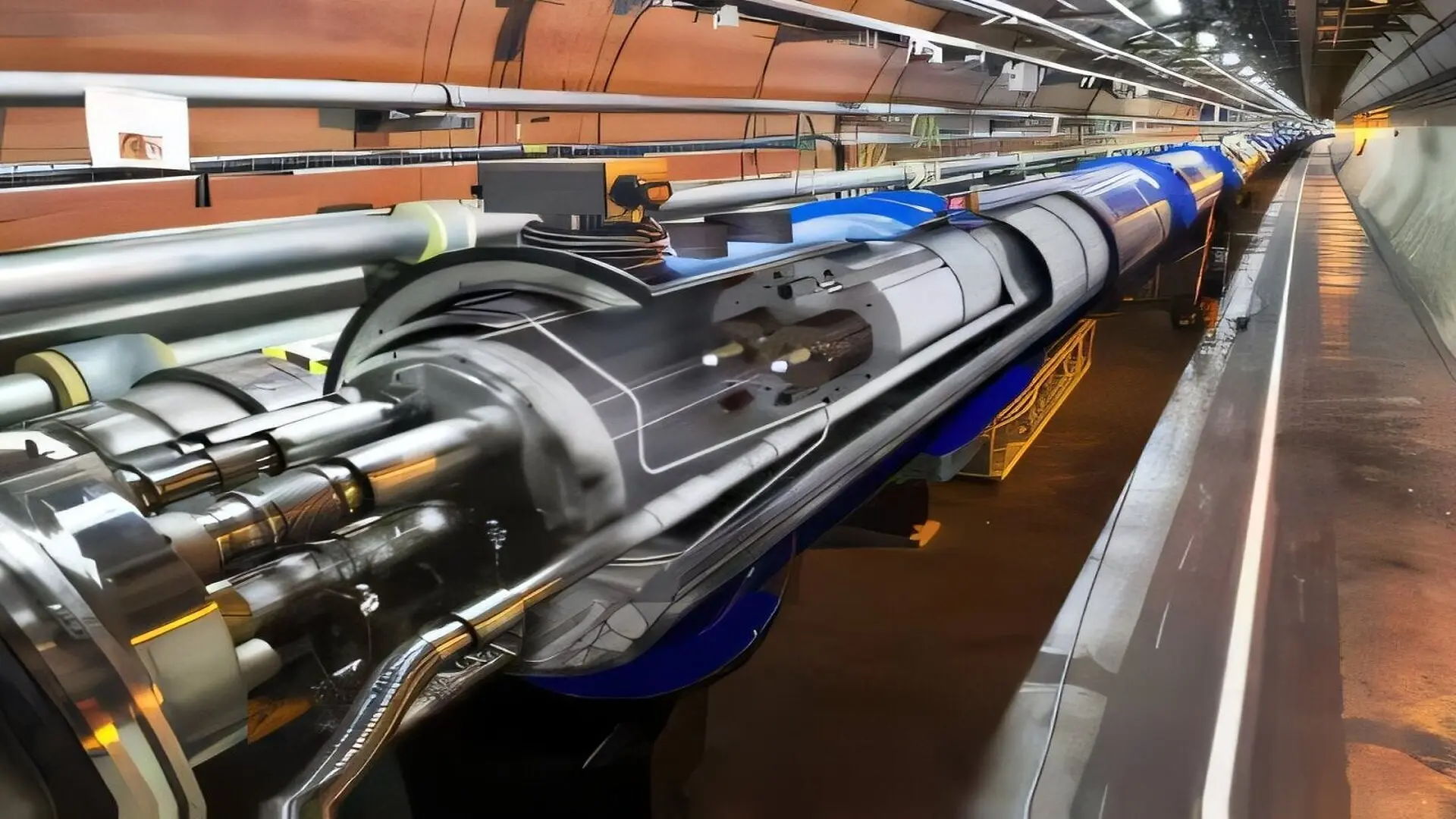
Quantum entanglement, once regarded as a theoretical curiosity, has been observed in one of the most extreme environments imaginable: the high-energy decays of Higgs bosons. Researchers working with the ATLAS experiment at CERN have uncovered evidence that pairs of Z bosons, produced during these fleeting particle decays, emerge with inextricably linked spin states.
This result, published in Physical Review Letters, marks a significant departure from traditional quantum experiments. While entanglement is typically demonstrated using stable, easily manipulated systems like trapped atoms or photons, the Z bosons involved in this study are massive, short-lived particles that vanish almost instantly after they are created.
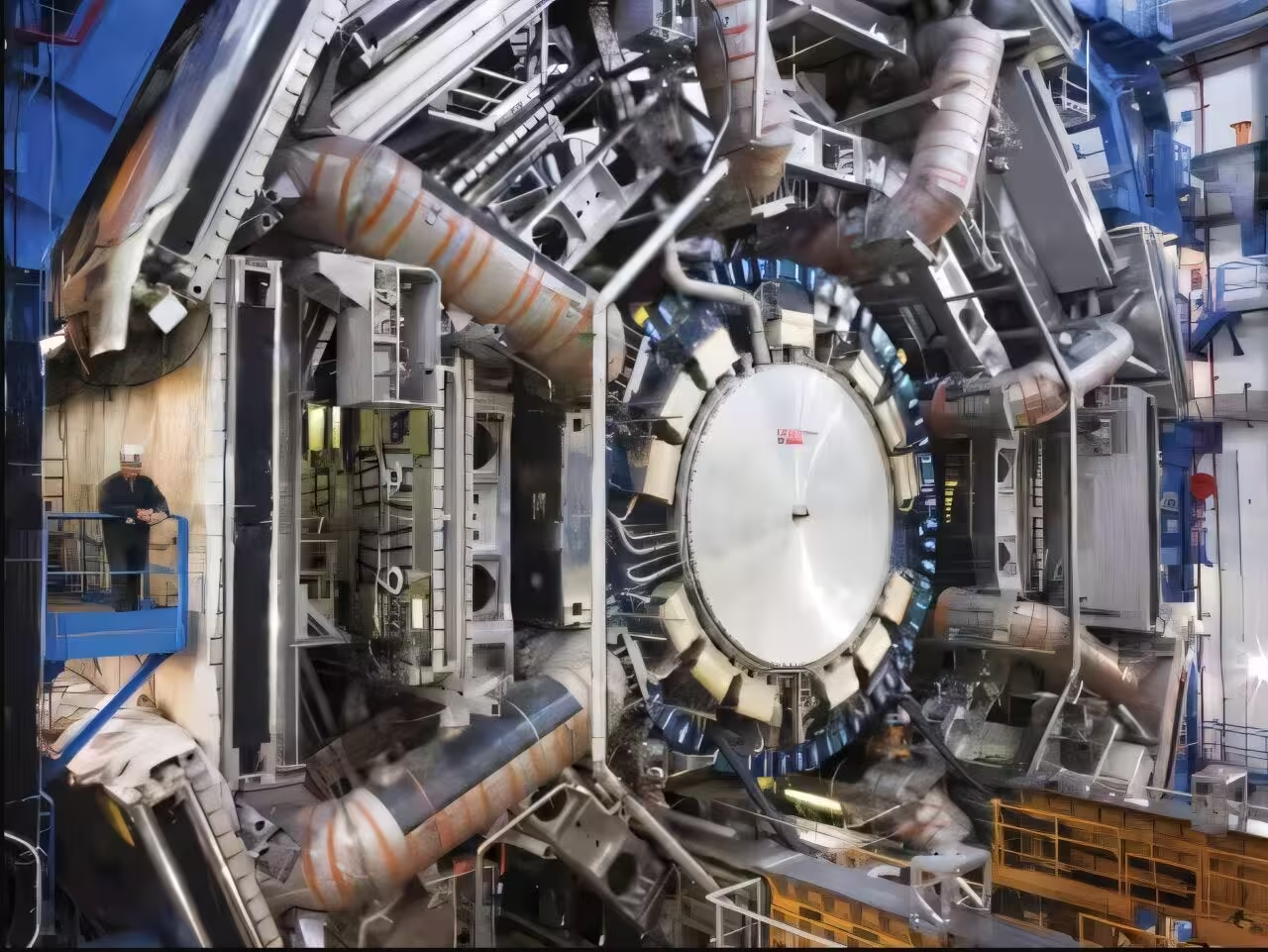
Pushing Quantum Mechanics to the Electroweak Limit
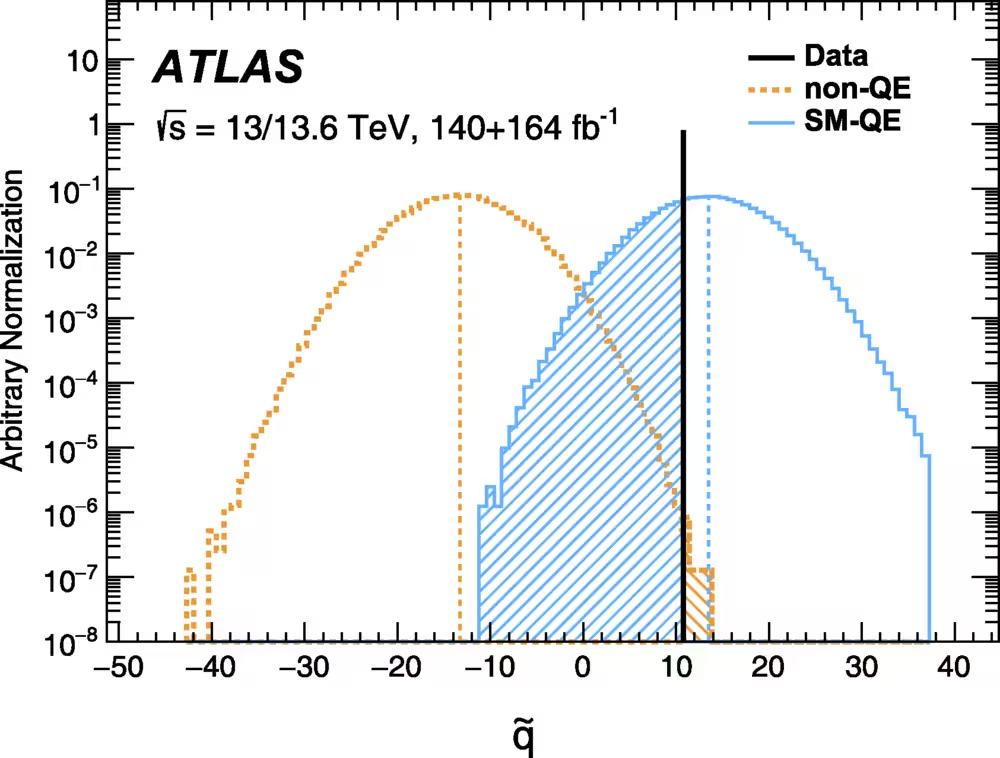
By analyzing data from proton-proton collisions conducted at 13 and 13.6 trillion electron volts at the Large Hadron Collider (LHC), the research team was able to probe the nature of quantum correlations at energy levels and distance scales vastly smaller than an atomic nucleus. The analysis successfully rejected a specific non-entangled state with a significance of 4.7 standard deviations, providing strong experimental backing for the behavior predicted by the Standard Model of particle physics.
According to Oxford physicist Alan Barr, these collider experiments serve as a unique laboratory. “Using particle colliders allows us to test quantum mechanics at energies a trillion times higher and over distances smaller than the size of the nucleus,” Barr noted. “This probes some of the extreme conditions where quantum mechanics might break down.”
Analyzing the Higgs Decay Chain
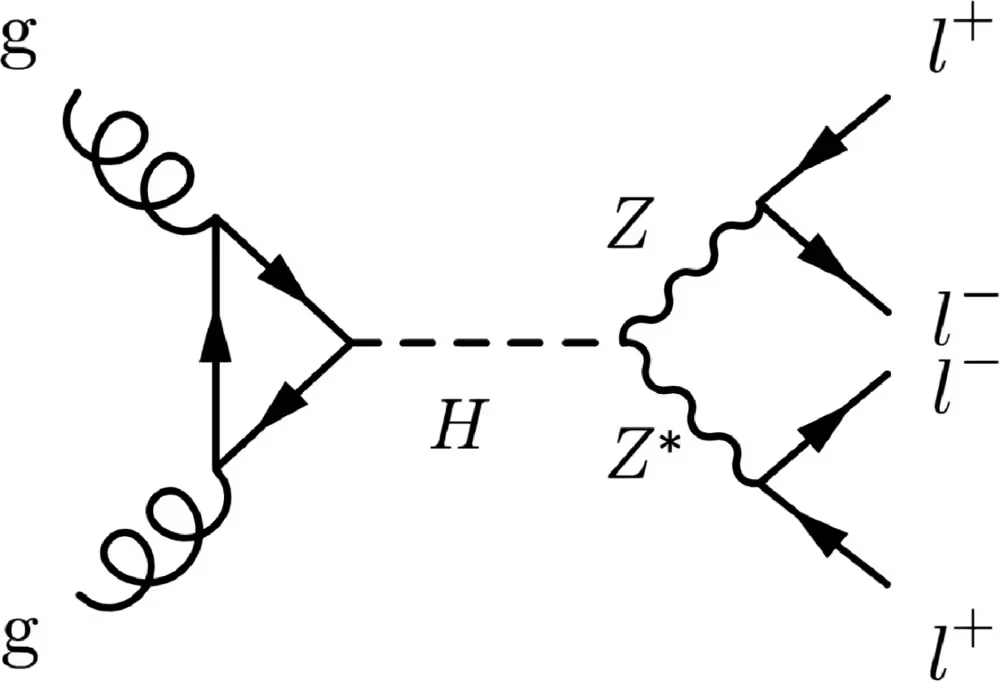
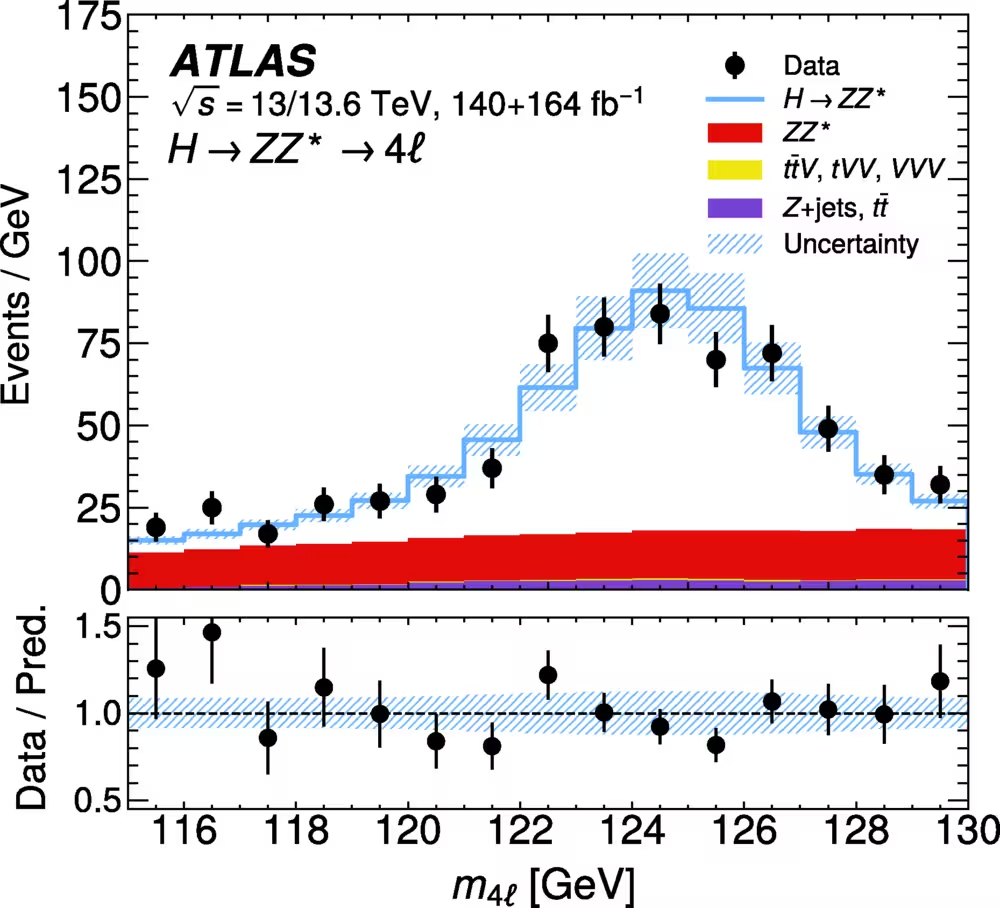
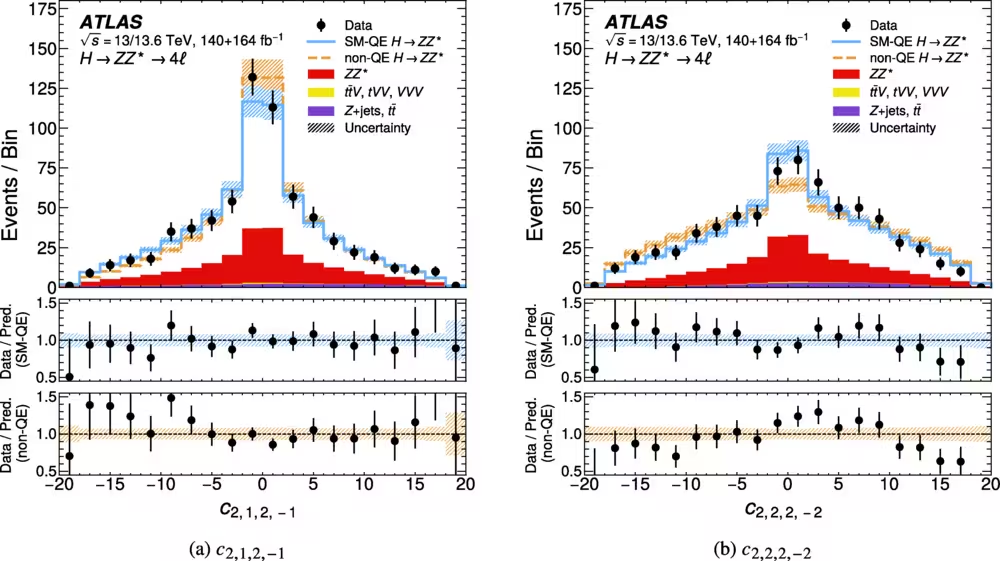
The experiment focused on the decay of a Higgs boson into a pair of Z bosons. Because the Higgs does not possess enough mass to generate two full-sized, on-shell Z bosons, at least one of the pair must exist in a virtual, off-shell state. Because these Z bosons decay into leptons almost immediately, researchers utilized the angular distribution of the resulting four-lepton products to reconstruct the spin states of the parent bosons.
This reconstruction relied on mapping the spin-density matrix of the pair. By examining the off-diagonal components of this matrix, physicists identified the tell-tale markers of quantum entanglement. The study compared the measured data against a non-entangled model where the bosons maintained independent longitudinal polarizations, ultimately finding that the Standard Model’s prediction of an entangled state provided a superior fit for the observed data.
Broadening the Scope of Collider Physics
This achievement follows a 2024 breakthrough where the ATLAS and CMS collaborations observed similar entanglement in top-quark pairs. By successfully extending these techniques to include massive spin-1 vector bosons, the field of high-energy physics is increasingly adopting quantum information science as a primary investigative tool.
Rather than merely measuring mass or momentum, quantum tomography allows scientists to characterize the underlying state of particle systems. This sensitivity offers a new path for detecting potential deviations from the Standard Model, which could point toward new physical laws or unknown particle couplings. As the High-Luminosity LHC prepares to increase the volume of collision data, researchers expect that entanglement measurements will move from experimental novelty to a precision tool for fundamental physics research.
Further Reading on Collider Quantum Studies
- Observation of quantum entanglement with top quarks at the ATLAS detector(Nature, 2024)
- Observation of quantum entanglement in top quark pair production in proton-proton collisions at √s = 13 TeV(Reports on Progress in Physics, 2024)
- Stringent bounds on HWW and HZZ anomalous couplings with quantum tomography at the LHC(Journal of High Energy Physics, 2023)
- Quantum frontiers in high energy physics(Science China Physics, Mechanics & Astronomy, 2025)
- Separability Criterion for Density Matrices(Physical Review Letters, 1996)
This article has been fact checked for accuracy, with information verified against reputable sources. Learn more about us and our editorial process.
Last reviewed on .
Article history
- Latest version
Reference(s)
- Aad, G.., et al. “Measurements of
- , et al. “Observation of quantum entanglement with top quarks at the ATLAS detector.” Nature, vol. 633, no. 8030, September 18, 2024, pp. 542-547. Springer Science and Business Media LLC, doi: 10.1038/s41586-024-07824-z. <https://doi.org/10.1038/s41586-024-07824-z>.
- CMS Collaboration, The. “Observation of quantum entanglement in top quark pair production in proton–proton collisions at
- Fabbrichesi, M.., et al. “Stringent bounds on HWW and HZZ anomalous couplings with quantum tomography at the LHC.” Journal of High Energy Physics, vol. 2023, no. 9, September 27, 2023 Springer Science and Business Media LLC, doi: 10.1007/JHEP09(2023)195. <https://doi.org/10.1007/JHEP09(2023)195>.
- Fang, Yaquan., et al. “Quantum frontiers in high energy physics.” Science China Physics, Mechanics & Astronomy, vol. 68, no. 6, April 15, 2025 Springer Science and Business Media LLC, doi: 10.1007/s11433-024-2635-4. <https://doi.org/10.1007/s11433-024-2635-4>.
- Peres, Asher. “Separability Criterion for Density Matrices.” Physical Review Letters, vol. 77, no. 8, August 19, 1996, pp. 1413-1415. American Physical Society (APS), doi: 10.1103/PhysRevLett.77.1413. <https://doi.org/10.1103/PhysRevLett.77.1413>.
Cite this page:
- Posted by Aisha Ahmed