New AI Method Slashes Ocean Simulation Memory Demands By Tenfold
Innovative pullback approximations allow researchers to train complex climate and ocean models up to five times faster without losing predictive accuracy.

A breakthrough in computational oceanography and atmospheric physics reveals how artificial intelligence models can be trained up to five times faster while slashing memory demands by an order of magnitude. Researchers addressing the severe computational bottlenecks of ocean and weather simulations have introduced innovative gradient approximation methods that maintain high accuracy without requiring exact mathematical steps at every single interval.
Modern weather forecasting and climate projections rely heavily on numerical simulations of fluid flows, but capturing tiny, chaotic turbulence eddies alongside large global ocean currents demands immense computing power. Researchers often couple physics-based equations with machine learning sub-models to account for unmeasured dynamics or system errors. Training these hybrid configurations online, where predictions unroll over time windows to minimize accumulated errors, requires calculating gradients across every time step using exact backpropagation techniques. This standard process forces computers to store massive computation graphs in memory, creating a severe barrier that has previously restricted scientists to coarse spatial resolutions and small geographic domains.
How New Approximation Techniques Outsmart Memory Limits
To overcome this computational wall, computer scientists Emilio González-Zamora, Pierre Tandeo, Laurent Debreu, and Said Ouala developed a novel framework of pullback approximation strategies that preserve long-range dependencies across the entire trajectory while locally simplifying mathematical operations. Instead of calculating exact sensitivity pullbacks at every discrete time step, the new approach computes exact values only at sparse anchor states placed at regular intervals.
Between these anchor points, the system utilizes one of two methods: a zero-order approximation that propagates sensitivities through the identity matrix, or a pullback reuse strategy that recycles frozen anchor Jacobians. By keeping the parameter pullback constant within each temporal chunk, the algorithm factorizes the gradient sum. This clever mathematical adjustment means the computer evaluates parameter updates just once per chunk rather than once per time step.
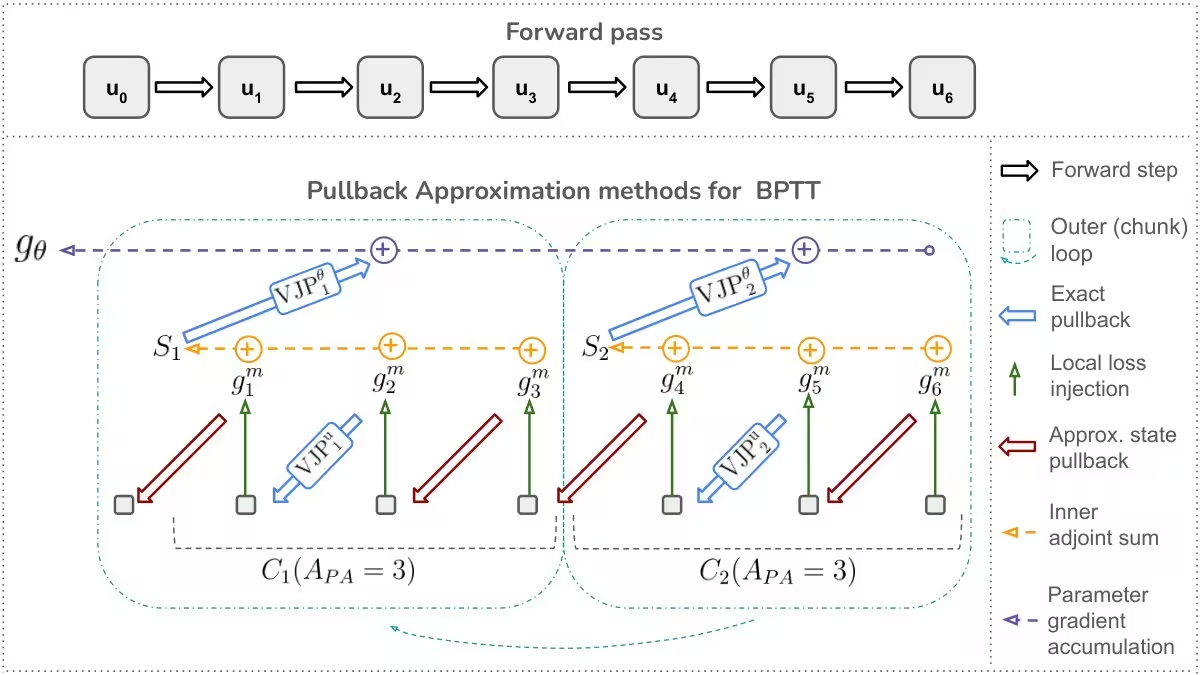
The study, published on the arXiv preprint server, evaluated these approximation techniques across three distinct physical systems of increasing complexity. These ranged from the chaotic Lorenz-63 atmospheric convection model to a two-dimensional quasi-geostrophic turbulence large-eddy simulation and a semi-realistic multilayer ocean configuration modeling the western Mediterranean Sea.
Testing Chaotic Systems and Ocean Circulation
In tests involving the chaotic Lorenz-63 system, the approximation strategies successfully trained multilayer perceptron networks to recover the characteristic two-lobed geometry of the Lorenz attractor. Despite following slightly different optimization pathways than exact backpropagation, the approximate gradients provided more than enough information for the optimizer to learn correct physical corrections.
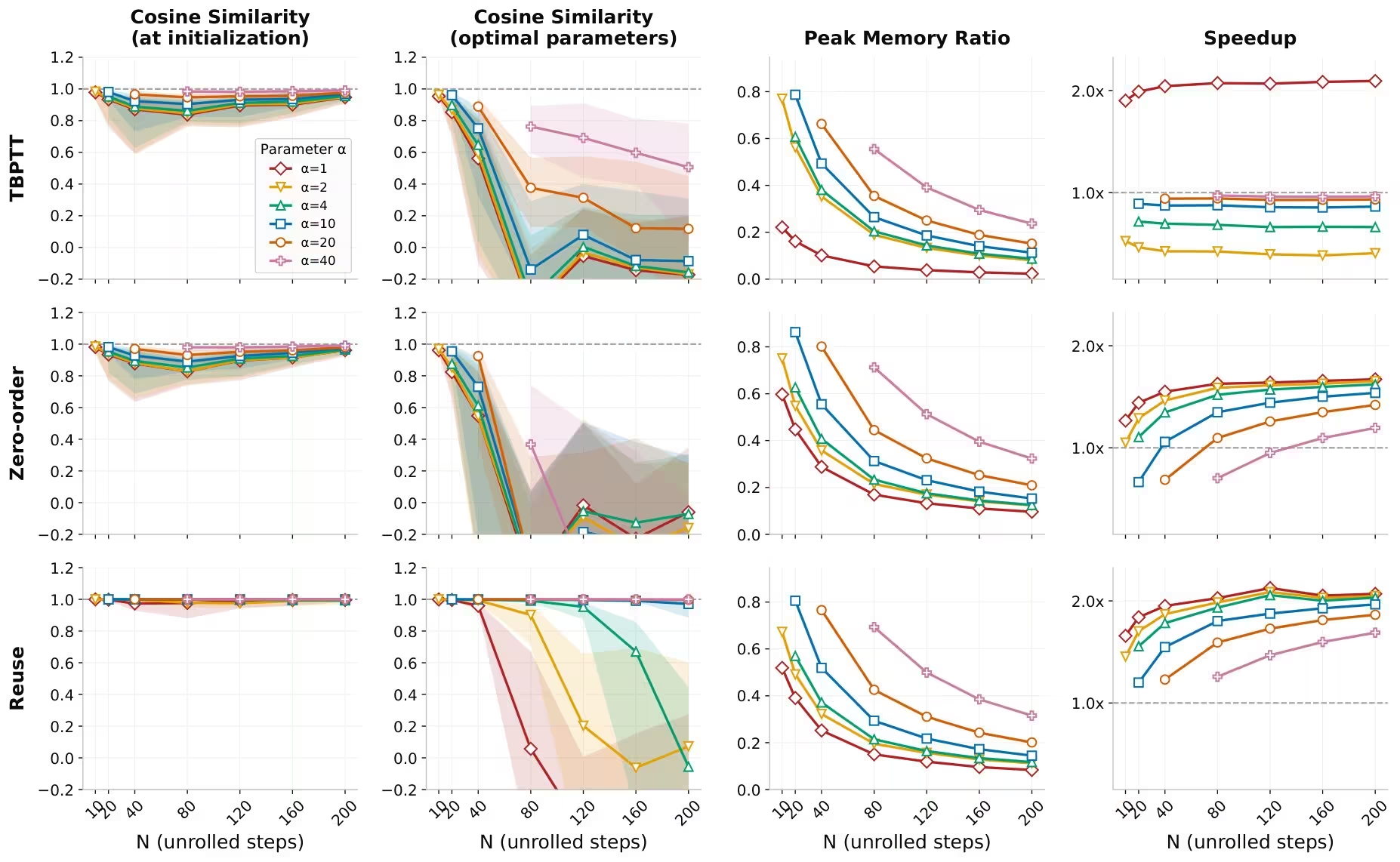
When scaled up to complex ocean dynamics over a 1,550 by 1,270 kilometer western Mediterranean domain discretized on a 310 by 254 grid, the benefits became even more pronounced. The zero-order and pullback reuse methods reduced peak memory consumption by roughly ten times compared to exact methods. Furthermore, the zero-order approach delivered a fourfold to fivefold execution speedup over standard backpropagation while maintaining a directional gradient agreement above 0.7.
Long-term simulations running over five-year periods demonstrated that hybrid models trained using these approximated gradients successfully recovered eddy kinetic energy and sustained coherent vorticity structures matching ground-truth dynamics. Whether calibrating a single physical coefficient like bottom drag or training a convolutional neural network with 1,456 parameters, the approximate backward passes proved robust enough for stable online learning.
The authors note that while these approximation strategies introduce a mild gradient bias, they effectively eliminate the memory explosion that plagues high-resolution geophysical modeling. By cutting down expensive pullback constructions, this computational advance opens the door for researchers to train complex hybrid ocean and weather models across longer temporal horizons and finer spatial grids than previously possible.
The study was posted to the arXiv preprint server on November 19, 2026.
This article has been fact checked for accuracy, with information verified against reputable sources. Learn more about us and our editorial process.
Last reviewed on .
Article history
- Latest version
Reference(s)
- González-Zamora, Emilio. “Approximate Adjoint Models for Memory and Compute-Efficient Online Learning of Hybrid Models.” arXiv.org <http://arxiv.org/abs/2611.26095v1>.
Cite this page:
- Posted by Divya Iyer