Astronomers Discover Rare Planet Born From the Ashes of a Dead Star
Astronomers have discovered a giant planet that may have formed from the debris left behind by its host star’s dramatic death.
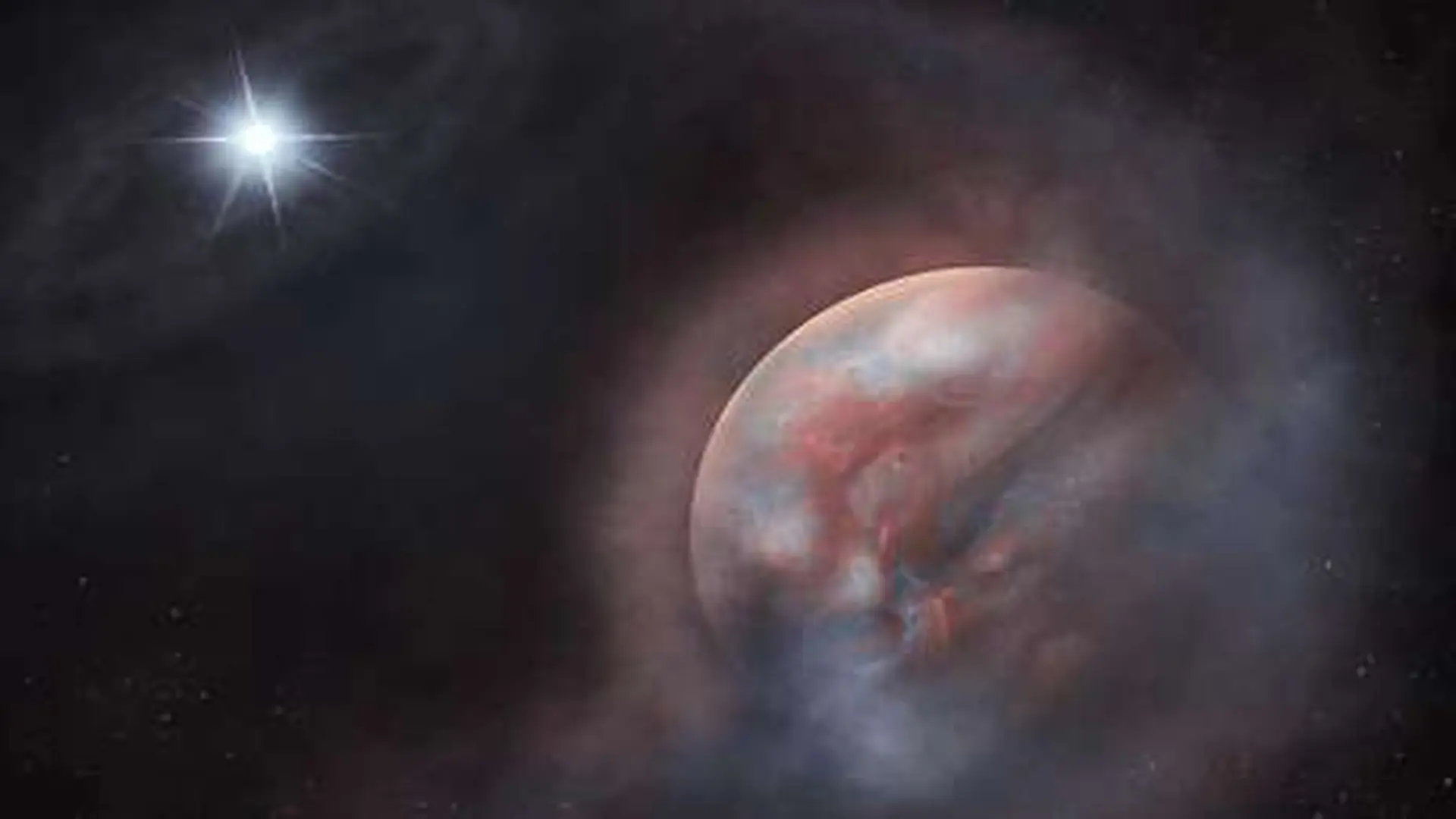
Astronomers have identified a potential candidate for a rare “second-generation” planet, a world that appears to have coalesced from the debris of a dead star. The findings, published in Nature Astronomy, suggest that planetary systems are not always permanently destroyed when their host stars reach the end of their life cycles, but can instead undergo a process of rebirth.
Evidence of a Post-Stellar Origin
The system centers on a white dwarf known as HS 0209+0832. Unlike typical planetary systems that form from the primordial gas and dust accompanying a star’s birth, this suspected giant planet likely formed long after the host star exhausted its fuel, shed its outer layers, and collapsed into a dense white dwarf. While astronomers have previously theorized about the existence of planets around pulsars, detecting such a companion orbiting a white dwarf indicates that this phenomenon may occur across a broader range of stellar remnants.
Jamie Williams, the study’s lead author and a researcher at the University of Warwick, noted the rarity of the discovery. “Second-generation planets are worlds that form out of the material a star casts off as it dies,” Williams said. “They’re incredibly rare, and finding one around a white dwarf was completely unexpected. It’s a bit like finding a planet that has risen from the ashes of the very star it once orbited.”
Chemical Signatures of Nucleosynthesis
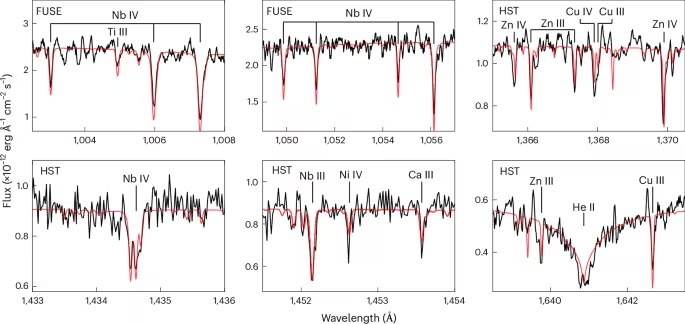
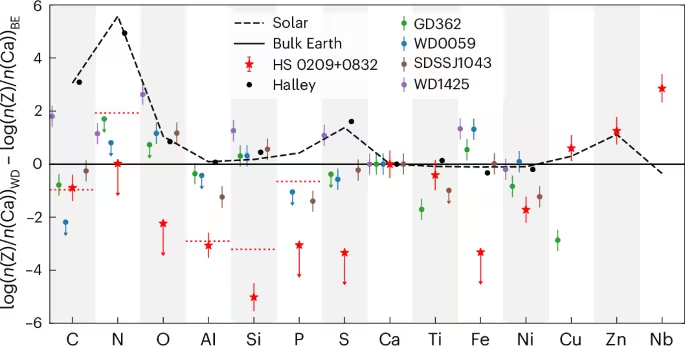
The breakthrough in identifying this world came from analyzing the atmosphere of the white dwarf. White dwarfs possess intense gravity, pulling in surrounding material and effectively “polluting” their surfaces with elements that provide a snapshot of the objects in their vicinity. While most white dwarfs show traces of rocky, Earth-like debris, HS 0209+0832 displays an unusual abundance of heavy elements, including zinc, copper, and niobium.
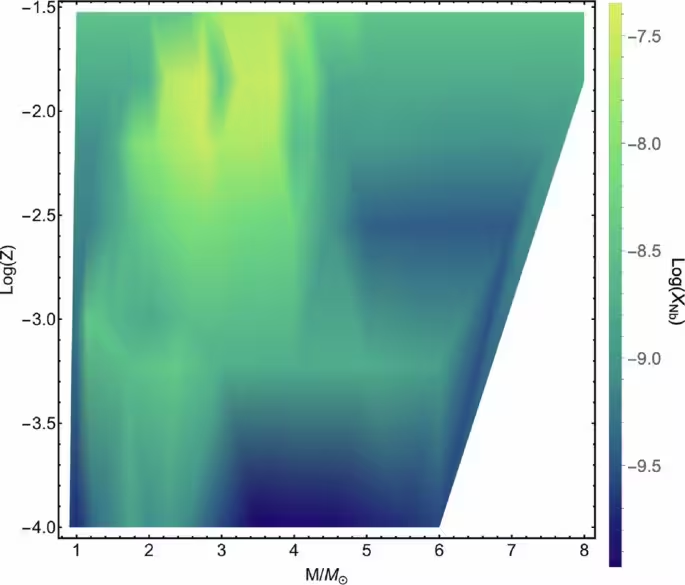
Niobium, in particular, was detected at concentrations more than 1,000 times higher than those found in the Sun. Dr. Nicholas Stone of the University of Wisconsin–Madison explained that this specific chemical profile serves as a fingerprint for nuclear processing. “This pattern of elements is a telltale sign of the ‘s-process,’ a nuclear reaction that builds heavy elements inside dying stars during their bloated red giant phase,” Stone said. “It’s a chemical signature no ordinary, ‘first-generation’ planet should carry, which told us that this new planet was something different.”
The Role of Binary Interactions
The formation of a planet around a lone, dying star is physically challenging because ejected matter typically disperses into space. The researchers propose that a companion star likely played a critical role in this system. By exerting gravitational influence, a partner star could have redirected the expelled stellar material, forcing it to accumulate into a disk rather than dissipating. This stable disk would then provide the necessary environment for the material to cool and coalesce into a new planetary body.
This model implies that multi-star systems may be uniquely equipped to facilitate these “second-generation” planetary cycles. Rather than merely disrupting existing orbits, the complex interactions within binary systems may create the specific conditions required for planets to re-emerge from the remnants of their predecessors.
Observations Reveal a Close-In Orbit
Data from NASA’s Transiting Exoplanet Survey Satellite (TESS) provided additional support for the hypothesis. The telescope recorded a faint, rhythmic dimming of the white dwarf occurring every 4.4 days, suggesting the presence of a massive, Jupiter-sized object in a tight orbit. This proximity likely creates a destructive cycle: the white dwarf’s radiation may be actively stripping away the planet’s atmosphere, fueling the atmospheric contamination observed by the researchers. This dynamic link provides a rare opportunity for astronomers to study the composition of a planet that would otherwise be impossible to image directly, essentially “sampling” the world as it is consumed by its host.
This article has been fact checked for accuracy, with information verified against reputable sources. Learn more about us and our editorial process.
Last reviewed on .
Article history
- Latest version
Reference(s)
- Williams, Jamie. “Discovery of a second-generation planet candidate accreting onto a white dwarf - Nature Astronomy.”, October 5, 2026, pp. 1-9. Nature, doi: 10.1038/s41550-026-02983-7. <https://www.nature.com/articles/s41550-026-02983-7>.
Cite this page:
- Posted by Bilal Abbasi