Shape-Memory Net Could Reuse Itself to Capture Multiple Space Debris Pieces
A reusable shape‑shifting membrane could let spacecraft capture multiple hazardous orbital debris pieces, offering a new, efficient cleanup method.

Researchers in China have unveiled a concept for a reusable net‑membrane apparatus that could snag hazardous space junk, pull it down from orbit, and then reset for another capture. Described in Space: Science & Technology, the design integrates a pliable multilayer sheet, built‑in electronics, power cells, and shape‑memory alloys to address the long‑standing problem of seizing uncontrolled objects without spawning additional fragments.
A Reusable Net May Redefine the Cost Structure of Orbital Cleanup
The near‑Earth environment is increasingly cluttered with defunct satellites, spent rocket stages, collision fragments and other anthropogenic items traveling at orbital velocities. Even a modest piece of debris can threaten an operational spacecraft, making active removal a priority for engineers worldwide.
Existing proposals often trade off precision, complexity and expense. Robotic manipulators can grapple objects, but they rely on predictable approach vectors and can shatter delicate targets, creating more debris. Laser‑based ideas avoid contact but demand high power levels and detailed knowledge of a target’s dynamics and material properties.
Nets present an alternative: a sufficiently large mesh can engulf an irregular or tumbling body, eliminating the need for a precise attachment point. This makes them attractive for seizing non‑cooperative debris that was never designed for servicing or removal.
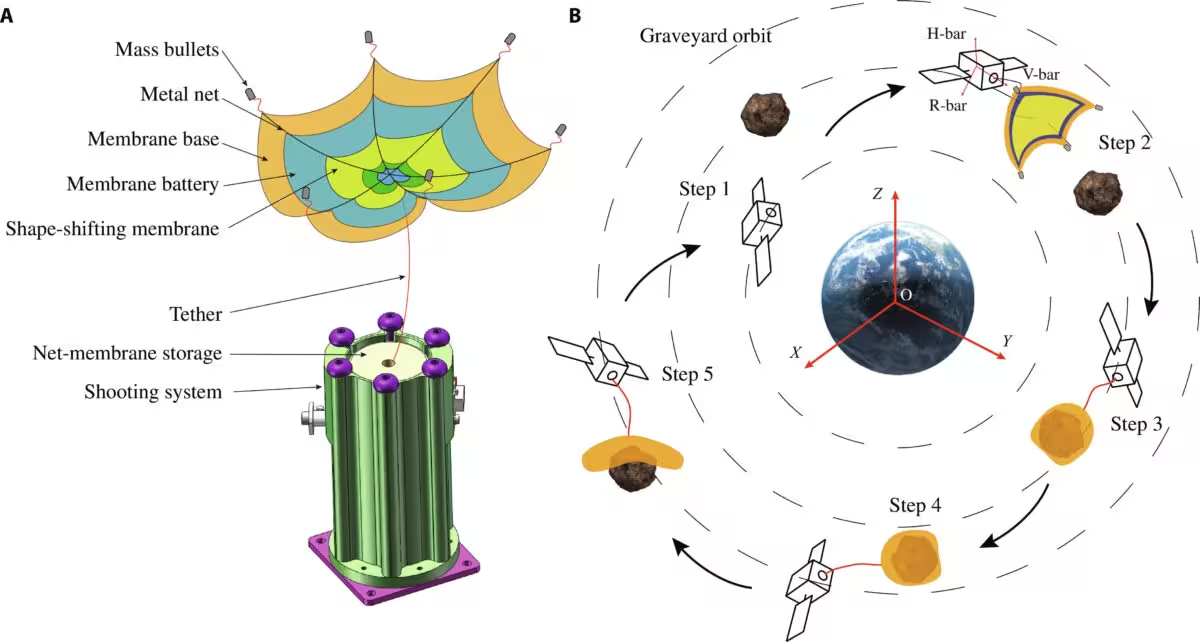
Traditional space nets are difficult to steer once deployed and are generally intended for single‑use missions. Consequently, a dedicated spacecraft would be required for each piece of debris, a model that could become prohibitively costly when thousands of objects need attention.
The new proposal seeks to break that limitation by engineering a capture sheet that can unfurl, wrap around a target, retain its shape during retrieval, and then collapse back into the service vehicle.
Mechanics of the Shape‑Changing Net‑Membrane
The scheme starts with a chaser satellite that maneuvers close to the target. Once the optimal standoff is reached, the spacecraft releases four projectile‑like deployment masses, each tethered to a corner of the folded sheet.
Simulations indicate that launching the projectiles at roughly 30 degrees from the line of sight provides the right outward momentum to unfold the membrane and sweep it around the object, allowing the net to encircle the debris rather than relying on a single contact point.
What sets this design apart is its internal architecture. The pliable sheet incorporates multiple functional strata, including electronics, battery modules, and shape‑memory alloys (SMAs). These alloys can recover a preset shape when activated, offering a potential means to control the membrane after it has been deployed.
After the debris is enclosed, the embedded SMAs would help the net maintain its configuration, securing the object for transport. The chaser could then guide the captured mass toward a lower orbit or a trajectory that ensures a controlled atmospheric re‑entry.
The most ambitious aspect of the concept is the ability of the net to retract, fold, and re‑integrate into the chaser after each capture. In theory, the same satellite could repeat the operation multiple times, dramatically improving the economics of active debris removal.
Cost efficiency hinges on how many objects a single platform can address. A reusable capture system could convert one‑off missions into multi‑target campaigns, although significant engineering hurdles remain before the idea can be validated in space.
Simulation Insights Highlight a Tight Deployment Window
The study, published in Space: Science & Technology, relies on numerical modeling to explore how the membrane behaves during unfolding, stretching, bending, shearing, and encircling of a target.
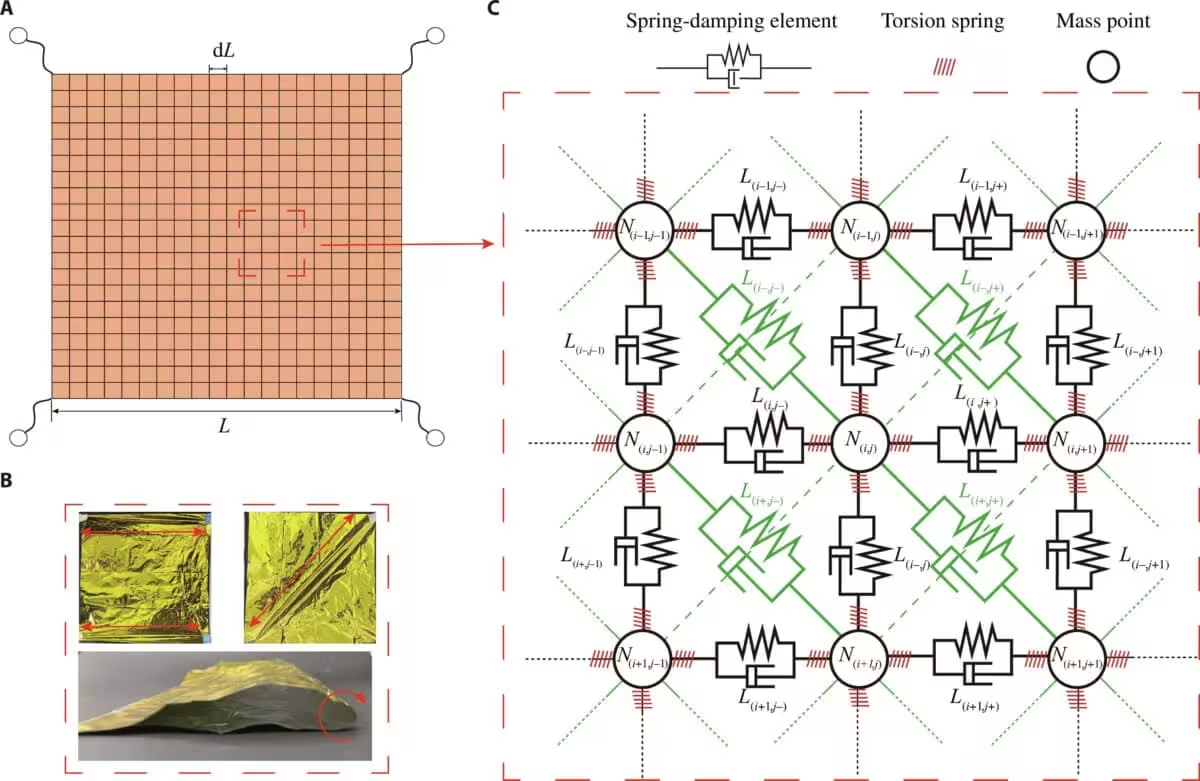
Instead of conventional finite element analysis (FEA), the authors employed the Multiparticle Method (MPM), representing the sheet as a lattice of discrete masses linked by spring‑damper elements. This approach captures complex deformations while reducing computational load, a crucial factor for a structure that must deploy rapidly, absorb high loads, and potentially return to its original shape.
The simulations identified a deployment angle of 30 degrees as optimal under the modeled conditions. Equally critical was the standoff distance at release. At a separation of 2 meters (about 6.6 feet), the membrane experienced peak forces near 3,374 newtons. Extending the distance to 3 meters (roughly 9.8 feet) cut those forces roughly in half.
A one‑meter shift in launch distance therefore alters structural demands dramatically, influencing navigation tolerances, material choices and safety margins for any future mission.
Thin‑Film Challenges: A 10‑Micron Sheet Under Extreme Loads
The proposed membrane is only about 10 microns thick, yet the model predicts it must endure forces of several thousand newtons during deployment. Achieving such strength in a sheet of that caliber requires a composite of layers that each serve distinct functions—energy storage, electronic control, structural flexibility, and shape recovery.
While individual components may meet performance targets, integrating them into a durable whole that can survive repeated high‑stress cycles, temperature swings, radiation exposure and mechanical fatigue is a formidable materials‑engineering problem.
The simulations also omitted environmental effects such as solar radiation pressure and atmospheric drag, both of which can influence orbital dynamics depending on altitude, geometry and surface properties. These forces could complicate both the net’s deployment and the chaser’s ability to maneuver a captured object.
Moreover, real debris presents unpredictable challenges: rapid tumble rates, protruding components, sharp edges, or fragile structures that might fragment upon contact. A net that succeeds with a dormant satellite may behave very differently when faced with a shattered rocket stage or a partially broken spacecraft.
Consequently, the findings demonstrate theoretical feasibility rather than operational readiness, underscoring the need for further experimental validation before the concept can be deployed in orbit.
This article has been fact checked for accuracy, with information verified against reputable sources. Learn more about us and our editorial process.
Last reviewed on .
Article history
- Latest version
Reference(s)
- Yu, Shuangqing., et al. “Dynamic Modeling of a Net-Membrane Capture System with Combined Deformation for Space Debris Removal.” Space: Science & Technology, November 4, 2025 American Association for the Advancement of Science (AAAS), doi: 10.34133/space.0340. <https://spj.science.org/doi/10.34133/space.0340>.
Cite this page:
- Posted by Zara Tariq