TESS Finds Hidden Jupiter‑Mass Planet 40,000 Light‑Years Away Using Einstein Microlensing
Scientists used a novel technique on NASA data to uncover a previously hidden planet, revealing a world once thought out of reach.
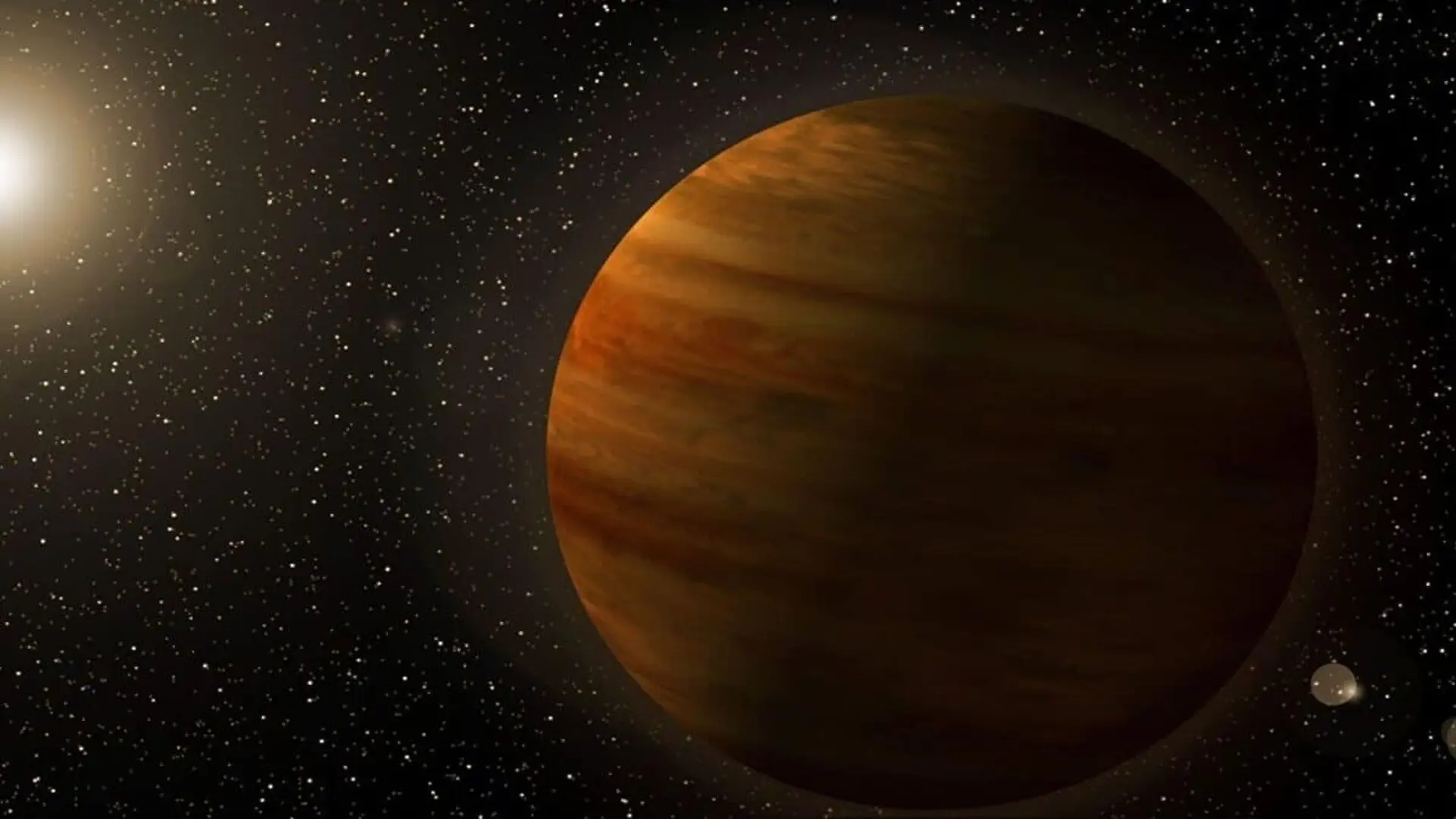
NASA’s TESS (Transiting Exoplanet Survey Satellite) has identified a distant exoplanet hidden in its archive by exploiting a detection technique grounded in Einstein’s general relativity. The planet, designated Gaia23bra b, emerged through a gravitational‑microlensing signal—a method that may reveal worlds overlooked by conventional planet searches.
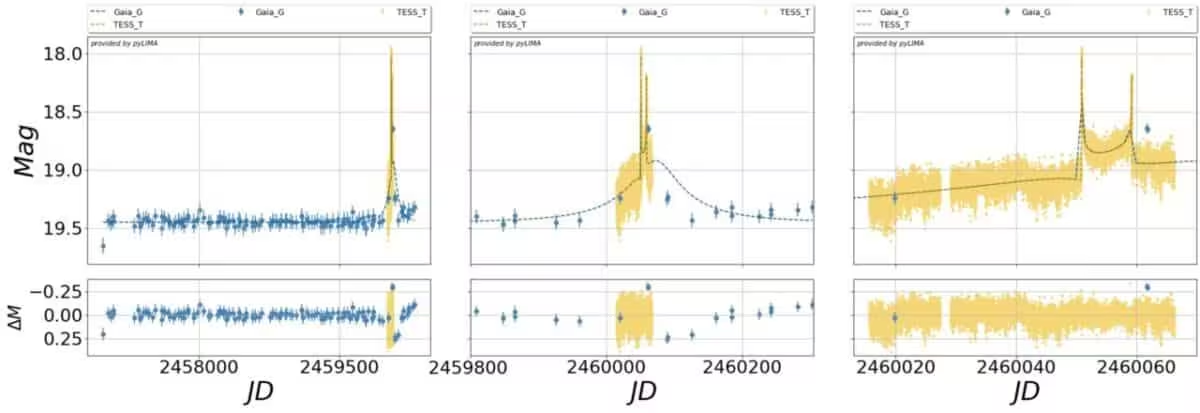
Unlike the transit approach for which TESS was built, researchers spotted Gaia23bra b by detecting a fleeting brightening of a background star caused by the planet’s gravitational field acting as a tiny lens.
The signal first surfaced in 2023 via data from the retired Gaia space telescope. A microlensing episode was recorded when the planetary system passed between Earth and a distant star, producing a subtle but measurable amplification of the star’s light.
Gaia23bra b is markedly different from the close‑in worlds that dominate TESS’s catalog. The giant has roughly 1.6 times Jupiter’s mass and circles an orange‑dwarf star at a distance comparable to Jupiter’s orbit around the Sun. Its host is about 80 percent the size of the Sun and lies roughly 40,000 light‑years away.
Relativistic Lens Uncovers a Distant World
The finding, detailed on July 1 in The Astrophysical Journal Letters, hinges on gravitational microlensing, a phenomenon rooted in the way mass curves spacetime. In 1915, Albert Einstein’stheory demonstrated that gravity bends the path of light.
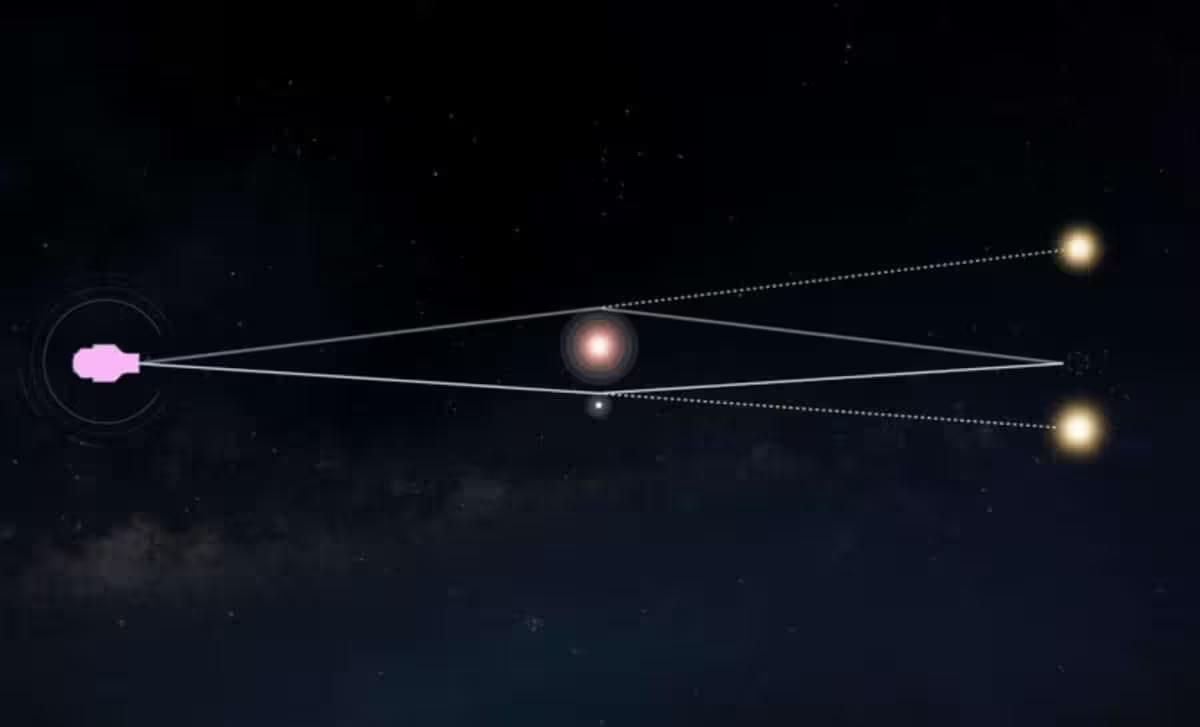
When light from a distant source skirts a massive object, the curvature can amplify the background source’s brightness, effectively acting as a natural telescope. This effect has been employed to study far‑off galaxies whose light is magnified by foreground galaxy clusters. Though planets are far less massive, they can still generate a miniature version of this lensing known as microlensing.
“When TESS launched, no one expected it to ever be capable of finding this kind of planet,” said Diana Dragomir of the University of New Mexico. “The discovery implies that there are probably other so‑called microlensing planets hiding in TESS’s data that we hadn’t previously thought to look for.”
Microlensing Provides an Alternative Planet‑Hunting Path
The detection of Gaia23bra b illustrates how microlensing can supplement the transit technique that dominates most exoplanet missions. While transits require a planet to pass directly in front of its star, microlensing depends on a brief geometric alignment among a planetary system, Earth, and a distant background star.
This alignment permits astronomers to probe planets on wide orbits. Gaia23bra b, for example, would have been a difficult target for TESS’s standard pipeline because of its remote orbit and great distance.
Of the roughly 6,000 confirmed exoplanets, only about 5 percent have been identified via microlensing, whereas roughly 75 percent stem from transit detections.
Mallory Harris of the University of New Mexico explained that microlensing can access planets with larger separations, even those residing in the habitable zones of their stars. She added that such events are singular, meaning the same alignment cannot be revisited once it fades.
Joint Mission Strategy Expands the Exoplanet Census
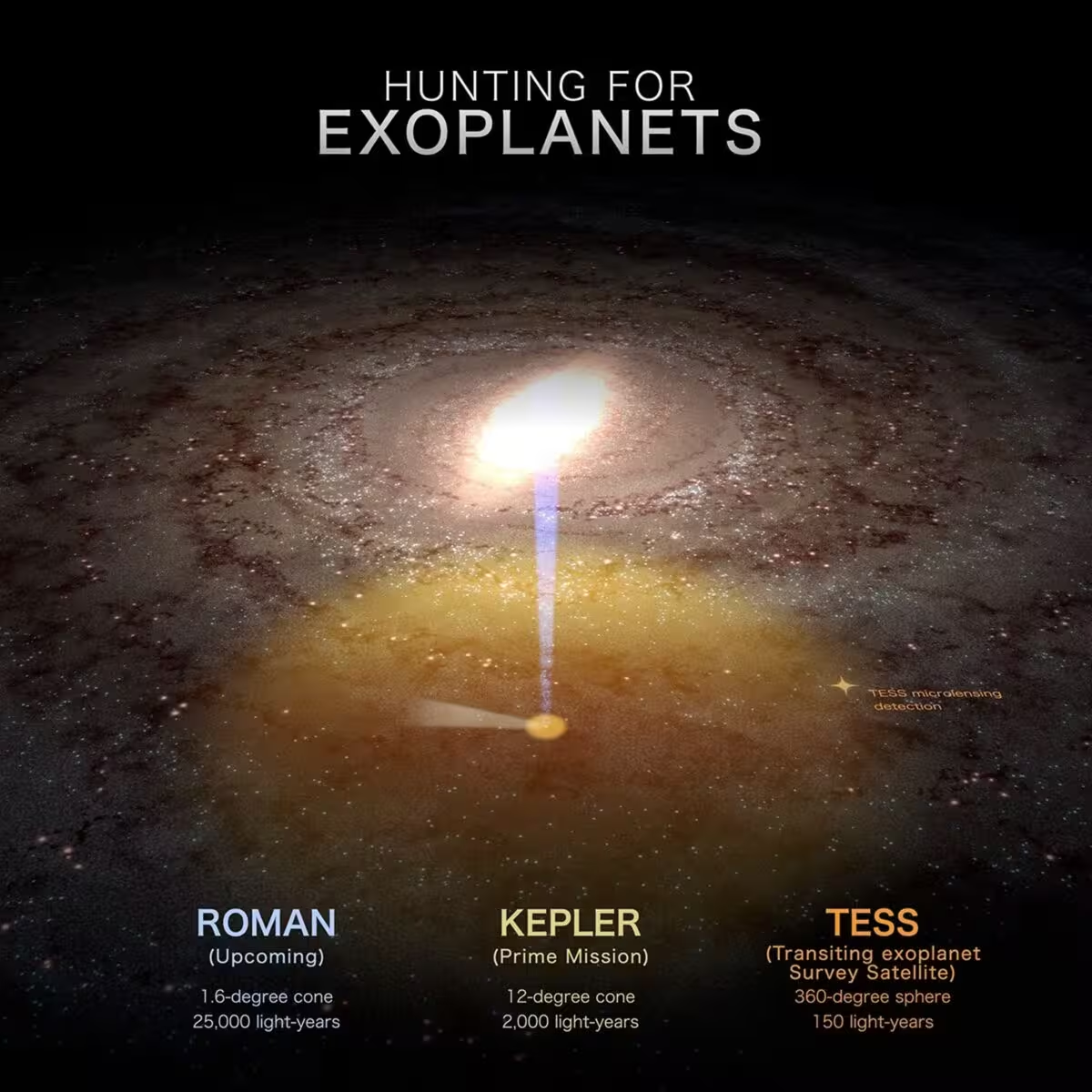
The result also showcases the benefit of merging data from multiple space observatories. TESS offers a preview of the microlensing program planned for NASA’s upcoming Nancy Grace Roman Space Telescope.
Roman will target the dense stellar fields at the heart of the Milky Way, where microlensing events are most frequent. NASA forecasts that the mission could uncover around 1,000 microlensing planets alongside roughly 100,000 transiting worlds detected through other techniques.
Michael Fausnaugh of Texas Tech University noted that TESS’s rapid sky coverage complements Roman’s deeper, longer‑term survey, enabling scientists to map planetary systems across diverse galactic environments.
“The TESS mission uniquely provides these rapid observations for stars in other parts of the galaxy, and pairing the two opens up prospects for understanding planet formation in a diverse population of stars.”
This article has been fact checked for accuracy, with information verified against reputable sources. Learn more about us and our editorial process.
Last reviewed on .
Article history
- Latest version
Reference(s)
- Harris, Mallory., et al. “TESS’s First Bound Microlensing Planet—A Binary Microlensing Event Revealing a Planetary Companion toward the Galactic Plane.” The Astrophysical Journal Letters, vol. 1005, no. 2, July 1, 2026, pp. L33 American Astronomical Society, doi: 10.3847/2041-8213/ae7a50. <https://iopscience.iop.org/article/10.3847/2041-8213/ae7a50>.
- “Theory of relativity | Physics | Research Starters | EBSCO Research.” EBSCO <https://www.ebsco.com/research-starters/physics/theory-relativity>.
- “Diana Dragomir | Exoplanetologist.” <https://exoplanets.unm.edu/>.
- “Mallory Harris :: UNM Department of Physics and Astronomy | The University of New Mexico.” <https://physics.unm.edu/people/graduate/mallory-harris.html>.
- Kazmierczak, Jeanette. “TESS (Transiting Exoplanet Survey Satellite) - NASA Science.”, April 22, 2025 NASA <https://science.nasa.gov/mission/tess/>.
- “Michael Fausnaugh.” <https://faus.science/>.
Cite this page:
- Posted by Farah Siddiqui