Swift and AI Spot Wandering Supermassive Black Hole Devouring Star Far From Galactic Core
Rare star destruction reveals a wandering supermassive black hole, offering a fresh method to hunt these elusive cosmic giants.
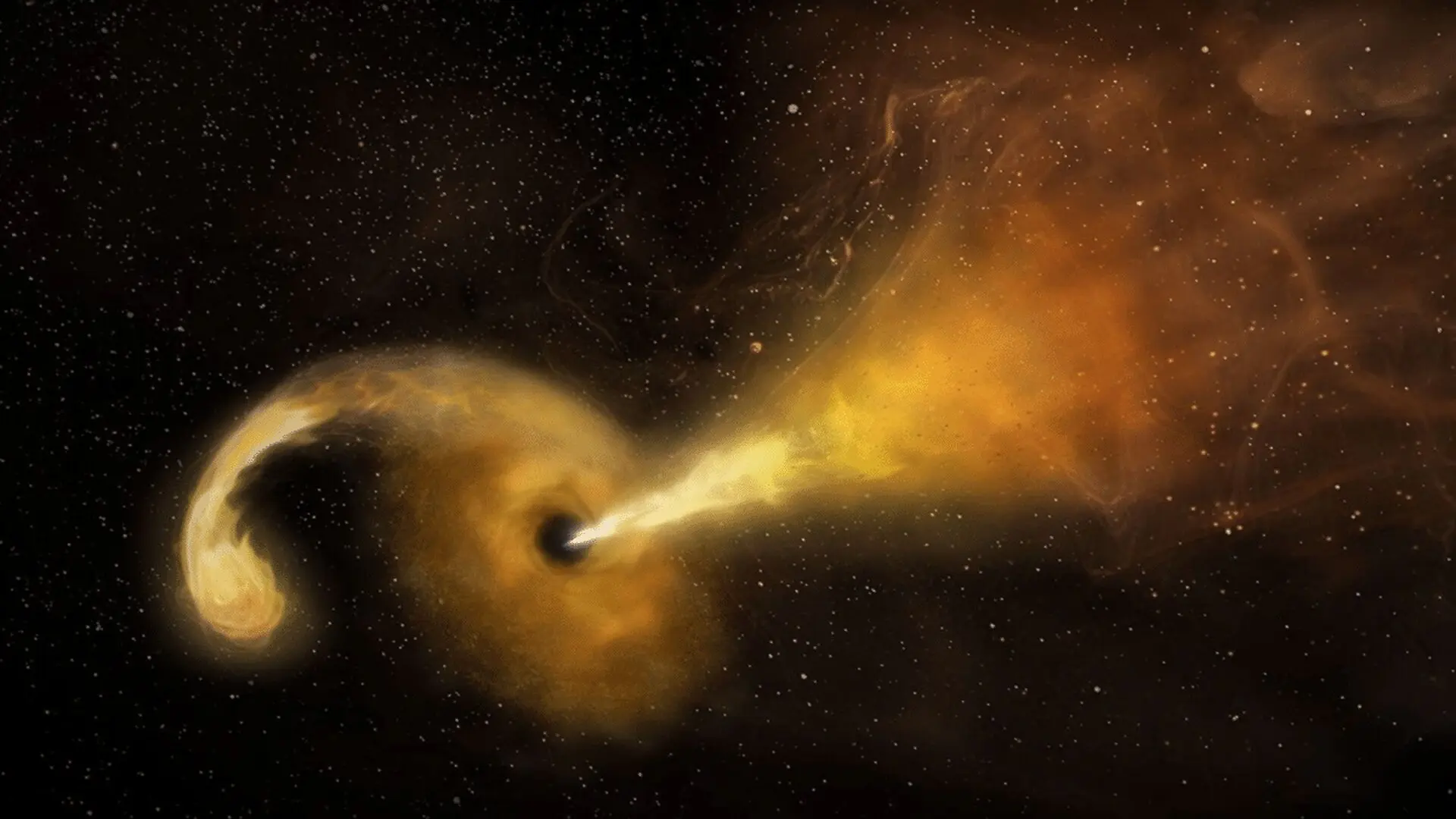
Astronomers using NASA’s Swift Observatory together with a worldwide network of telescopes have recorded a brilliant outburst that marks a supermassive black hole shredding a star far from the center of its host galaxy. The detection offers solid proof that these colossal objects can wander through galactic outskirts rather than staying fixed at their nuclei.
A Distant Star’s Demise Exposes a Roaming Black Hole
For decades, researchers have assumed that virtually every massive galaxy contains a supermassive black hole weighing millions to billions of solar masses, typically nestled at the galactic core where its gravity steers the host’s evolution. Because dormant black holes emit virtually no light, finding one away from the nucleus has been exceedingly difficult—until a tidal disruption event (TDE) lit up the hidden monster.
The flash originated on the outer edge of galaxy WISEA J014656.04‑152214.7, situated about 750 million light‑years away in the constellation Cetus. Its peripheral location hinted that the responsible black hole was not anchored in the galactic center, raising the prospect of finally spotting a wandering supermassive black hole.
“We were looking for these star‑shredding events as a way to find otherwise invisible supermassive black holes wandering away from the galactic cores where they usually reside,” said Robert Stein, a research fellow at The University of Maryland, College Park and NASA’s Goddard Space Flight Center in Greenbelt, Maryland. “With this discovery, which is one of just a couple that have been confirmed so far, we’ve validated a new technique and can use it to hunt for more.”
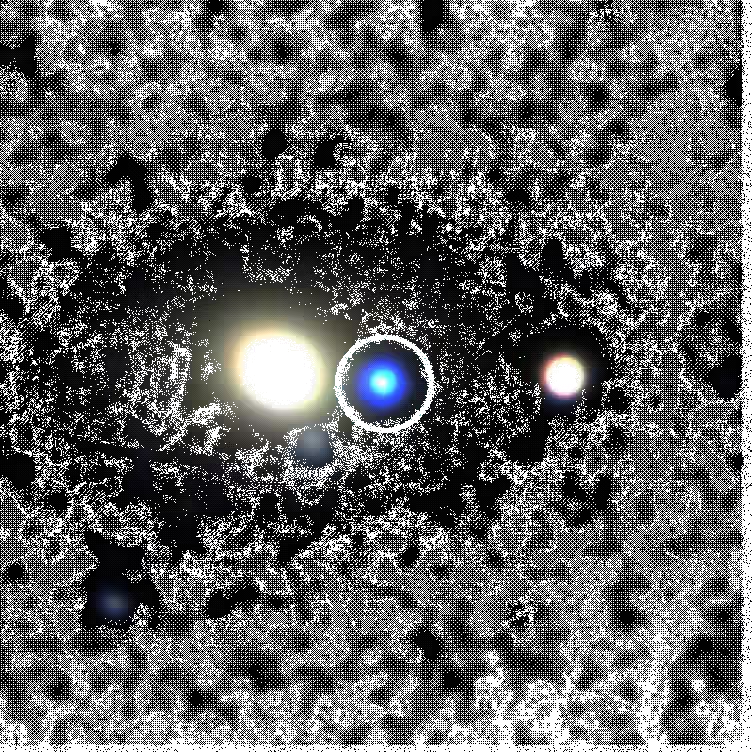
Machine‑Learning Filter Isolates the Unusual Flash
The alert emerged from the Zwicky Transient Facility (ZTF), a survey that patrols the night sky nightly and flags roughly half a million transient signals. Sifting through such a volume by hand is impractical, so the team deployed an advanced artificial‑intelligence algorithm trained to spot the distinctive signature of rare astrophysical phenomena. Amid the torrent of detections, the AI singled out a flare that resembled a tidal disruption event despite its unexpected position on the galaxy’s outskirts.
“Out of the half million flashes ZTF detects each night, our new artificial intelligence algorithm automatically recognized a flare that looked a lot like a tidal disruption event, despite its unusual location in the outskirts of a galaxy,” Stein said.
Coordinated Observations Verify a Tidal Disruption
To rule out alternative explanations such as a supernova or activity from an active galactic nucleus, the team gathered data from a suite of ground‑based telescopes and space‑borne instruments covering optical, ultraviolet, X‑ray, and spectroscopic regimes. Spectra revealed the chemical fingerprints expected when a star is stretched and ripped apart by extreme tidal forces, while the multi‑wavelength light curve matched the theoretical profile of a TDE.
“The combination of all this data helped us rule out other explanations and confidently say it’s a tidal disruption event, despite its strange location,” said Jonathan Carney, a doctoral student at the University of North Carolina at Chapel Hill, who obtained the first spectra supporting the flare’s interpretation.
Next‑Generation Surveys Promise a Surge in Rogue Black Hole Finds
Only a few wandering supermassive black holes have been confirmed to date, but scientists suspect many more remain hidden, displaced by past galaxy mergers or lingering from ancient dynamical interactions. Determining their prevalence could reshape theories of galaxy assembly and black‑hole growth.
“Further discoveries could reveal the origin of this apparent ‘orphan’ black hole,” Stein said. “The key science question we want to answer is: How common are wandering black holes?”
The forthcoming Vera C. Rubin Observatory will repeatedly scan vast swaths of sky with unprecedented depth, while NASA’s Nancy Grace Roman Space Telescope will extend the search to far‑more distant epochs. As Carney notes, “Rubin’s wide, deep surveys will reveal a much larger sample of tidal disruption events than current observatories are capable of collecting, including ones that are off‑center. And Roman’s space‑based surveys will extend the current search zone by seeing ones that are farther away, looking back through 9 billion years of cosmic history.”
Together, these next‑generation facilities are poised to transform isolated detections into a systematic field of black‑hole astronomy, uncovering how many of these massive wanderers silently traverse the cosmos.
This article has been fact checked for accuracy, with information verified against reputable sources. Learn more about us and our editorial process.
Last reviewed on .
Article history
- Latest version
Cite this page:
- Posted by Karan Das