Inside Curiosity’s Cracked Wheel Reveals Why the Rover Still Thrives on Mars
NASA’s latest image spotlights Curiosity’s battered wheel, underscoring the rover’s enduring resilience after years of Martian exploration.
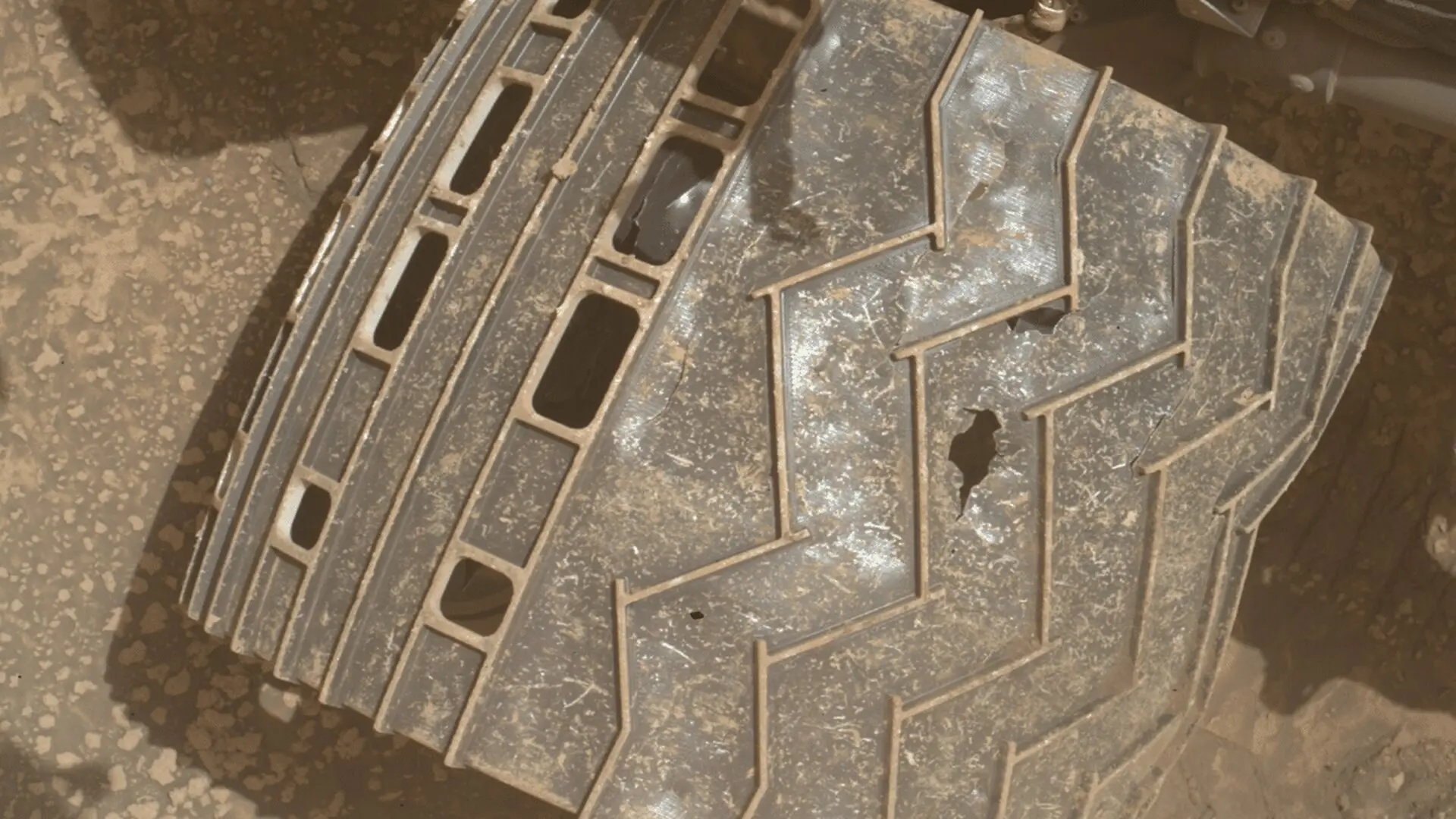
More than ten years after its launch, NASA’s Curiosity rover continues to trek across the stark Martian terrain, gathering data that reshapes our view of the Red Planet. A freshly released NASA photograph showcases one of the rover’s most recognizable blemishes—a heavily fractured aluminum wheel—yet the wheel still rolls forward despite relentless exposure to jagged rocks. The picture underscores the remarkable endurance of a machine that has become a benchmark for planetary exploration.
New NASA Snapshot Highlights a Wheel Still in Service
The latest image captures Curiosity as it inspects its own wheel while navigating within Gale Crater. Since its 2011 design, the aluminum wheels have logged thousands of traverses over terrain far more abrasive than anticipated, with sharp stones gouging the metal and forming the characteristic fissures seen today. Internal reinforcement and a suite of cautious driving techniques keep the wheel operational despite the visible wear.
Engineering Strategies Keep the Mission on Track
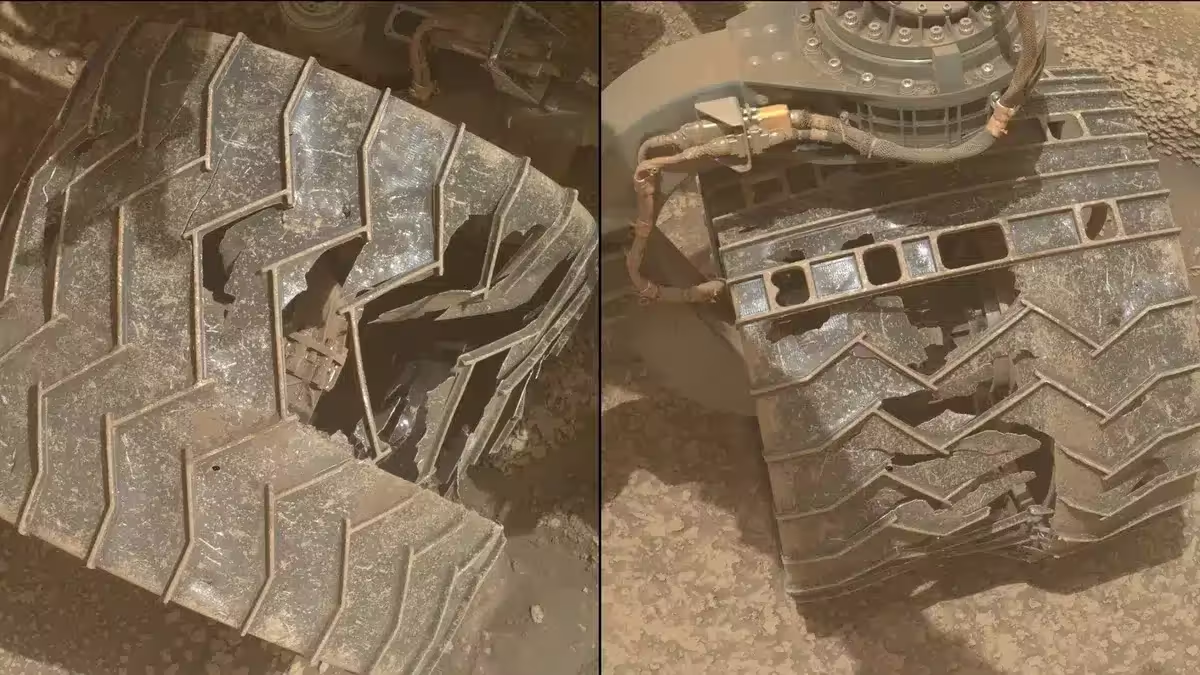
Mission specialists continuously refine navigation routes to limit further degradation while still targeting fresh scientific locales. Each assessment of wheel condition informs adjustments that balance the rover’s exploratory ambitions against the need to preserve its hardware. The visible scars serve as a tangible reminder of the hostile environment faced by autonomous explorers millions of miles from Earth.
A Decade‑Long Journey Across Diverse Martian Landscapes
Since touching down in August 2012, Curiosity has covered extensive ground, scaling the lower flanks of Mount Sharp and probing rock formations that preserve clues to the planet’s ancient climate. Early traverses revealed unexpectedly razor‑sharp stones that accelerated wheel damage well beyond the original forecasts, prompting a shift toward safer pathways whenever feasible, without sacrificing key scientific objectives.
Software upgrades and refined operational protocols have reduced unnecessary strain while allowing the rover to reach critical sites. Despite the ongoing deterioration of its wheels, Curiosity has continued to deliver landmark findings—evidence of ancient lakes, detection of organic compounds, and environments that could have once hosted microbial life. The wear on its wheels has become part of the narrative rather than a hindrance.
Continuous Health Monitoring Extends Rover Longevity
NASA emphasizes routine imaging of the rover’s wheels as a core component of its long‑term health‑check regimen. Engineers track the evolution of cracks and holes to fine‑tune future travel plans, striking a balance between scientific pursuits and the preservation of the spacecraft for as many additional years as possible.
The recent photograph offers a fresh data point, confirming that the wheel, though visibly scarred, still supports standard operations on the Martian surface. Such surveillance is vital for extending the service life of robotic explorers in environments where on‑site repairs are impossible, and the accumulated knowledge will shape the design of next‑generation rovers destined for Mars.
A Single Wheel Symbolizes the Broader Tale of Mars Exploration
Beyond its visual impact, the cracked wheel encapsulates the challenges of planetary science: each discovery carries the cost of operating in one of the Solar System’s most unforgiving settings. Curiosity keeps climbing, drilling, and sending data home even as the hardware bears the marks of nearly fourteen years on Mars.
The distinction between superficial damage and mission‑critical failure highlights how deliberate engineering can sustain a spacecraft well beyond its projected lifespan. As NASA readies upcoming robotic and crewed missions to the Red Planet, the insights gained from Curiosity’s endurance will be integral to building machines capable of enduring even longer voyages across the Martian landscape. The worn wheel stands as a testament to perseverance, ingenuity, and the profound achievements made possible through sustained exploration.
This article has been fact checked for accuracy, with information verified against reputable sources. Learn more about us and our editorial process.
Last reviewed on .
Article history
- Latest version
Reference(s)
- “Sol 4963: Mars Hand Lens Imager (MAHLI) – NASA Mars Exploration.” NASA Mars Exploration <https://mars.nasa.gov/raw_images/1617663/?site=msl>.
Cite this page:
- Posted by Karan Das