Andromeda’s Star Birth Slows Dramatically: Is Tiny Companion M32 the Culprit
Hubble study of millions of Andromeda stars reveals a mysterious, unexpected change spreading across its spiral disk.
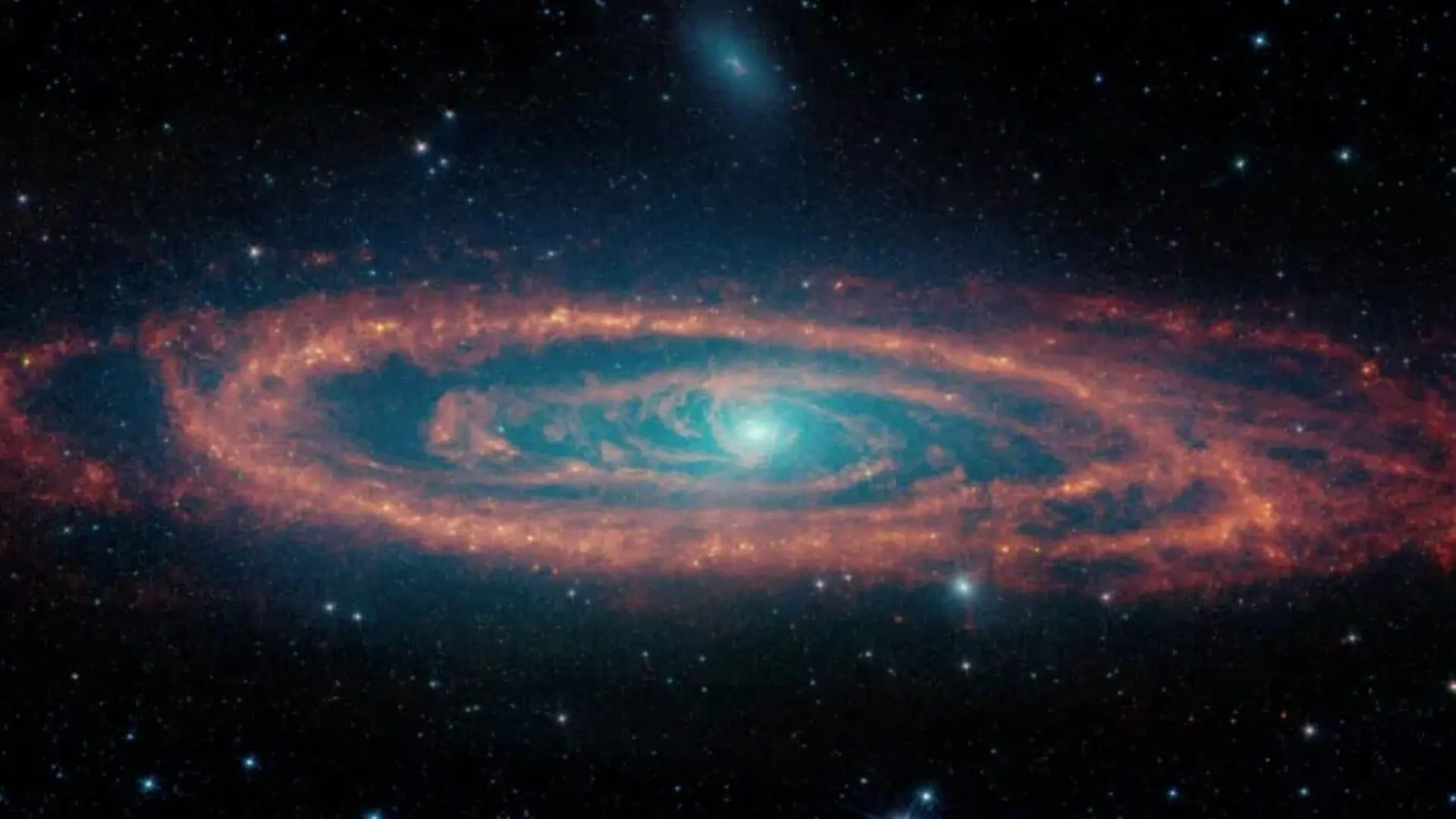
A comprehensive analysis of NASA’s Hubble Space Telescope data shows that the Andromeda galaxy has been steadily losing its ability to form new stars over the last half‑billion years, with the most pronounced slowdown occurring in the past few tens of millions of years.
Situated roughly 2.5 million light‑years away, Andromeda’s proximity enables astronomers to resolve individual stars across much of its disk, turning the galaxy into a natural laboratory for tracing the evolution of stellar populations on galactic scales.
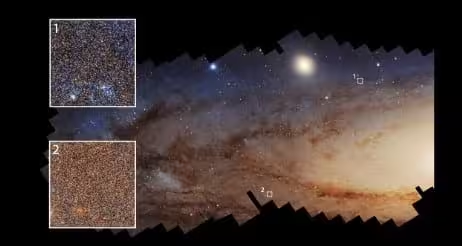
The findings, published in The Astrophysical Journal, draw on two extensive Hubble campaigns—the Panchromatic Hubble Andromeda Treasury (PHAT) and its southern counterpart (PHAST). Together they provide coverage of about two‑thirds of Andromeda’s visible disk and contain photometric measurements for close to 200 million stars.
Because a star’s colour encodes its age, the researchers used the contrast between hot, blue objects (signatures of recent star birth) and cooler, redder ones (tracers of older generations) to reconstruct the galaxy’s star‑formation timeline.
Hubble Survey Reveals Shifts in Andromeda’s Star Population
To map recent activity, the team sliced the galaxy’s plane into thousands of cells each roughly 300 light‑years on a side, then evaluated the proportion of blue versus red stars within every segment. The analysis highlighted regions still glowing with youthful, massive stars and identified zones where the stellar population had grown older.
“We need to measure the individual stars because they are the fossil record of the galaxy’s formation,” Ben Williams of the University of Washington told Daily Galaxy. He added, “Hubble is the only telescope that can give you high enough spatial resolution over a large enough area to be able to do that in Andromeda.”
“We need to measure the individual stars because they are the fossil record of the galaxy’s formation,” Williams said. He added that: “Hubble is the only telescope that can give you high enough spatial resolution over a large enough area to be able to do that in Andromeda.”
Earlier work had identified a major star‑formation burst roughly two billion years ago, likely sparked by a galactic encounter. The new study concentrates on the more subtle, long‑term decline that followed that event.
Gradual Decline in Star Birth Follows Past Burst
The authors estimate that Andromeda was producing stars at a rate of about one solar mass per year 500 million years ago. By the time 40 million years had elapsed, that pace had dropped to roughly half, and today the galaxy forms stars at only one‑fifth of the Sun’s mass each year.
Most of the recent stellar production appears to be confined to a ring roughly 32,000 light‑years from the galactic centre. A reduction in activity within this ring accounts for a large share of the overall slowdown.
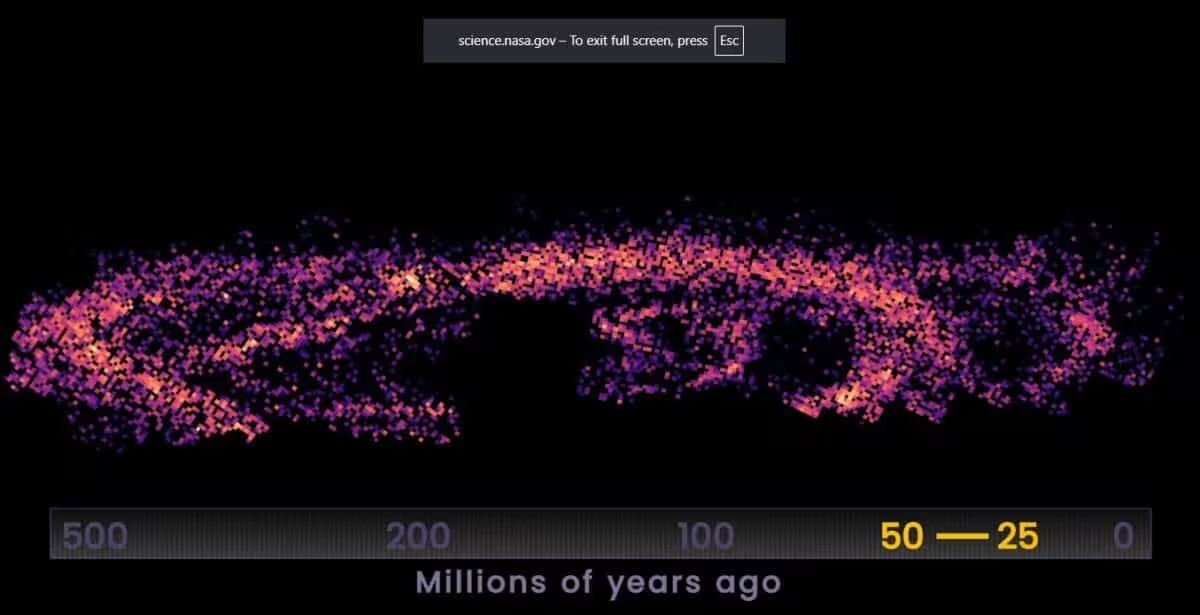
The decline does not appear to stem from a sudden loss of the gas required for star formation; instead, the data suggest a progressive tapering after the galaxy’s more vigorous epoch.
“It’s just like after running a marathon, sometimes you’ve got to take a bit of a breather,” said Tobin Wainer, lead author of the study from the University of Washington, describing the galaxy’s reduced activity.
Assessing M32’s Role in Andromeda’s Recent Star Formation Drop
The team also investigated whether the dwarf companion Messier 32 could be linked to the observed slowdown. Seen in projection, M32 lies about 16,000 light‑years from Andromeda’s main disk, though its true three‑dimensional separation remains uncertain.
Using PHAST observations of the southern portion of Andromeda, the researchers identified sectors adjacent to M32 that exhibit noticeably weaker star‑formation signatures compared with more distant regions.
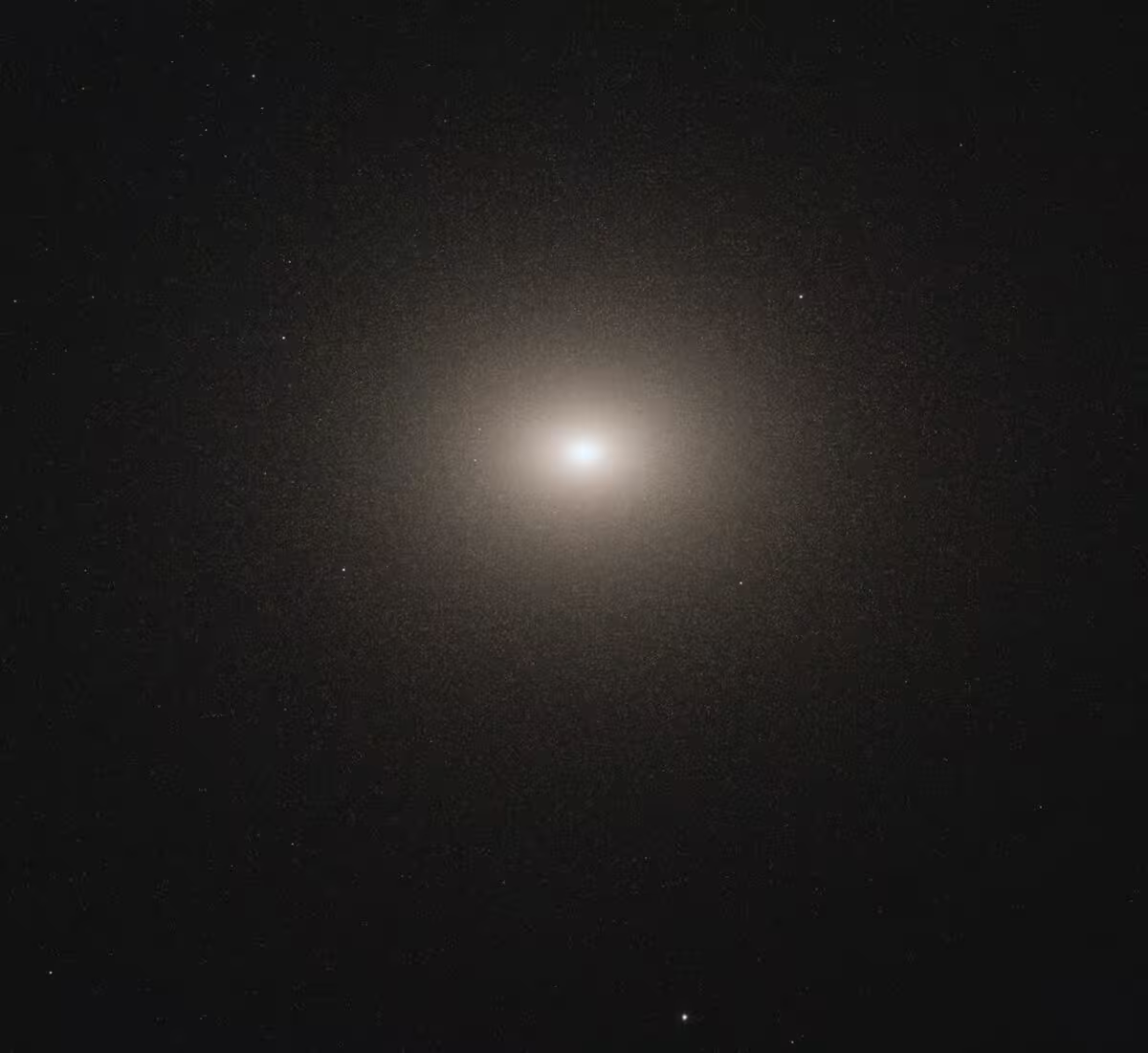
The reduction in star formation appears to have begun roughly 60 million years ago, a timeline that could correspond to a past interaction between the two galaxies.
“One of the major motivations for this program was to probe potential interactions between M32 and Andromeda’s disk,” said Zhuo Chen, co‑author of the study at the University of Washington.
While a definitive causal link remains unproven, the proximity of M32 makes it a plausible candidate for influencing Andromeda’s recent star‑formation history. “It’s right there, and it’s definitely the most likely suspect,” Wainer noted.
Future work will combine the extensive Hubble archive with ground‑based observations, and the upcoming Nancy Grace Roman Space Telescope is slated to probe Andromeda’s disk and halo in greater detail.
“There’s a strong scientific value to this archival data. Andromeda is important because it’s a neighbor that is close enough that we can see it in great detail while also getting a global perspective,” the study’s co‑author, Raja Guha‑Thakurta of the University of California, Santa Cruz, explained.
This article has been fact checked for accuracy, with information verified against reputable sources. Learn more about us and our editorial process.
Last reviewed on .
Article history
- Latest version
Reference(s)
- “Tobin Wainer | Department of Astronomy | University of Washington.” <https://astro.washington.edu/people/tobin-wainer>.
- “Zhuo Chen | Department of Astronomy | University of Washington.” <https://astro.washington.edu/people/zhuo-chen>.
Cite this page:
- Posted by Karan Das