Astronomers Baffled as Ordinary Space Explosion Suddenly Brightens Weeks Later
An ordinary space explosion has taken a mysterious turn, with new research suggesting the event may hide something far more extraordinary than expected.

Astronomers have uncovered the true, violent nature of a cosmic explosion that initially appeared to be a mundane event. Designated GRB 260310A, the blast was first detected on March 10, 2026, by NASA’s Fermi Gamma-ray Space Telescope. While its opening act—a 53-second flash of gamma rays—seemed modest, the aftermath revealed a high-energy phenomenon that ranks among the most luminous events observed in the last two decades.
An international research team, led by the ERC-funded BHianca group at the University of Rome Tor Vergata, published their findings in The Astrophysical Journal Letters. The data suggests that Earth’s perspective on the event may have masked its true intensity, hiding a massive, high-speed jet of radiation from direct view.
An Anomalous Afterglow
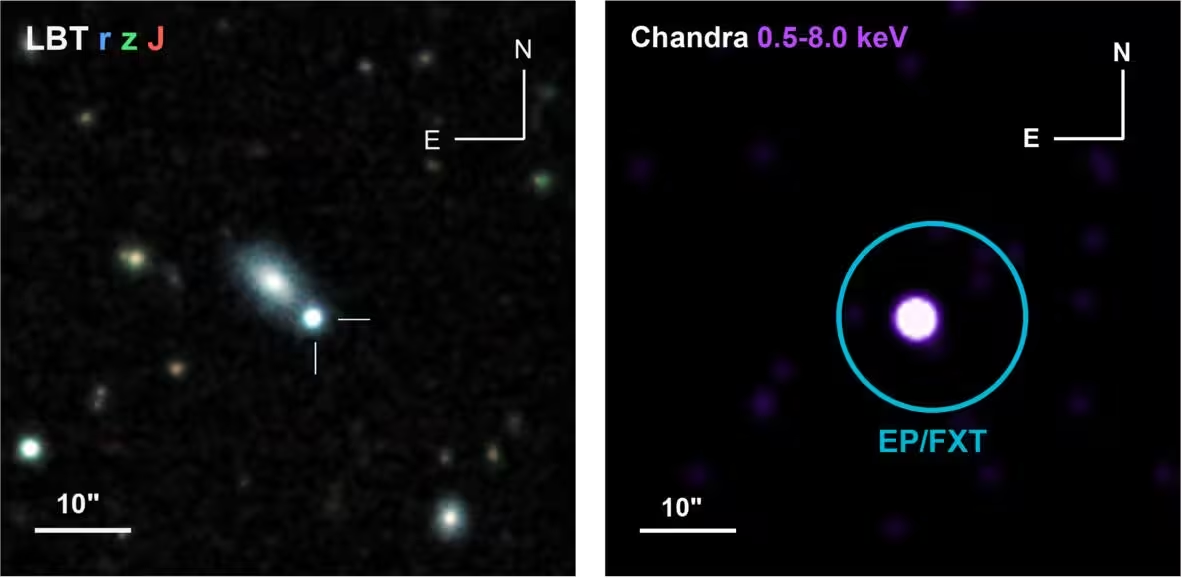
The progression of GRB 260310A defied conventional expectations. Following the initial trigger, the optical afterglow intensified until it overshadowed the host galaxy itself. By the time researchers measured the event across multiple wavelengths, they found that its X-ray and optical signatures were in the top 1% of recorded bursts, while its radio emissions placed it within the top 5%.
The most baffling development occurred roughly three weeks post-explosion. Rather than fading into the background, the X-ray afterglow surged in brightness and maintained an anomalous level of luminosity for over a week, remaining detectable for months. Roberto Ricci, who spearheaded the radio observation efforts, noted that while the team could account for the individual characteristics of the blast, reconciling them into a unified model was a complex puzzle.
Decoding the Geometry of the Blast
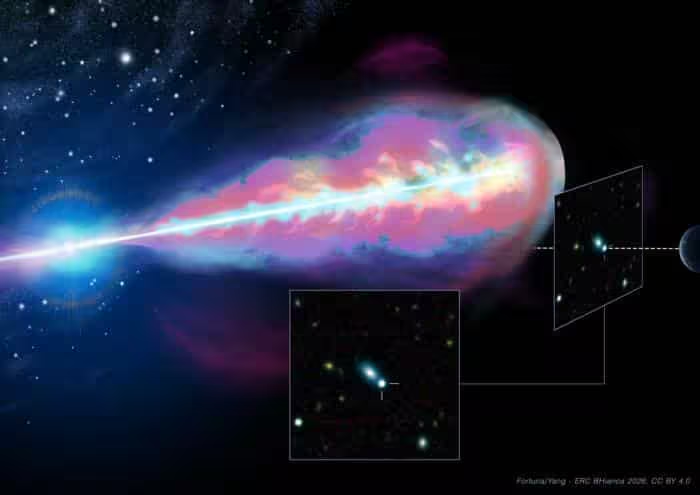
Gamma-ray bursts typically result from the collapse of massive stars, which fire off narrow, near-light-speed jets of material. The perceived brightness of these jets is highly dependent on the observer’s viewing angle. Lead author Yu-Han Yang explained that the apparent weakness of the burst initially was likely a consequence of our vantage point.
“Much like a flashlight, the jet appears brightest when seen head-on. Most of our models are calibrated using events seen from that same perspective. This burst gave us a chance to look beyond that glare,” said Yang.
The team proposes that the event featured a highly energetic, narrow core shrouded by a wider, slower-moving outflow. As the material expanded and decelerated, the radiation from the intense inner core became visible to Earth-based instruments from a broader range of angles, triggering the late-stage X-ray spike.
A Monster Hidden in Plain Sight
To verify this model, researchers aggregated data from a suite of global observatories, including NASA’s Chandra X-ray Observatory, ESA’s XMM-Newton, the Einstein Probe, the Large Binocular Telescope, and the Karl G. Jansky Very Large Array. Observations from the Calar Alto Observatory confirmed a supernova signature, confirming the stellar origins of the blast.
Calculations suggest that the total energy released in this narrow, focused beam was equivalent to a billion years of solar output. “What appeared to us as an unremarkable GRB might have looked like a monster explosion to an observer looking straight down the jet’s core,” Yang added.
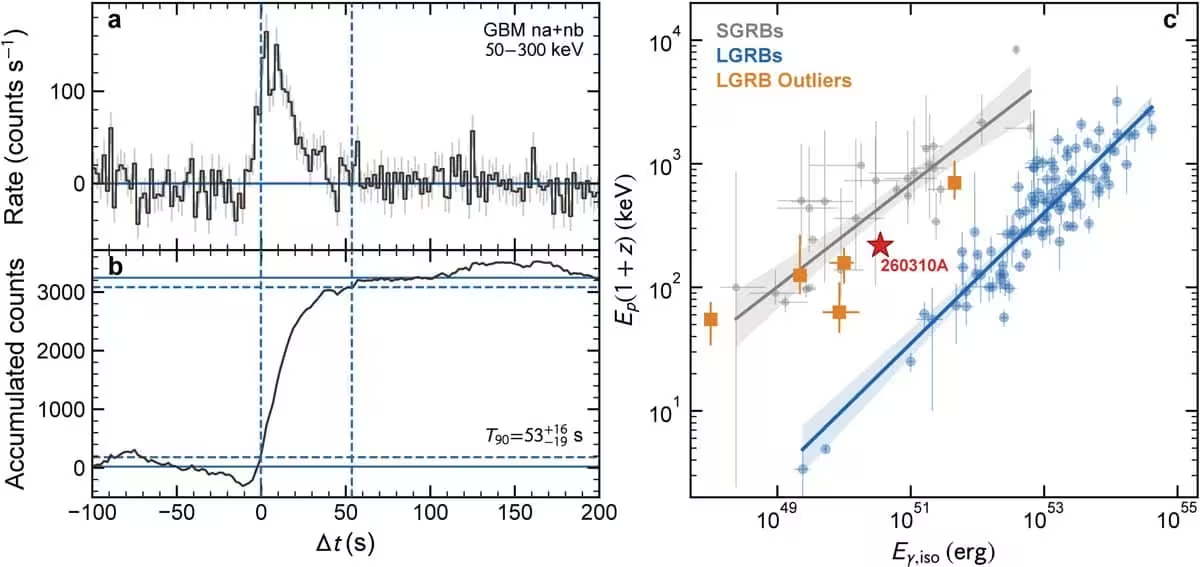
The discovery raises questions about how many similar high-energy events are currently being overlooked due to unfavorable orientation. Graduate researcher Muskan Yadav, who contributed to the study, remains optimistic about the future of time-domain astronomy. “Upcoming surveys will pick up hundreds of them. Identifying them among millions of variable sources won’t be easy, but it’s a challenge I’m excited to take on,” she said.
This article has been fact checked for accuracy, with information verified against reputable sources. Learn more about us and our editorial process.
Last reviewed on .
Article history
- Latest version
Reference(s)
- Yang, Yu-Han., et al. “An Extremely Bright Slow-rising Afterglow from an Off-axis Jet in GRB 260310A.” The Astrophysical Journal Letters, vol. 1011, no. 1, October 28, 2026, pp. L22 American Astronomical Society, doi: 10.3847/2041-8213/aea990. <https://iopscience.iop.org/article/10.3847/2041-8213/aea990>.
Cite this page:
- Posted by John Williams