Ancient Chinese Record of a Solar Eclipse Reveals How Fast Earth Spun 2,700 Years Ago
Japanese researchers have analyzed a 2,700-year-old Confucian chronicle to uncover surprising new details about Earth’s past rotation and solar activity.

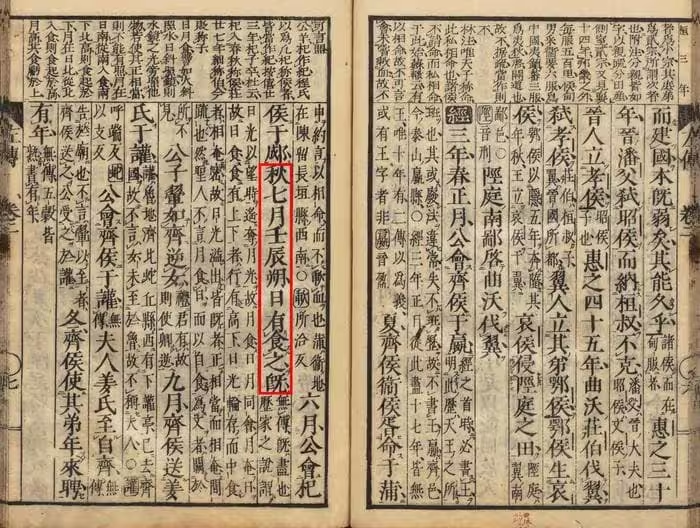
On July 17, 709 BCE, observers in the state of Lu witnessed the Moon completely obscuring the Sun. This event was documented in the Spring and Autumn Annals, a historical text traditionally associated with Confucius, making it the oldest datable written record of a total solar eclipse. Published in The Astrophysical Journal Letters, new research demonstrates how this ancient observation functions as a precise instrument for measuring long-term fluctuations in Earth’s spin.
Resolving a Geographical Discrepancy
For years, the account remained a source of academic frustration. When researchers attempted to model the eclipse using modern astronomical calculations, the math failed to align with historical accounts. The city of Qufu, the ancient capital of the Lu state, was situated outside the calculated path of totality. According to these simulations, the event should have appeared as a partial eclipse, yet the text explicitly describes a total one.
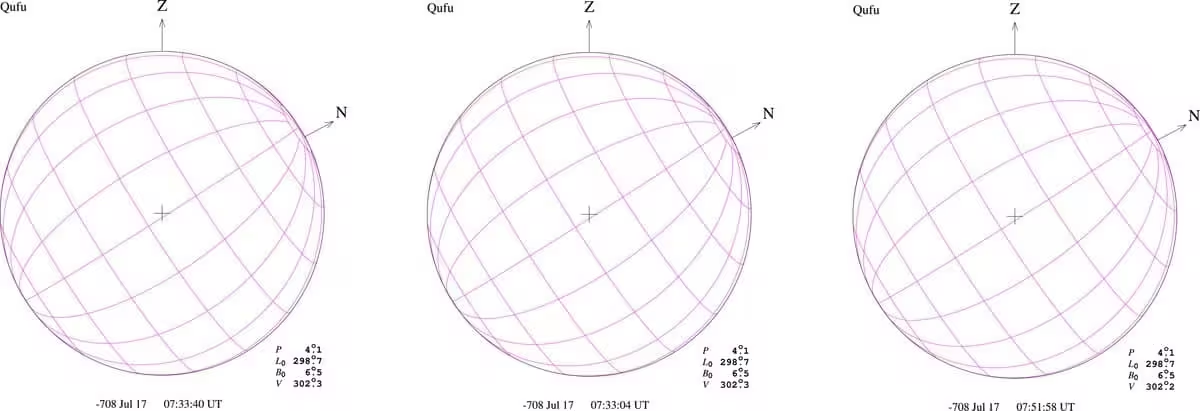
A team led by Hisashi Hayakawa of Nagoya University addressed this by re-examining archaeological data, discovering that previous studies had misidentified the historical location of Qufu by roughly eight kilometers. Because the path of a lunar shadow is remarkably narrow, even a minor geographical adjustment was sufficient to reconcile the historical account with the astrophysical models, confirming that Qufu indeed sat within the zone of totality.
Tracking Earth’s Decelerating Spin
The rotation of Earth is not a constant; it is subject to subtle variations caused by the Moon’s gravitational pull, which generates tidal friction. Additionally, geological shifts and changes in the distribution of global water and ice masses influence the planet’s rotational velocity. While these changes are imperceptible over a human lifespan, they are cumulative over millennia. For instance, in the Jurassic period, a single day was approximately 23 hours long, resulting in a year composed of 380 to 385 days.
By determining the exact path of the 709 BCE eclipse, scientists can work backward to calibrate models of Earth’s historical rotation. This refined data allows researchers to better account for the influence of non-tidal effects on the planet’s spin rate throughout history.
Insights Into Ancient Solar Behavior
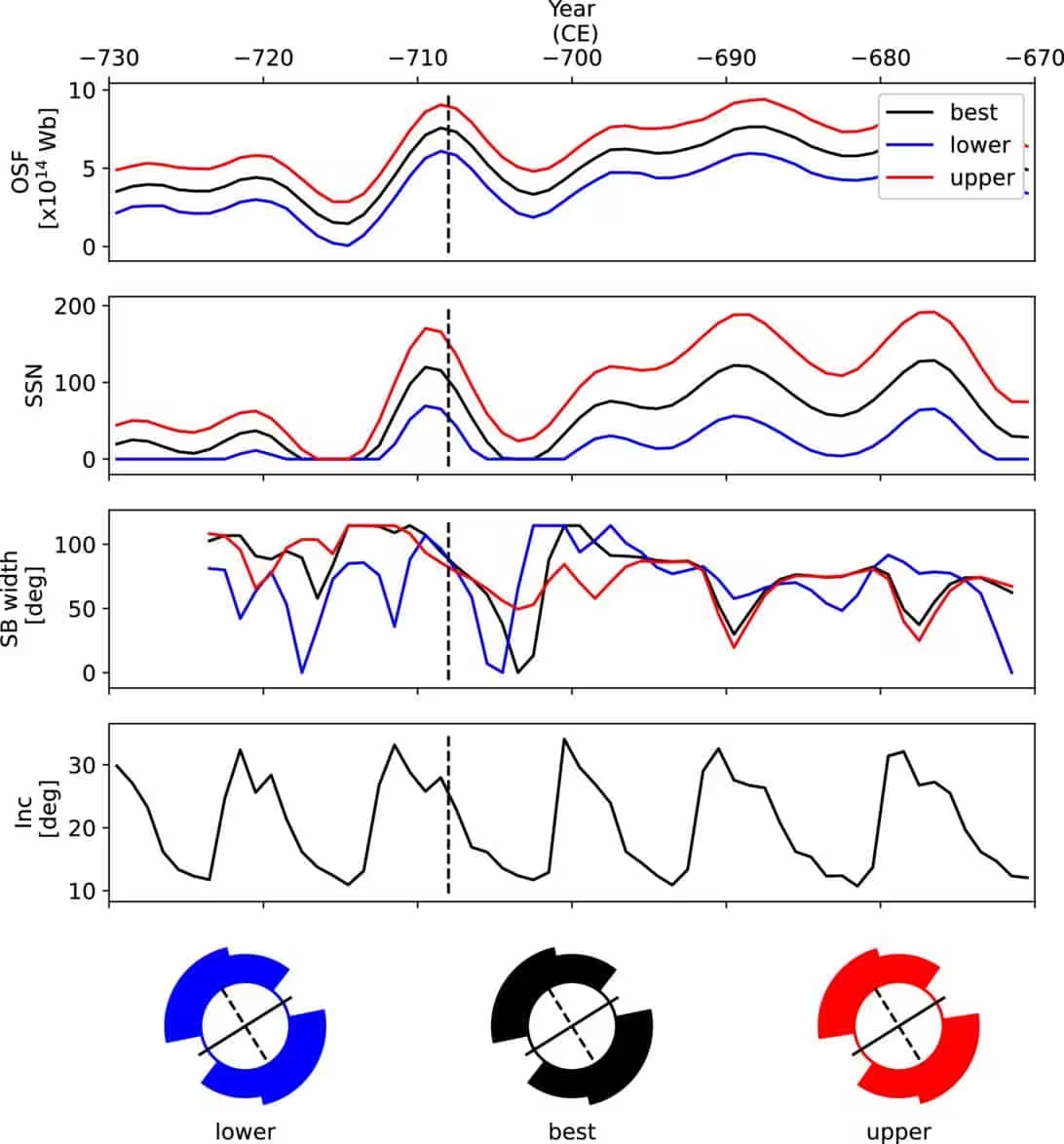
The historical investigation also yielded unexpected details regarding the Sun itself. The Hanshu, another ancient Chinese chronicle, describes the Sun appearing yellow at its upper and lower edges during the event. Modern researchers posit this may be one of the earliest recorded descriptions of the solar corona, which is typically hidden from view by the Sun’s intense glare.
To verify this, the team reconstructed the solar orientation during the 709 BCE eclipse and cross-referenced it with radiocarbon data from tree rings, which tracks historical solar activity. They found that the event occurred shortly after a peak in the 11-year solar cycle, creating conditions under which prominent coronal features would have been visible to the naked eye. While the interpretation of the “yellow glow” remains a subject of study, the finding highlights how cross-disciplinary cooperation between historians and astrophysicists can yield significant insights into our planet’s past and the long-term behavior of the Sun.
This article has been fact checked for accuracy, with information verified against reputable sources. Learn more about us and our editorial process.
Last reviewed on .
Article history
- Latest version
Reference(s)
- Hayakawa, Hisashi., et al. “Analyses of the Ancient Chinese Report on the Total Solar Eclipse in 709 BCE: Implications for the Contemporaneous Earth’s Rotation Speed and Solar Cycles.” The Astrophysical Journal Letters, vol. 995, no. 1, December 2, 2025, pp. L1 American Astronomical Society, doi: 10.3847/2041-8213/ae0461. <https://doi.org/10.3847/2041-8213/ae0461>.
- <https://www.researchgate.net/profile/Hisashi-Hayakawa-2/2>.
Cite this page:
- Posted by Nida Rehman