New Study Reveals How Astronauts Can Protect Their Hearts For A Future Mission To Mars
New research reveals that tailored exercise routines can effectively preserve astronaut heart function during long-duration missions to Mars.

New research from UT Southwestern Medical Center offers a promising outlook for the future of deep-space exploration, suggesting that a rigorous daily exercise regimen is sufficient to protect astronaut heart health during lengthy missions to Mars. The study, published in the journal Circulation, confirms that current training protocols aboard the International Space Station (ISS) effectively preserve cardiovascular function even after six months of exposure to microgravity.
Monitoring Cardiac Adaptation in Orbit
The human cardiovascular system is uniquely tuned to Earth’s gravitational pull. In the weightless environment of space, blood distribution shifts and the heart experiences a significant reduction in its workload. Past observations have raised concerns regarding cardiac atrophy, a condition where the heart muscle shrinks and weakens, potentially leaving astronauts vulnerable when transitioning back to a gravity-filled environment.
As part of NASA’s comprehensive Integrated Cardiovascular Study, researchers tracked 14 astronauts—nine men and five women—throughout their six-month stays on the International Space Station. This duration serves as a vital proxy for the time required to reach Mars. The team utilized detailed echocardiography and Doppler ultrasound to evaluate heart performance under various gravitational simulations, including those replicating Earth and the partial gravity of Mars, at multiple intervals throughout each mission.
Mitigating Atrophy Through Consistent Training
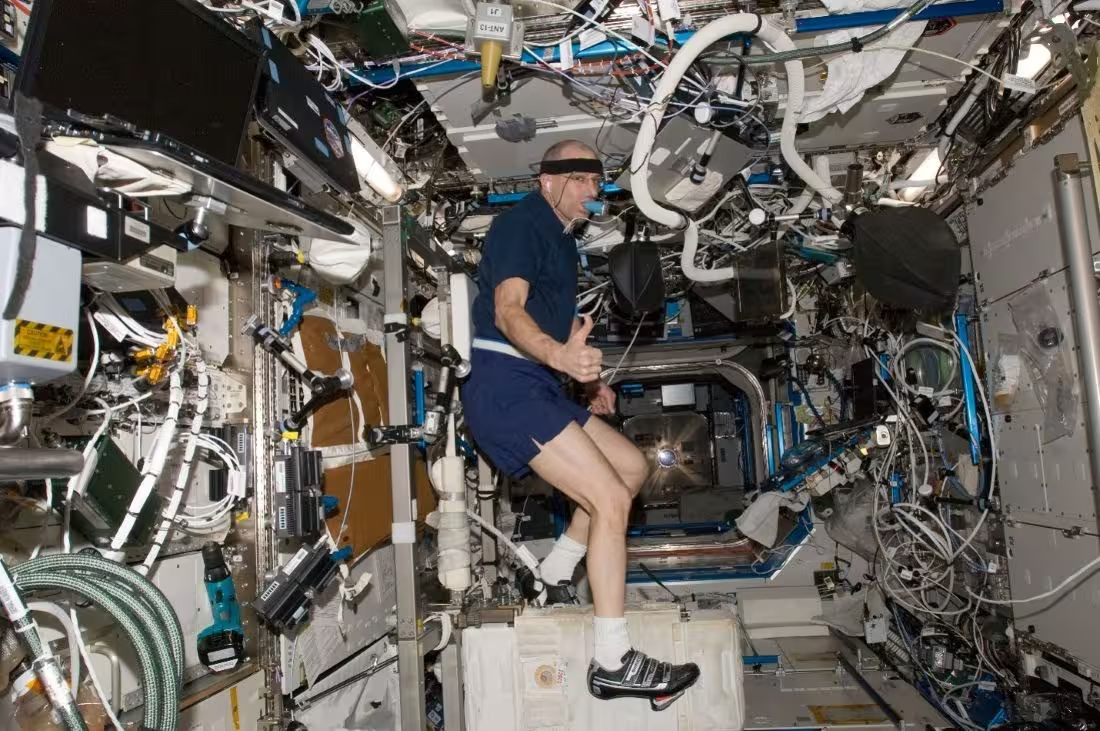
The data revealed that while initial exposure to microgravity led to a modest reduction in heart size during the first few weeks of flight, this trend was not permanent. Astronauts who adhered to a disciplined 45-to-60-minute daily schedule of strength and endurance training saw their cardiovascular markers stabilize and trend back toward preflight levels.
Benjamin Levine, M.D., a professor of internal medicine at UT Southwestern and a lead investigator on the project, noted that the initial signs of atrophy were once a major point of concern. However, the study provides strong evidence that existing countermeasures are robust enough to maintain heart health for the stresses of a Mars-bound journey.
“Our previous studies had demonstrated that the heart atrophies in both bed rest and in space—it becomes smaller and stiffer—and we were concerned that could be a problem over long-duration spaceflight, especially for missions to Mars. Our findings suggest that the exercise countermeasures we already have in place are enough to keep the heart in good working order for Mars’ gravitational loads,” said Benjamin Levine, M.D., professor of internal medicine in the Division of Cardiology at UT Southwestern, where he holds a distinguished professorship in exercise sciences.

Implications for Martian Exploration and Earth-Based Medicine
The prospect of landing on Mars requires the cardiovascular system to adapt to approximately 38% of Earth’s gravity after an extended period of weightlessness. The latest findings, detailed in Circulation, suggest that the human heart is well-equipped to handle this transition if the current standards for physical activity are maintained. These results represent a critical milestone in the roadmap for crewed interplanetary travel.
Beyond the benefits for space flight, the research carries significant weight for clinical practice on Earth. Insights into how the heart responds to gravity and inactivity are helping doctors better understand conditions like syncope and orthostatic intolerance. By refining exercise protocols for astronauts, scientists are simultaneously developing more effective rehabilitation strategies for patients experiencing chronic circulatory issues or reduced tolerance to movement.
This article has been fact checked for accuracy, with information verified against reputable sources. Learn more about us and our editorial process.
Last reviewed on .
Article history
- Latest version
Reference(s)
- Appadurai, Vinesh., et al. “Impact of Prolonged Spaceflight on Cardiac Structure and Function: An Exploratory Longitudinal Observational Study.” Circulation, September 15, 2026 Ovid Technologies (Wolters Kluwer Health), doi: 10.1161/CIRCULATIONAHA.125.078665. <https://www.ahajournals.org/doi/10.1161/CIRCULATIONAHA.125.078665>.
Cite this page:
- Posted by Karan Das