JWST Just Discovered Two Mystery Objects That Aren’t The Black Holes Astronomers Expected
Using next-generation telescope data, astronomers have uncovered a complex new mystery behind two distant cosmic sources that previously puzzled researchers.
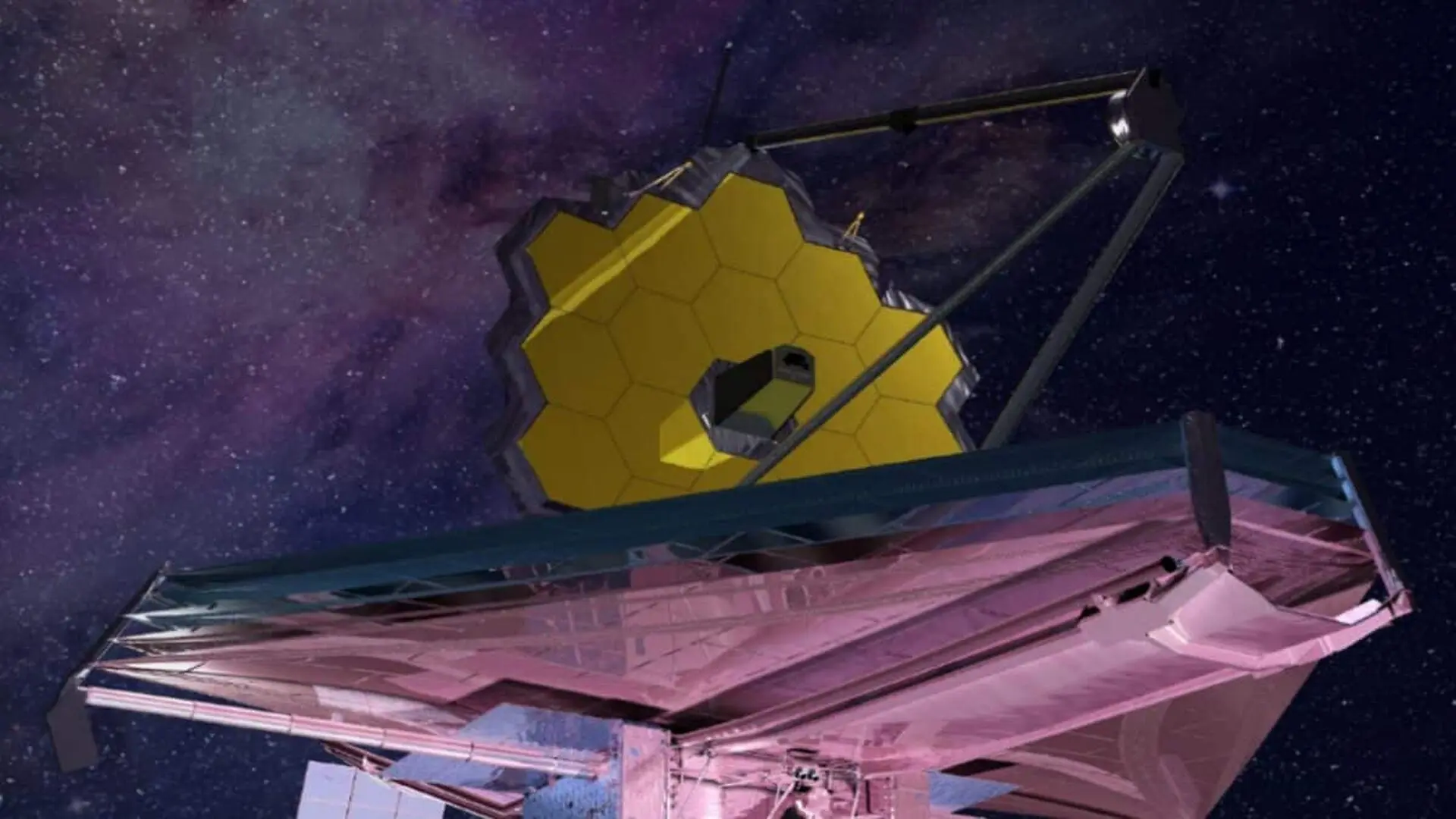
New data from the James Webb Space Telescope (JWST) has forced a significant reclassification of two distant cosmic objects previously identified as faint quasars. Researchers have determined that these entities, which date back to the first billion years of the universe, are not powered by central black holes, but are instead hyper-productive galaxies experiencing intense, concentrated bursts of star formation.
The study, led by Sarah E. I. Bosman of Leiden University and published on the arXiv preprint server, highlights the ongoing struggle to categorize light sources from the early cosmos. Because both young, star-bursting galaxies and black-hole-powered quasars can emit similar blue ultraviolet signatures and hydrogen Lyman-alpha light, distinguishing between the two has long been a major hurdle in deep-space observation.
Stellar Signatures Replace Black Hole Evidence
The research team focused on two specific sources, J1450−0144 and J1429−0104, which were initially spotted by the Subaru High-z Exploration of Low-Luminosity Quasars (SHELLQs) survey. By deploying the precision of JWST’s NIRSpec instrument, the scientists analyzed the spectral makeup of these objects, finding clear evidence of massive stellar activity rather than the chaotic accretion of a growing black hole.
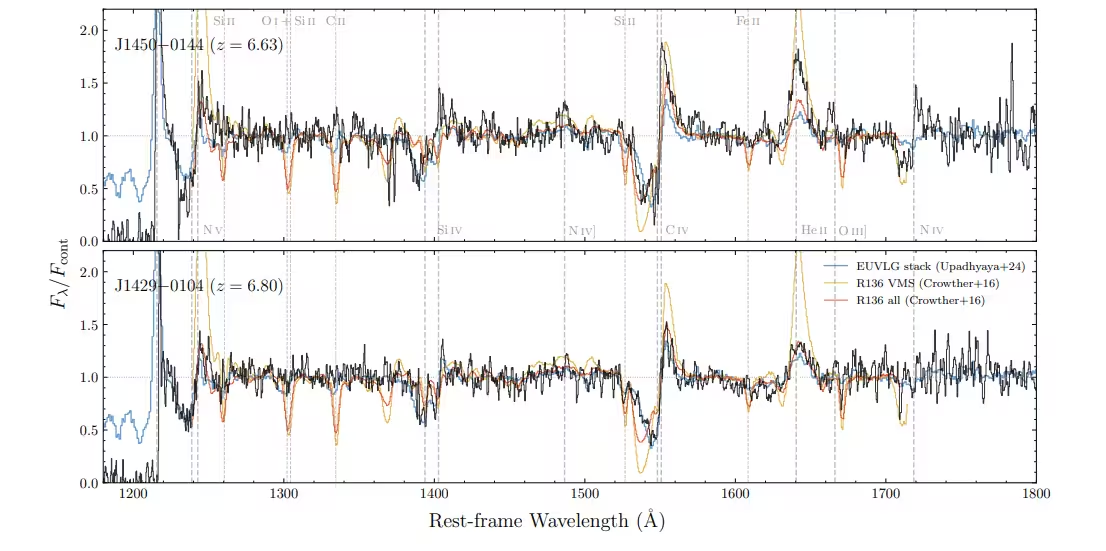
Central to this discovery was the identification of P Cygni profiles, which are spectral patterns indicative of powerful, radiation-driven winds emanating from massive stars. Furthermore, the team detected unusually strong broad helium emission. Their analysis suggests that existing models—which typically limit stellar masses to around 100 times that of our Sun—cannot explain the intensity of the light observed. Instead, the data points to the presence of stars exceeding 100 solar masses.
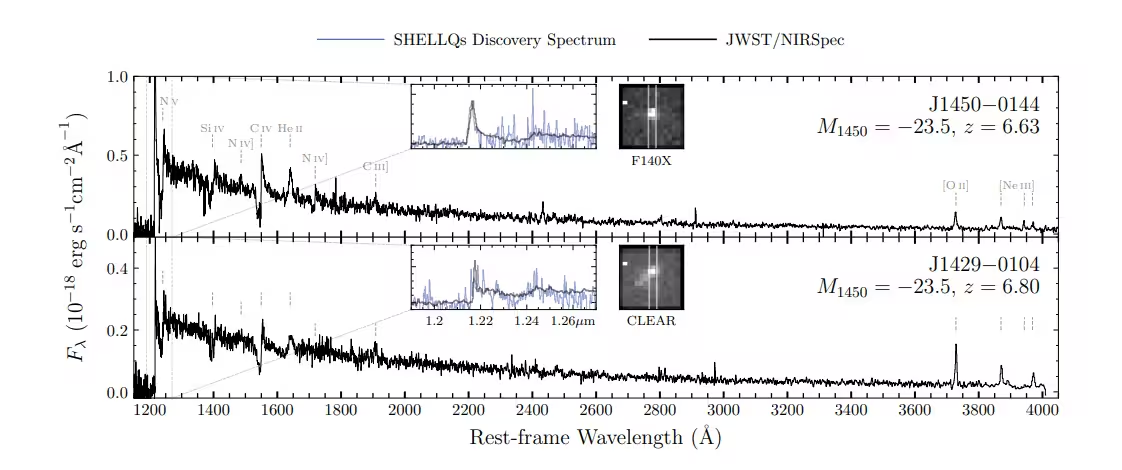
Estimates suggest these systems are forging stars at an astonishing pace, ranging from 300 to 540 solar masses annually. This suggests each galaxy may host anywhere from 100,000 to one million exceptionally massive stars, though the researchers note that current stellar wind models rely on Milky Way data, which may not perfectly reflect the conditions of the primordial universe.
Multi-Wavelength Confirmation
To cross-verify their findings, the team utilized the Atacama Large Millimeter/submillimeter Array (ALMA). This allowed them to observe the colder gas and dust environments that surround the hot, young stars. The absence of specific emission lines—namely broad Lyman-alpha and Mg II—further debunked the quasar classification, confirming these sources as Extreme UV Luminous Galaxies (EUVLGs).
The investigation also revealed a spatial oddity within J1429−0104. Researchers discovered a 17,600 light-year gap between the source of the ultraviolet light and the location of the cold gas and dust. This discrepancy could indicate a violent galactic merger or intense feedback loops where star-forming activity has physically displaced the surrounding dust clouds.
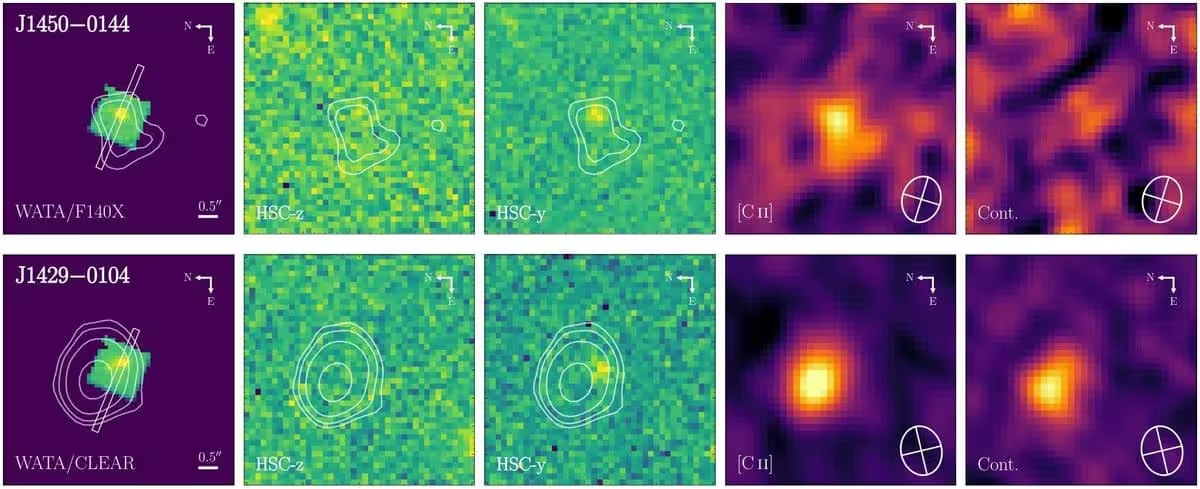
These findings imply that the population of high-redshift galaxies may be more diverse and active than previously realized. By proving these objects are essentially high-energy stellar nurseries rather than black-hole-driven quasars, astronomers now have a new framework for analyzing the brightest, most distant light sources in the universe.
“Taken together, these results identify J1450−0144 and J1429−0104 as a new class of laboratories at the very bright end of the UVLF at high redshift: compact, gas-rich, intensely star-forming galaxies that simultaneously host substantial very massive star populations,” the researchers conclude.
This article has been fact checked for accuracy, with information verified against reputable sources. Learn more about us and our editorial process.
Last reviewed on .
Article history
- Latest version
Reference(s)
- Sabia, Stephen. “NIRSpec - NASA Science.”, August 12, 2024 NASA <https://science.nasa.gov/mission/webb/nirspec/>.
- Yang, Daming. “Quasar Impostors: Two Extremely UV-Bright ($M_{\rm UV}\approx-23.5$) Reionisation-Epoch Galaxies Powered by Very Massive Stars.” arXiv.org <https://arxiv.org/abs/2608.18212>.
Cite this page:
- Posted by Karan Das