Scientists Have Found a Way to Turn Martian Air Into Rocket Fuel
Scientists have developed a new copper catalyst that efficiently converts Martian carbon dioxide into methane fuel, paving the way for sustainable space travel.

Engineers at the University of Mississippi have unveiled a potential breakthrough for future human exploration of the Red Planet. By leveraging specialized copper catalysts, researchers have successfully demonstrated a chemical process capable of transforming the carbon-dioxide-rich atmosphere of Mars into methane, a vital propellant for return missions.
Fueling the Return Trip from Mars
The logistical hurdles of a crewed Mars expedition are immense, particularly the challenge of returning astronauts to Earth. Carrying sufficient fuel for a round trip from the start would impose prohibitive costs and mechanical constraints, as every extra kilogram of mass significantly increases launch complexity and requirements.
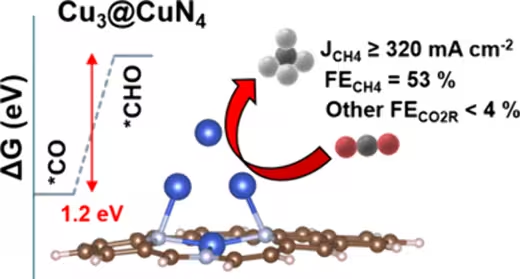
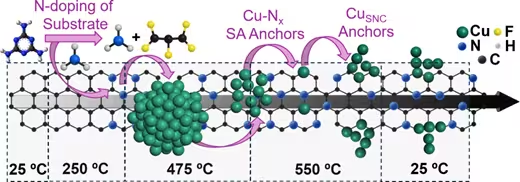
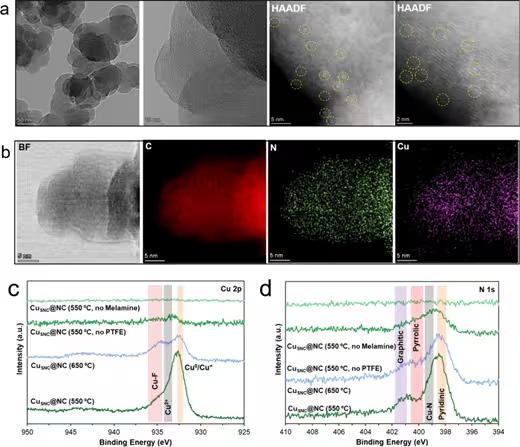
Because the Martian atmosphere is composed of approximately 96% carbon dioxide, scientists are looking toward in-situ resource utilization (ISRU). This strategy involves manufacturing essential supplies on the surface rather than relying on Earth-bound logistics. The recent study, published in ACS Catalysis, describes a method utilizing a copper catalyst measuring roughly 100,000 times smaller than the width of a human hair to drive the conversion of CO2 into usable methane fuel.
“You can’t bring up everything you need from Earth, because every additional kilogram adds enormous cost and complexity to launch and escape Earth’s gravity,” said Ahmed Badreldin, assistant professor of chemical engineering. “So the question becomes: How do we make the fuels and chemicals needed for space exploration from the resources already available at the destination?”
Simplifying Chemical Synthesis for Deep Space
Existing carbon-conversion technologies often produce a cocktail of chemical byproducts, necessitating extensive, energy-intensive purification systems. On Mars, where industrial infrastructure is non-existent, this complexity is a major drawback. The team at the University of Mississippi and Texas A&M University aimed to refine the reaction to favor methane production directly, reducing the need for elaborate separation equipment.
“The work we’re doing is basically taking CO2 and using electricity to convert it into carbon-containing fuels and chemicals,” Carter Racine said. “If we can make them using captured CO2 and renewable electricity, it could reduce reliance on virgin fossil carbon and help close the carbon cycle.”
Broad Impacts for Earthly Industries
While the primary application remains space travel, this carbon-recycling technology has significant implications for terrestrial industries. By shifting away from centralized fossil-fuel reliance toward decentralized production models, methane created from atmospheric CO2 could serve as a sustainable feedstock for higher-value chemicals, such as alcohols.
This process also holds promise for decarbonizing sectors that are currently difficult to electrify, most notably aviation. Because current battery technology lacks the energy density required for long-distance commercial flight, synthetic carbon-based fuels could offer a viable pathway to reducing the aviation industry’s environmental footprint without requiring a total overhaul of existing engine designs.
Looking ahead, the research team is moving toward optimizing the catalyst’s durability and efficiency, supported by a Mississippi NASA EPSCoR Research Infrastructure Development grant. As international space agencies set their sights on crewed Martian missions in the coming decade, the development of reliable, autonomous systems for local fuel production is becoming increasingly critical.
This article has been fact checked for accuracy, with information verified against reputable sources. Learn more about us and our editorial process.
Last reviewed on .
Article history
- Latest version
Cite this page:
- Posted by Karan Das