Astronomers Just Witnessed a Distant Centaur Transform Into a Comet in Real Time
Astronomers have detected dramatic, unexpected activity on a distant icy object in the outer solar system, revealing secrets about its unusual history.
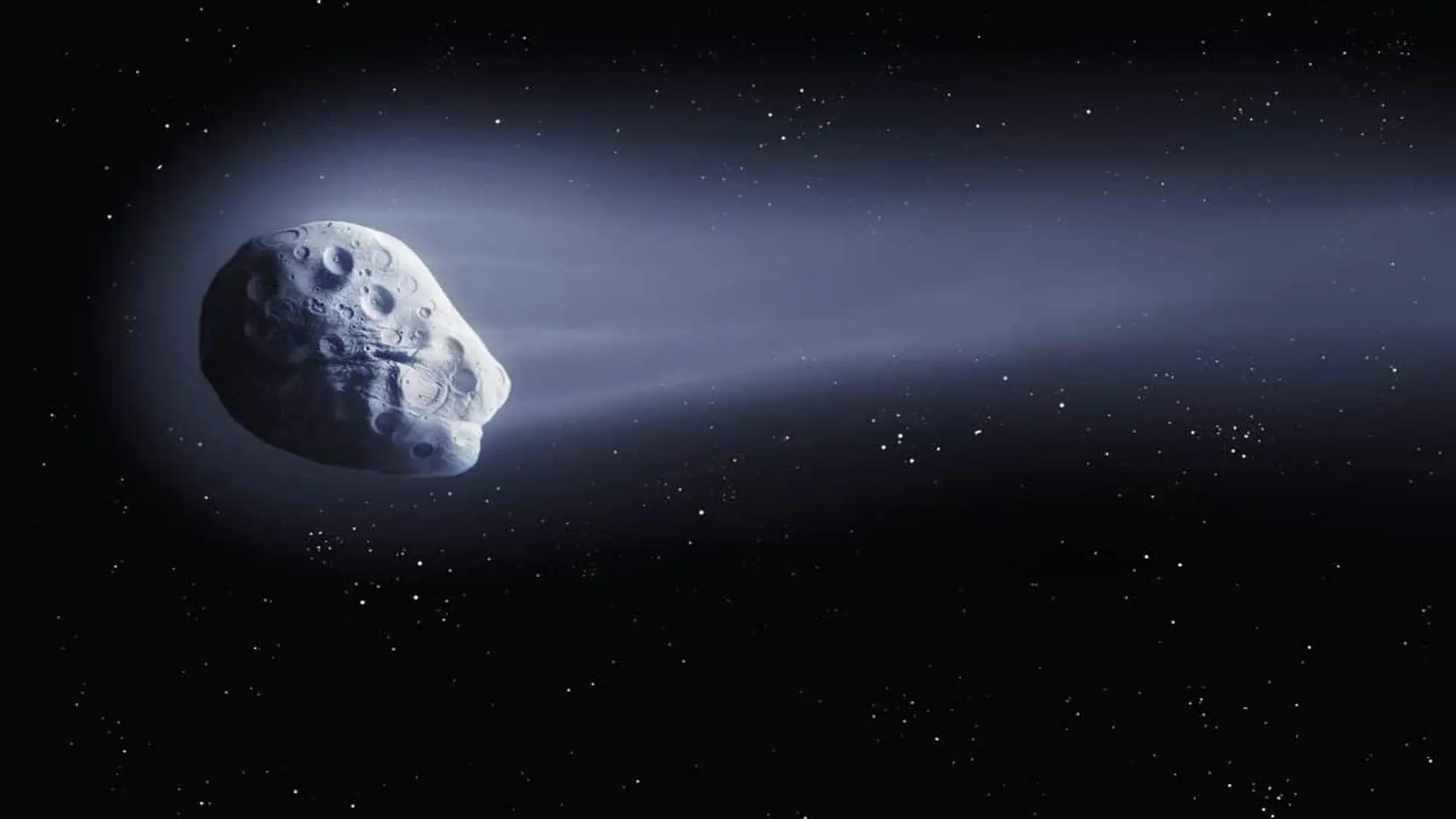
Astronomers are witnessing a rare celestial transformation in the outer solar system, where a once-dormant object known as 450P/LONEOS has begun to wake up. Long classified as a stable centaur, the icy body is developing a distinct shroud of gas and dust as its orbital path carries it closer to the Sun.
Centaurs, which typically reside in the volatile region between Jupiter and Neptune, are believed to be migrants from the Kuiper Belt beyond Pluto. Because their orbits intersect with those of the solar system’s giant planets, these bodies remain gravitationally unstable over millions of years. Researchers have long theorized that these objects are the precursors to Jupiter-family comets, and 450P is currently providing a front-row seat to this evolutionary shift.
Observing a Centaur in Transition
Planetary scientist Charles Schambeau of the University of Central Florida and his team have documented the object’s awakening using the Gemini North telescope in Hawaii. Between 2019 and 2024, observations revealed a brightening coma—the envelope of gas and dust surrounding the nucleus—as the object approached its perihelion, or closest point to the Sun, in August 2024.
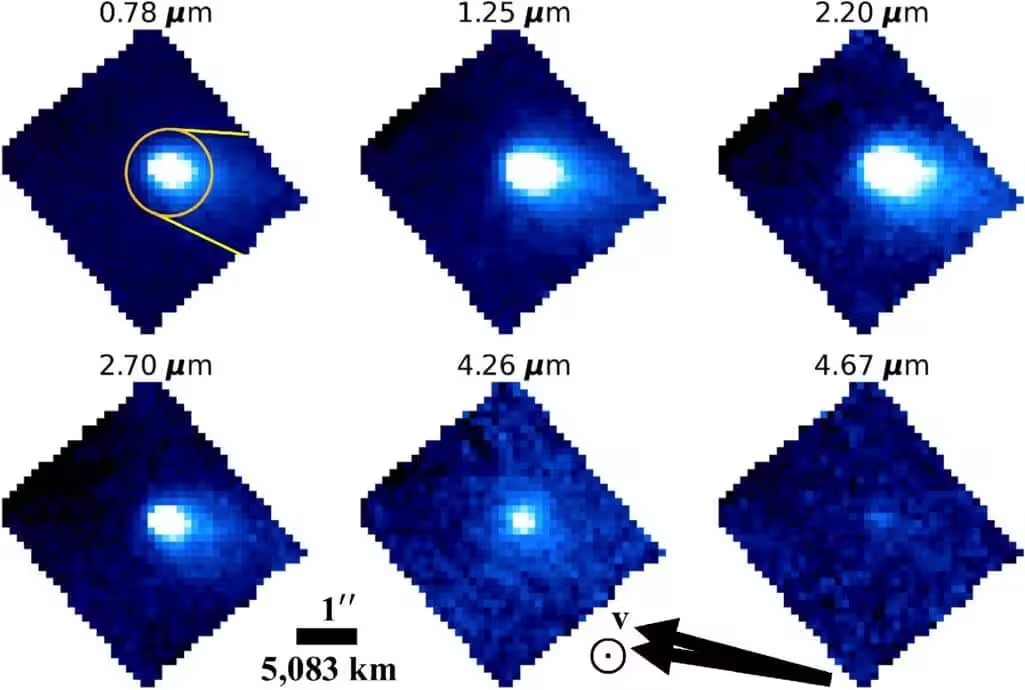
Follow-up data from the James Webb Space Telescope (JWST), as detailed in a report on the arXiv preprint archive, identified carbon dioxide as the primary driver of this activity. Notably, the telescope detected no water vapor, suggesting that the object is not undergoing standard water-ice sublimation.
“At 450P’s distance from the sun, the nucleus is too cold for normal water-ice sublimation to be the main activity source, so detecting carbon dioxide gives us an important clue about what is powering the coma,” Schambeau said in a statement.
The Gravitational Push That Changed Everything
The object’s recent activity is rooted in a past gravitational encounter. Tracing its historical trajectory, astronomers determined that 450P passed within 2.9 million miles of Saturn in 1992. This close approach significantly altered its orbit, pushing it toward a perihelion of 5.4 astronomical units—a region just beyond Jupiter that subjects the body to far more intense solar heat than it previously experienced.
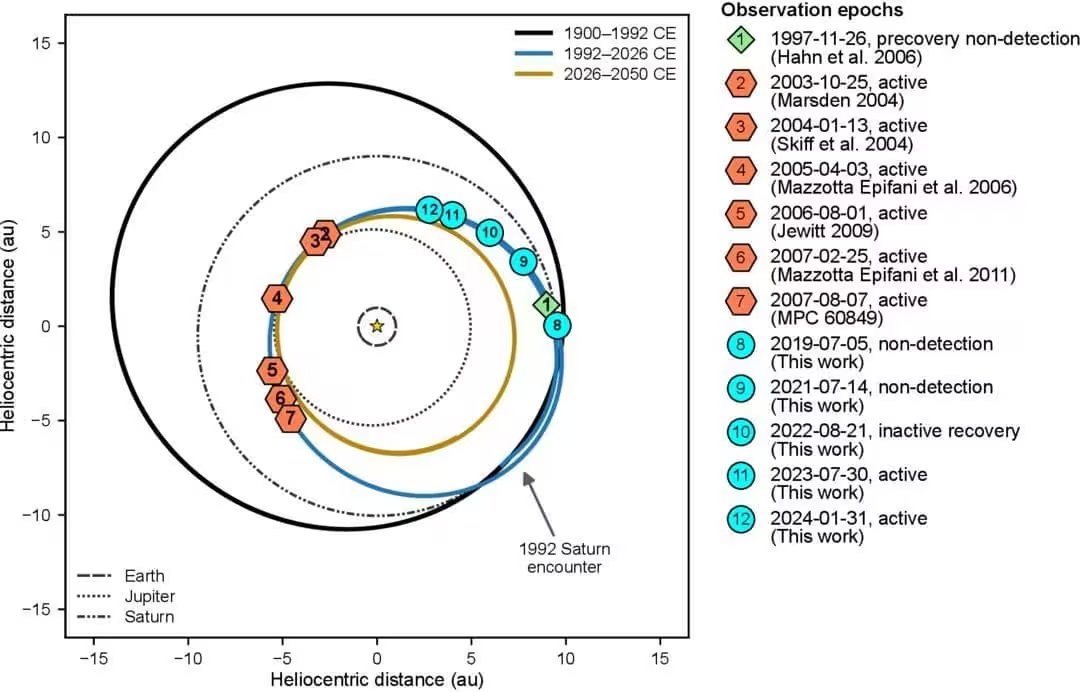
This thermal shift is crucial. As Schambeau explains, increased solar heating warms both the surface and deeper subsurface layers, releasing volatile gases that drag away dust and ice, effectively triggering the coma’s formation.
Clues to Ancient Origins
The JWST data also provided evidence of crystalline water ice. In most pristine, distant objects, water ice remains in an amorphous, porous state. The transition to a crystalline structure indicates that the material has undergone physical processing, confirming that 450P is actively responding to its new environment.
Because such transitions are rarely captured, 450P offers a unique look at primordial material, potentially dating back 4.5 billion years to the dawn of the solar system. By studying how these centaurs evolve, scientists are gaining insight into the mechanisms that move ancient matter from the cold reaches of the outer solar system toward the Sun.
“Centaurs are scientifically important because they are thought to be transitional objects that originated further out in the solar system and are slowly evolving toward becoming Jupiter-family comets,” Schambeau noted. “They give us a way to study relatively primitive material from the outer solar system while it is beginning to respond to stronger solar heating.”
This article has been fact checked for accuracy, with information verified against reputable sources. Learn more about us and our editorial process.
Last reviewed on .
Article history
- Latest version
Reference(s)
- “Charles Schambeau - UCF Planetary Sciences Group.”, October 15, 2017 UCF Planetary Sciences Group <https://planets.ucf.edu/people/charles_schambeau/>.
- projects, Contributors. “comet.”, May 11, 2025 Wikimedia Foundation, Inc. <https://en.wikipedia.org/wiki/450P/LONEOS>.
- Schambeau, Charles. “JWST and Gemini Observations of the Active Centaur 450P/LONEOS: Nucleus and Coma Characterizations.” arXiv.org, doi: 10.3847/PSJ/ae685c. <https://arxiv.org/abs/2605.24260>.
- Miller, Andrew. “UCF Researchers Study a Centaur Transforming Into a Comet.”, September 1, 2026 University of Central Florida News | UCF Today <https://www.ucf.edu/news/ucf-researchers-study-a-centaur-transforming-into-a-comet/>.
Cite this page:
- Posted by Karan Das