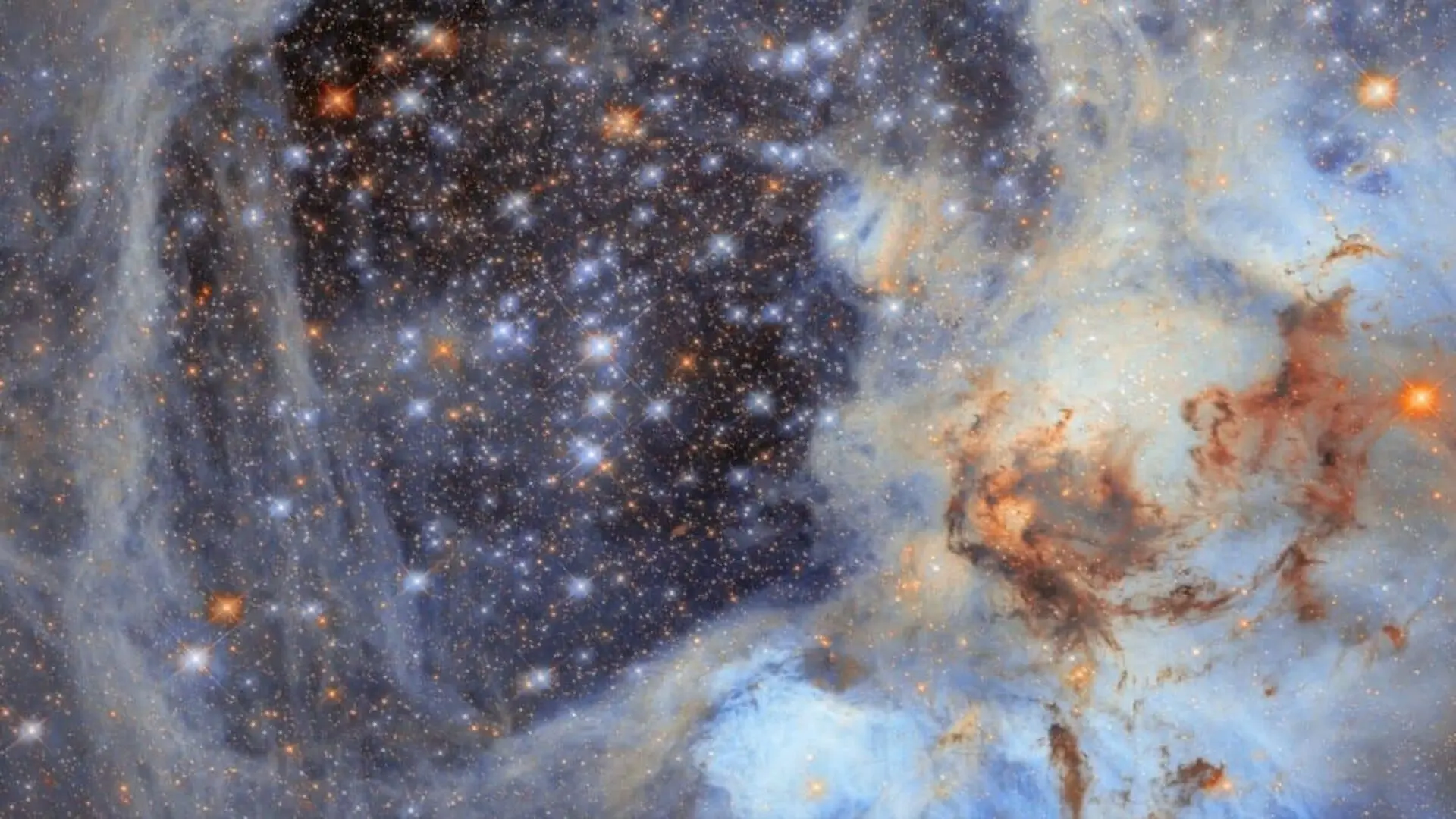
Deep within the constellation Dorado, roughly 160,000 light-years from our own solar system, lies a vibrant stellar nursery known as N44. This complex, spanning approximately 1,000 light-years, serves as a high-resolution laboratory for astronomers aiming to decode the chaotic and brilliant process of star formation.
The Anatomy of a Superbubble
The most striking feature of this region is a massive, hollow cavity—often referred to as a superbubble—that dominates the landscape. According to the NASA Hubble Mission Team, this void was carved out by the intense radiation and energetic stellar winds of massive stars, as well as the violent shockwaves of subsequent supernova explosions. These forces acted like a celestial plow, pushing gas and dust outward to create a dense, surrounding shell.
This shell is far from static. As the gas is compressed, it creates the perfect environment for new generations of stars to ignite. The region also features smaller, localized structures like N44F, an interstellar bubble sculpted by the winds of a single, particularly massive star, which has formed intricate, dusty pillars in its wake.
The intensity of the region extends beyond visible light. Past observations by the Chandra X-ray Observatory revealed that N44 emits significantly more X-ray energy than standard models once predicted. Research suggests this excess radiation stems from hot material evaporating from the cavity walls and shock waves colliding with the shell, rather than an abundance of heavy elements.
N44’s striking central void is a ‘superbubble’
spanning roughly 210 by 140 light-years. This bubble was blown by the powerful stellar winds and explosive supernovae
of the stars at its centre. 1/3 pic.twitter.com/vFMscZvkJm
To better understand how stars transition from cold gas clouds to active fusion, astronomers launched a dedicated survey—program 14689—led by principal investigator D. Gouliermis. By cataloging nearly half a million stars, the team identified roughly 30,000 pre-main-sequence stars. These objects are in a critical, early developmental phase, having not yet initiated the hydrogen-to-helium fusion process that powers stars like our Sun.
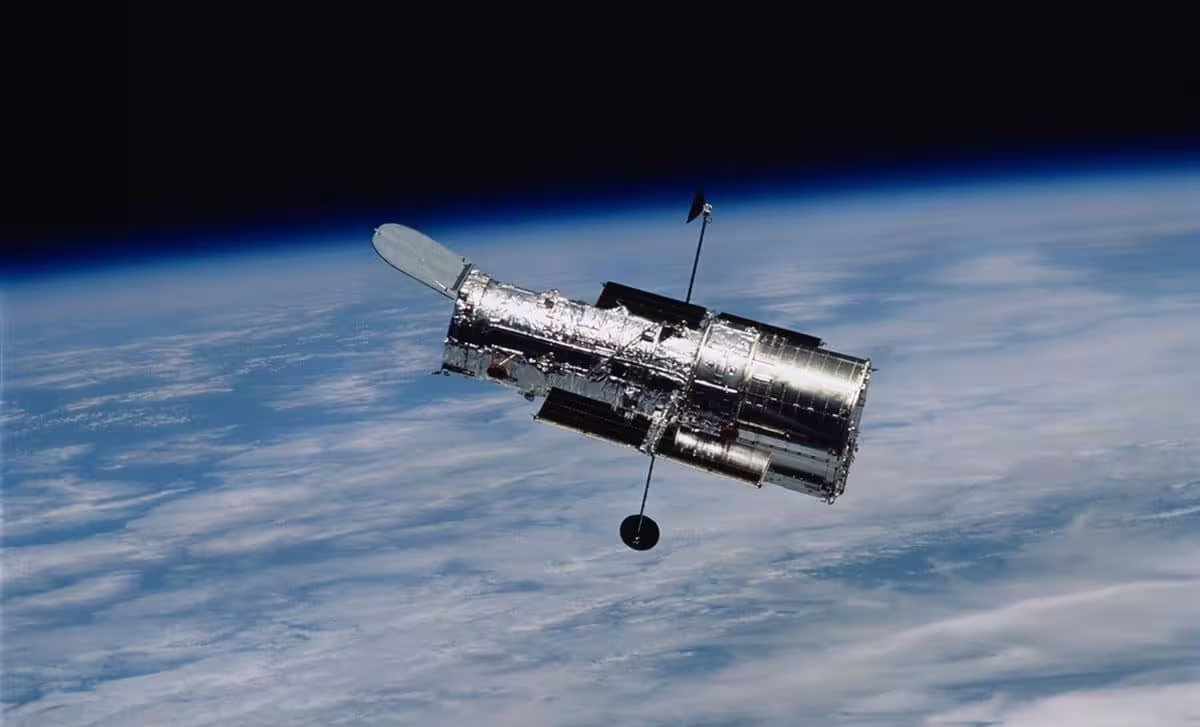
Hubble’s high resolution was vital for this census, allowing researchers to distinguish faint, immature stars amidst the dense, crowded, and dust-heavy environment of the nebula. Because N44 contains stars of various ages, it provides a rare, comprehensive look at how environmental factors influence stellar lifecycles.
The Large Magellanic Cloud, which hosts N44, is notably low in elements heavier than helium. This chemical composition mirrors that of galaxies in the early universe, making N44 a unique local proxy. By studying how these low-mass stars form in such a low-metallicity environment, scientists can gain insights into the conditions that governed the birth of stars billions of years ago, all within our own celestial backyard.
Das, Karan. “Hubble Just Spotted a Massive Cosmic Superbubble Carved by Explosions.” BioScience. BioScience ISSN 2521-5760, 06 September 2026. <https://www.bioscience.com.pk/en/subject/space-science/hubble-captures-a-massive-cosmic-void-carved-by-star-explosions-160-000-light-years-away>.
Das, K. (2026, September 06). “Hubble Just Spotted a Massive Cosmic Superbubble Carved by Explosions.” BioScience. ISSN 2521-5760. Retrieved September 06, 2026 from https://www.bioscience.com.pk/en/subject/space-science/hubble-captures-a-massive-cosmic-void-carved-by-star-explosions-160-000-light-years-away
Das, Karan. “Hubble Just Spotted a Massive Cosmic Superbubble Carved by Explosions.” BioScience. ISSN 2521-5760. https://www.bioscience.com.pk/en/subject/space-science/hubble-captures-a-massive-cosmic-void-carved-by-star-explosions-160-000-light-years-away (accessed September 06, 2026).