JWST Reveals Why Gas Giants Are In A Desperate Race Against Time To Form
New JWST observations reveal the complex processes unfolding around young stars, shedding light on the limited timeline for giant planet formation.

The formation of gas giants like Jupiter and Saturn is a high-stakes race against time, according to new data from NASA’s James Webb Space Telescope (JWST). Observations of 72 young, Sun-like stars have revealed that the protoplanetary disks—the swirling reservoirs of gas and dust from which planets emerge—are under constant depletion by powerful, shifting forces.
During the infancy of a solar system, these disks contain roughly 100 times more gas than dust. This gas serves as the essential raw material for gas giants to build their massive atmospheres. However, the new findings suggest that this window of opportunity closes as the system matures and the gas is systematically swept away.
Tracking the Dissipation of Protoplanetary Disks
The research team, led by Naman Bajaj of the University of Arizona and co-authored by SETI Institute scientist Uma Gorti, utilized archival data from the JWST’s Mid-Infrared Instrument (MIRI). By examining 72 stars at varying stages of development, the team was able to map the evolution of gas dispersal across a diverse sample. Their findings were recently published in The Astronomical Journal.
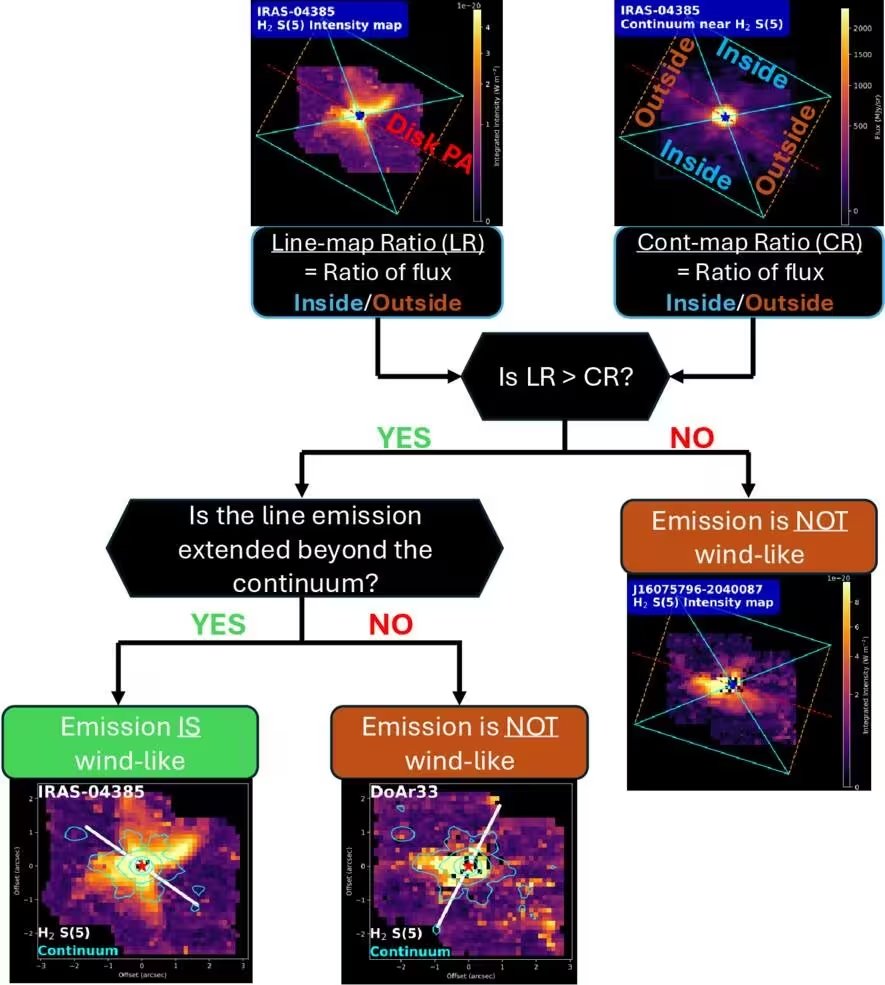
The researchers monitored two primary indicators of gas loss: molecular hydrogen and ionized neon. The sensitivity of the JWST allowed the team to distinguish between broad, sweeping winds and high-velocity jets. The results were widespread: 66 of the 72 surveyed disks displayed signs of gas depletion. Specifically, 46 systems exhibited conical molecular hydrogen winds, while 40 showed evidence of fast-moving neon jets. In every instance where a neon jet was identified, researchers also detected concurrent winds of molecular hydrogen or oxygen.
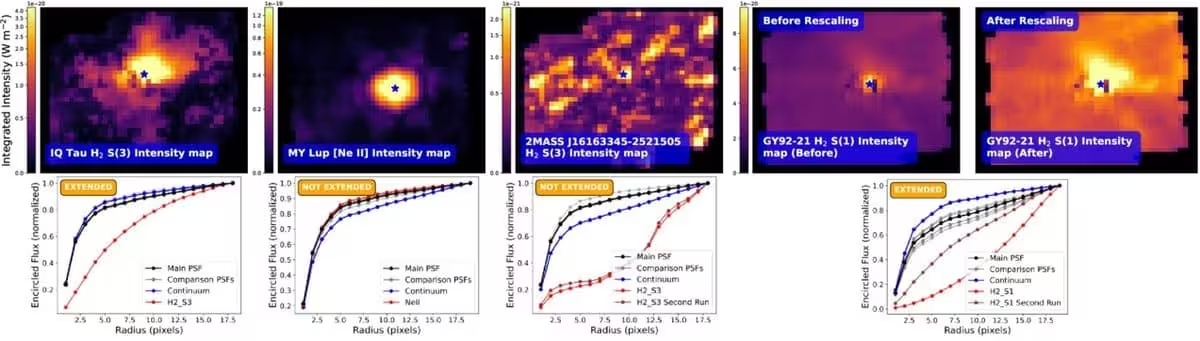
This discovery confirms theoretical work from 2020, where University of Arizona professor Ilaria Pascucci hypothesized that young star systems could generate molecular winds potent enough to shield the disk from high-energy X-ray photons.
Shifting Mechanisms of Disk Erosion
The study highlights a transition in how these disks lose mass as they age. In the earliest, most volatile stages, magnetic fields dominate. As material falls toward the central star, these magnetic fields act as a conduit, launching jets and broad outflows that carry away both mass and angular momentum.
As the system matures, this process shifts. The accretion of material onto the star slows, and the jets wane. At this stage, atomic gas outflows take precedence, driven by the star’s high-energy radiation. This process, known as photoevaporation, heats the disk gas until it is stripped away, effectively locking in the final mass of any planets that have managed to form.
“What is exciting about this study is that we can now see, across a large sample of young systems, how the mechanisms that remove gas from planet-forming disks change with time. Disk dispersal sets a fundamental clock for planet formation: once the gas is gone, the opportunity to build gas-rich planets is essentially over,” said Uma Gorti.
Planetary Development Against the Clock
For exoplanets, the implications are profound. Because the reservoir of gas is finite and subject to aggressive depletion, the timing of atmospheric accretion is critical. If a developing gas giant cannot capture sufficient material before the disk disperses, it remains a smaller, rocky world rather than a massive gas-rich planet.
“Planet formation is therefore a race against time,” said Bajaj. “Gas giants like Jupiter must assemble their massive atmospheres while the disk is still substantial enough to supply them, before winds and jets carry that raw material away into space.”
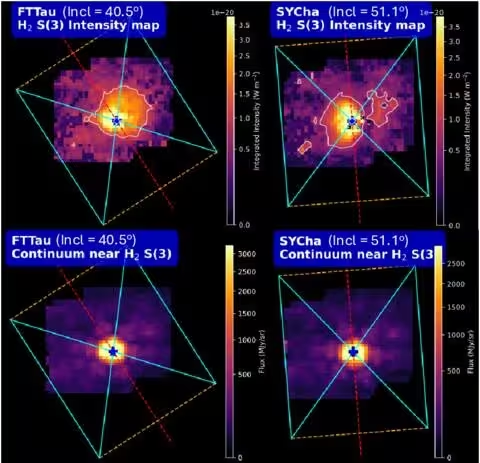
Building on previous JWST observations of the system surrounding the star T Cha, the research team intends to further quantify these mass-loss rates. Their future work will aim to pinpoint the specific regions within these disks that feed the escaping winds, providing a clearer picture of how solar systems lose the very material needed to build the giants of our cosmos.
This article has been fact checked for accuracy, with information verified against reputable sources. Learn more about us and our editorial process.
Last reviewed on .
Article history
- Latest version
Reference(s)
- “JWST Mid Infrared Instrument - JWST User Documentation.”, July 13, 2026 <https://jwst-docs.stsci.edu/jwst-mid-infrared-instrument>.
- Bajaj, Naman S.., et al. “JWST/MIRI Reveals the Evolution from Molecular to Atomic Disk Winds.” The Astronomical Journal, vol. 172, no. 3, August 25, 2026, pp. 161 American Astronomical Society, doi: 10.3847/1538-3881/ae9089. <https://iopscience.iop.org/article/10.3847/1538-3881/ae9089>.
- “Ilaria Pascucci | Lunar and Planetary Laboratory & Department of Planetary Sciences.”, July 28, 2026 Lunar and Planetary Laboratory & Department of Planetary Sciences <https://lpl.arizona.edu/faculty/ilaria-pascucci>.
- “Uma Gorti.” <https://www.seti.org/people/uma-gorti/>.
Cite this page:
- Posted by Karan Das