Scientists Have Discovered A Massive Thermal Divide Deep Inside Mars
New data from NASA spacecraft reveals that the stark geological divide between the Martian north and south extends deep into the planet’s interior.
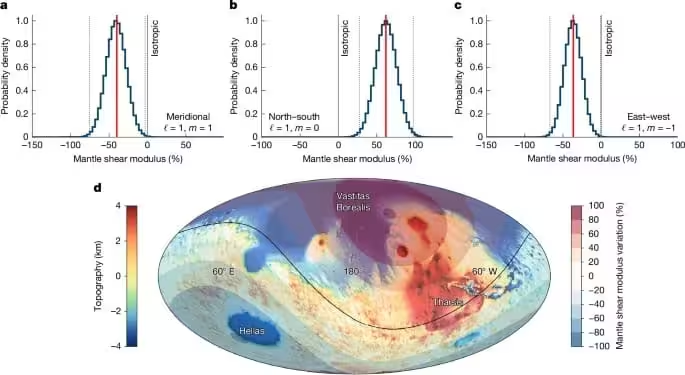
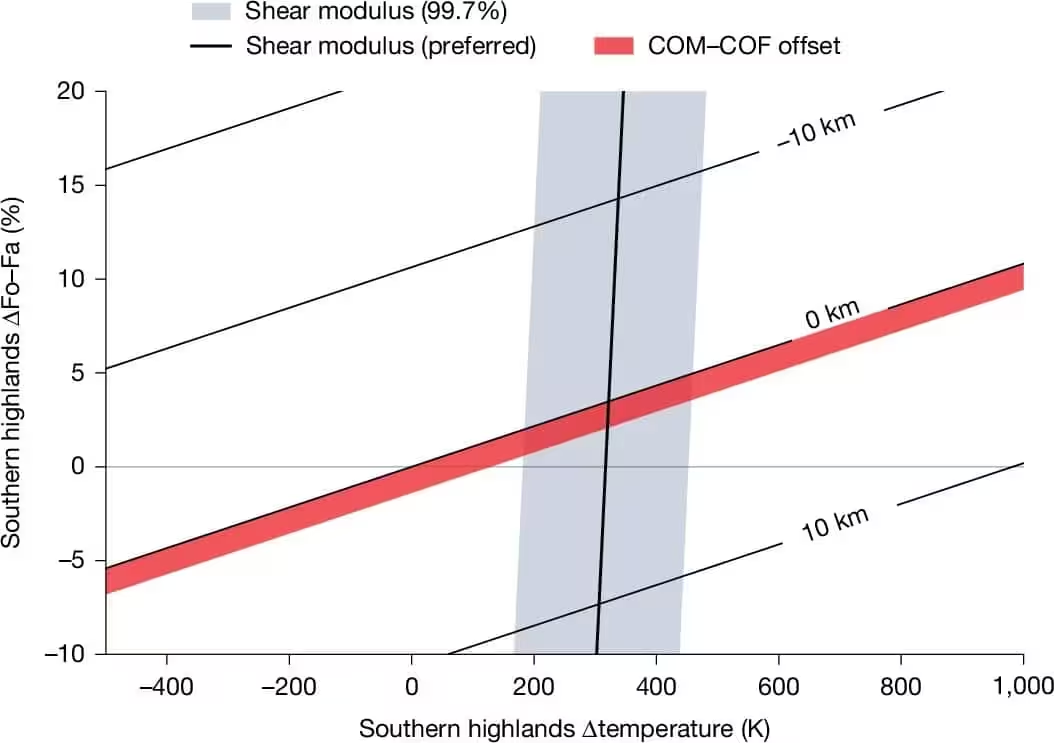
New evidence suggests that the interior of Mars is far more complex than previously assumed, characterized by a massive thermal imbalance between its northern and southern hemispheres. A study reveals that the southern mantle is between 200 and 400 degrees Celsius warmer than the north, a disparity that some researchers believe may indicate partial melting deep beneath the planet’s surface.
For decades, the prevailing consensus held that the famous Martian dichotomy—the stark contrast between the smooth, low-lying northern plains and the rugged, cratered southern highlands—was a phenomenon confined to the crust. This latest research indicates that the divide extends deep into the planet’s interior, effectively remapping our understanding of Martian geology.
Decoding the Planet’s Deep Structure
Led by Alexander Berne, a former Caltech researcher currently at the University of Arizona, the team utilized a sophisticated approach known as tidal tomography. By analyzing decades of gravitational data captured by the Mars Global Surveyor, Mars Odyssey, and the Mars Reconnaissance Orbiter, the scientists modeled the internal structure of the Red Planet. The technique hinges on measuring subtle fluctuations in spacecraft velocity, which occur as the planet responds to the gravitational pull of the Sun during its elliptical orbit.
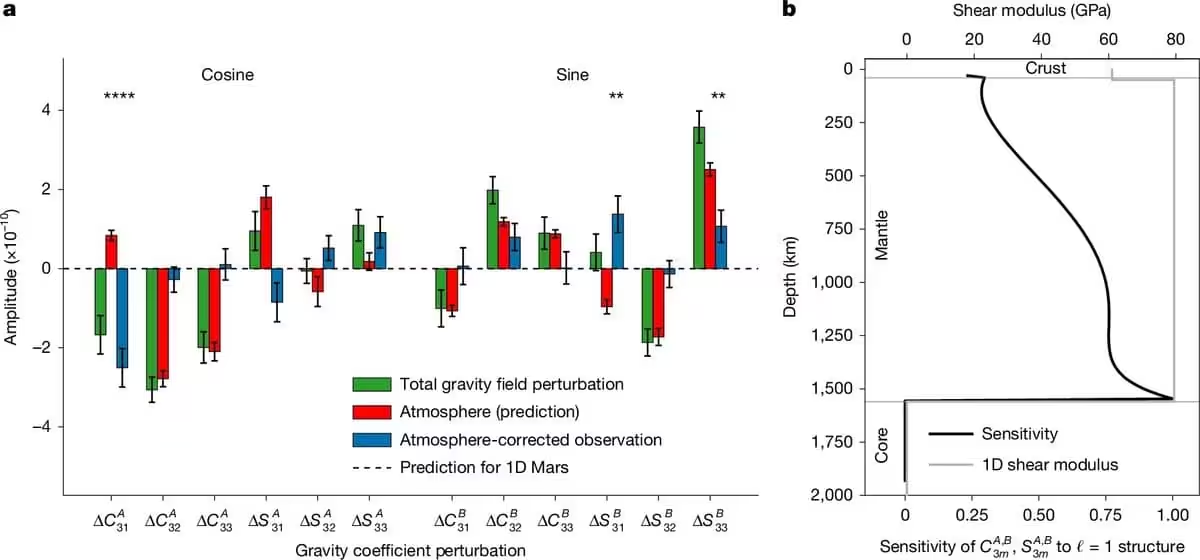
“Scientists usually assume that the interiors of planetary bodies are generally spherically symmetric, but this is not necessarily true,” Berne explained. “As we get more gravity data, we can determine the three-dimensional intricacies of a planet’s interior structure. These inferences in turn give us a blueprint for designing future missions and scientific exploration of these worlds.”
Linking Seismic Data and Ancient Magnetism
The discovery of this heat anomaly provides a potential key to solving long-standing mysteries regarding Mars. The data aligns with readings from NASA’s InSight lander, which observed that seismic waves encounter significant energy loss when traversing the southern hemisphere. A warmer, potentially softer mantle would naturally dampen these waves.
Furthermore, the thermal divide may explain the planet’s unique magnetic history. Iron-rich minerals in the southern crust contain magnetic signatures that vary significantly from those in the north. A hotter southern interior, possibly driven by ancient convection or the lingering effects of a massive prehistoric impact, suggests that deep-seated heat has fundamentally influenced the planet’s surface properties over eons.
Implications for Martian Hydrology
Beyond geophysics, this internal heat distribution has profound implications for understanding Mars’s past environment. Caltech researcher Amirhossein Bagheri, a co-author of the study, notes that the interior structure is intrinsically linked to the planet’s history of liquid water.
“The dichotomy that we see between north and south is important to understand because it gives information about processes that may have influenced the hydrology of Mars, including the formation of basins that may have held water,” said Bagheri.
By effectively “x-raying” the planet using gravitational data, scientists are closing the gap between surface observations and the mysterious processes occurring deep within the mantle. This new model provides a vital framework for interpreting why Mars developed such a drastically asymmetrical geography and how those internal forces shaped the world we see today.
This article has been fact checked for accuracy, with information verified against reputable sources. Learn more about us and our editorial process.
Last reviewed on .
Article history
- Latest version
Reference(s)
- “Alexander Berne.” <https://scholar.google.com/citations?user=UAoVH0kAAAAJ&hl=en>.
- Cermak, Alicia. “InSight Lander - NASA Science.”, December 5, 2017 NASA <https://science.nasa.gov/mission/insight/>.
- “Dr. Amirhossein Bagheri | Planetary Scientist.” <https://www.amir-bagheri.com/>.
Cite this page:
- Posted by Karan Das