Ultra-Deep Images Pinpoint IC 1101’s Edge Confirming It As 1.7 Million Light Year Giant
New ultra-deep observations finally unveil the hidden outer regions of a massive galaxy, solving a long‑standing mystery for astronomers.
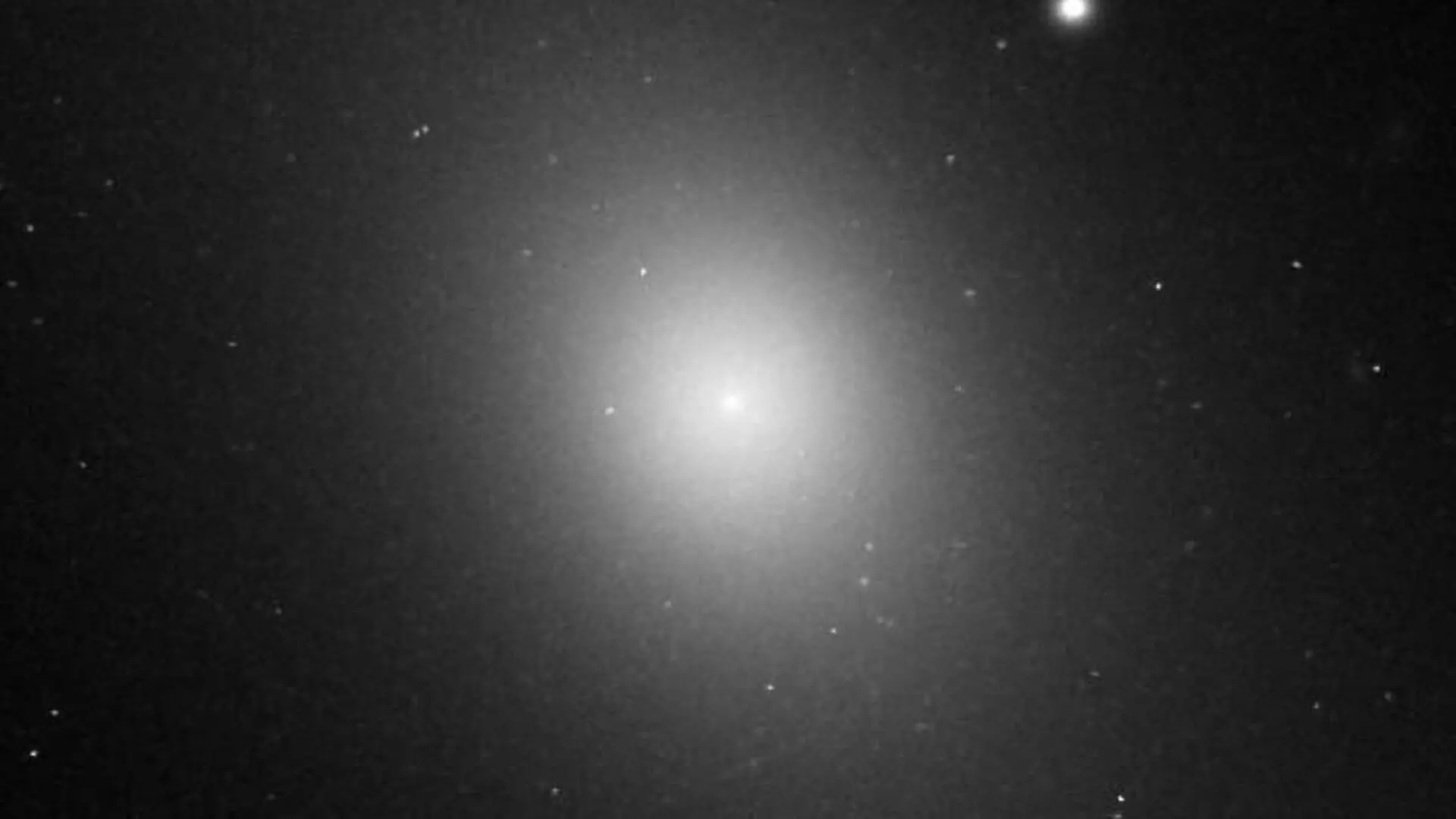
Using the deepest optical exposures ever taken of IC 1101, astronomers have finally delineated the galaxy’s outermost boundary. The measurements indicate a diameter of roughly 520 kiloparsecs—about 1.7 million light‑years—and a stellar mass close to 3.4 trillion times that of the Sun, reaffirming its status as the largest individual galaxy known.
The study, headed by Carlos Marrero‑de la Rosa of the Instituto de Astrofísica de Canarias, appeared on the arXiv preprint server on 16 July. By pairing ultra‑deep imaging with a meticulous correction for scattered light, the team isolated the galaxy’s faint outskirts from the ambient glow of the surrounding cluster.
IC 1101 occupies the core of the Abell 2029 galaxy cluster and is classified as a brightest cluster galaxy (BCG). Such titanic systems accumulate mass over billions of years by swallowing smaller companions, and their diffuse halos often merge with the intracluster light, obscuring the true edge of the galaxy.
Earlier attempts to measure the extent of IC 1101 yielded ambiguous results, as the transition between the galaxy and the cluster light remained unresolved. The latest campaign targeted the faintest detectable photons to settle the question of where the galaxy truly ends.
New Imaging Maps the Full Reach of IC 1101
The paper details how researchers employed the Wide Field Camera on the Isaac Newton Telescope to probe the outermost layers of IC 1101. Capturing such low‑surface‑brightness features required eliminating the glare produced by foreground stars, whose scattered light can conceal delicate stellar emission.
To address this, the team constructed a comprehensive model of the telescope’s point‑spread function using dozens of calibration stars spanning a wide brightness range. They then subtracted the scattered contribution from more than 250 foreground stars, one at a time, delivering an exceptionally clean view of the galaxy’s periphery.

Radial brightness profiles extracted from the cleaned data reveal a distinct edge at roughly 260 kiloparsecs from the galaxy’s centre, translating to a projected diameter of about 520 kiloparsecs. The authors note:
“The edge radius measured for IC 1101 remains among the largest values reported to date for an individual galaxy, corresponding to a projected diameter of ∼520 kpc.”
IC 1101 Outshines the Milky Way by Orders of Magnitude
The revised dimensions underscore the extraordinary scale of IC 1101. The analysis estimates a stellar mass near 3.4 trillion solar masses, though the precise figure varies with the chosen definition of the outer boundary.
For perspective, the Milky Way extends only about 30 kiloparsecs. Consequently, IC 1101’s diameter is roughly 17 times larger than that of our own galaxy. Moreover, the stellar mass alone surpasses current estimates of the Milky Way’s total mass—including dark matter—which is believed to lie between 1 and 1.5 trillion solar masses.

These findings cement IC 1101 as the largest individual galaxy whose size has been directly confirmed through observation.
Peripheral Features Hint at Ongoing Growth
Beyond the primary edge, the deep exposures uncovered eight expansive, faint, and asymmetric stellar structures that stretch beyond the main boundary, offering clues about the galaxy’s evolutionary history.
Two of the newly identified features line up with previously documented X‑ray “sloshing” patterns in the hot intracluster medium of Abell 2029. Earlier X‑ray work linked those disturbances to a merger event with another galaxy group roughly 2–3 billion years ago.
“IC 1101 stands as the largest galaxy known to date, yet its outskirts reveal signs of ongoing mass assembly,” the authors wrote.
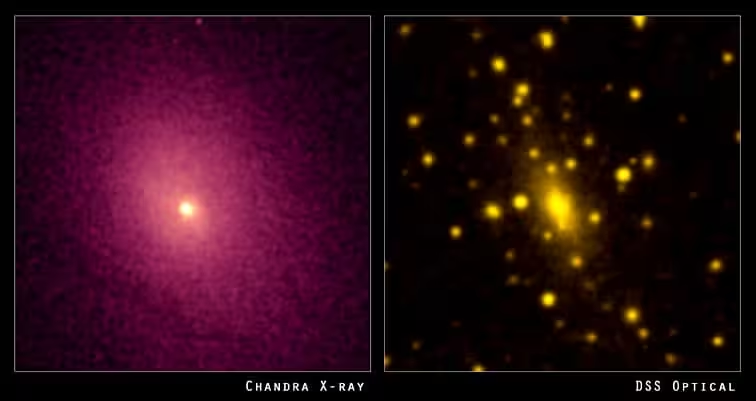
The presence of these peripheral structures supports the view that IC 1101 is still accreting material rather than existing as a fully settled system, providing fresh observational evidence of its ongoing assembly.
This article has been fact checked for accuracy, with information verified against reputable sources. Learn more about us and our editorial process.
Last reviewed on .
Article history
- Latest version
Reference(s)
- “How large can galaxies be?.” <https://arxiv.org/html/2607.15340v1>.
- <https://en.wikipedia.org/wiki/IC_1101>.
- “Chandra :: Photo Album :: Abell 2029 :: 11 June 03.” <https://chandra.harvard.edu/photo/2003/abell2029/>.
Cite this page:
- Posted by Karan Das