Scientists Say A Cosmic Blazar Fired A Record-Breaking Particle At Earth
Un neutrino ultra-énergétique détecté en 2023 trahit une origine lointaine : un blazar, accélérateur de particules extrême de l’univers
In 2023 a detector resting on the floor of the Mediterranean Sea recorded a neutrino whose origin may lie in a cosmic accelerator billions of light‑years away. The particle’s energy, reported in a recent paper in the Journal of Cosmology and Astroparticle Physics, exceeds by tens of thousands the energies achieved by the world’s most powerful human‑made colliders, suggesting an astrophysical engine of unprecedented magnitude.
Deep‑Sea Neutrino Event Challenges Established Theories
The elusive particle—often dubbed a “ghost particle” because it rarely interacts with matter—was captured by an underwater observatory. Its striking energy level, combined with the absence of any simultaneous X‑ray or gamma‑ray burst, left researchers without a clear explanation. Early interpretations ranged from rare cosmic explosions to the evaporation of primordial black holes. While some prior analyses entertained the black‑hole scenario, the latest study redirects focus toward a different astrophysical object: the blazar.
Blazars: Powerful Galactic Nuclei Pointing Directly at Us
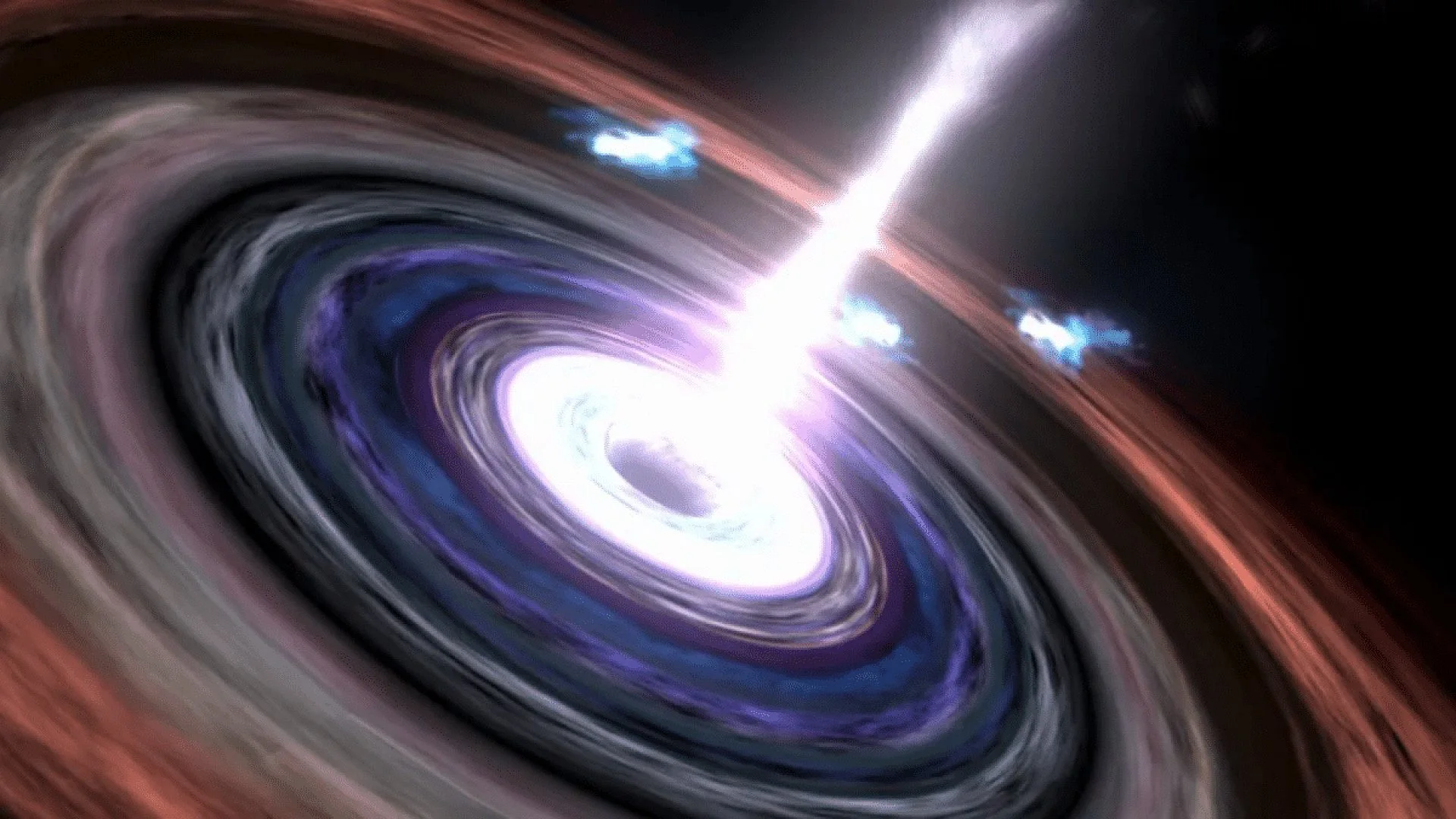
A blazar represents a class of active galactic nuclei (AGN) powered by supermassive black holes that ingest surrounding material. As the infalling matter forms an accretion disk, the system launches twin jets of high‑energy particles perpendicular to the disk. When one of these jets aligns with Earth, the source appears as a blazar, delivering an intense, highly directional beam of radiation. Scientists now suggest that the 2023 neutrino may have been accelerated within such a jet, accounting for its extraordinary energy.
Clustered Blazar Interactions as a Route to Ultra‑High‑Energy Neutrinos
The investigation published in the Journal of Cosmology and Astroparticle Physics examines a group of interacting blazars, proposing that gravitational and electromagnetic coupling among them could generate neutrinos of the observed magnitude. Computer models explored how combined jet emissions might produce a particle with the 2023 event’s signature, indicating that only a rare geometric configuration of multiple blazars could deliver such power. If validated, this mechanism would reveal a previously unrecognized natural particle accelerator operating on a cosmic scale.
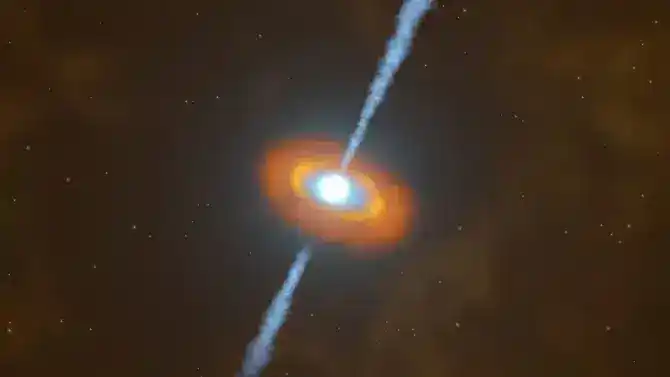
Credit: NASA
What a Single Ultra‑Energetic Neutrino Means for Physics
Detecting one particle with such a colossal energy challenges current models of both particle physics and high‑energy astrophysics. Replicating these energies would require colliders the size of our planet, underscoring the vast potential of natural cosmic accelerators. Researchers now must pinpoint the exact process that birthed the neutrino and delineate the environmental conditions that permit such extreme acceleration. Ongoing and future observations will reveal whether similar events are occasional outliers or part of a broader, yet unseen, population of high‑energy neutrino sources.
This article has been fact checked for accuracy, with information verified against reputable sources. Learn more about us and our editorial process.
Last reviewed on .
Article history
- Latest version
Reference(s)
- Adriani, O.., et al. “Blazars as a potential origin of the KM3-230213A event.” Journal of Cosmology and Astroparticle Physics, vol. 2026, no. 03, March 11, 2026, pp. 033 IOP Publishing, doi: 10.1088/1475-7516/2026/03/033. <https://iopscience.iop.org/article/10.1088/1475-7516/2026/03/033>.
Cite this page:
- Posted by Karan Das