Russia Uncovered 511 Billion Barrels of Oil in Antarctica: A Find That Could Turn the Frozen Continent Into a Flashpoint
Russian expeditions have identified oil deposits in Antarctica’s Weddell Sea, potentially doubling the reserves of Saudi Arabia.
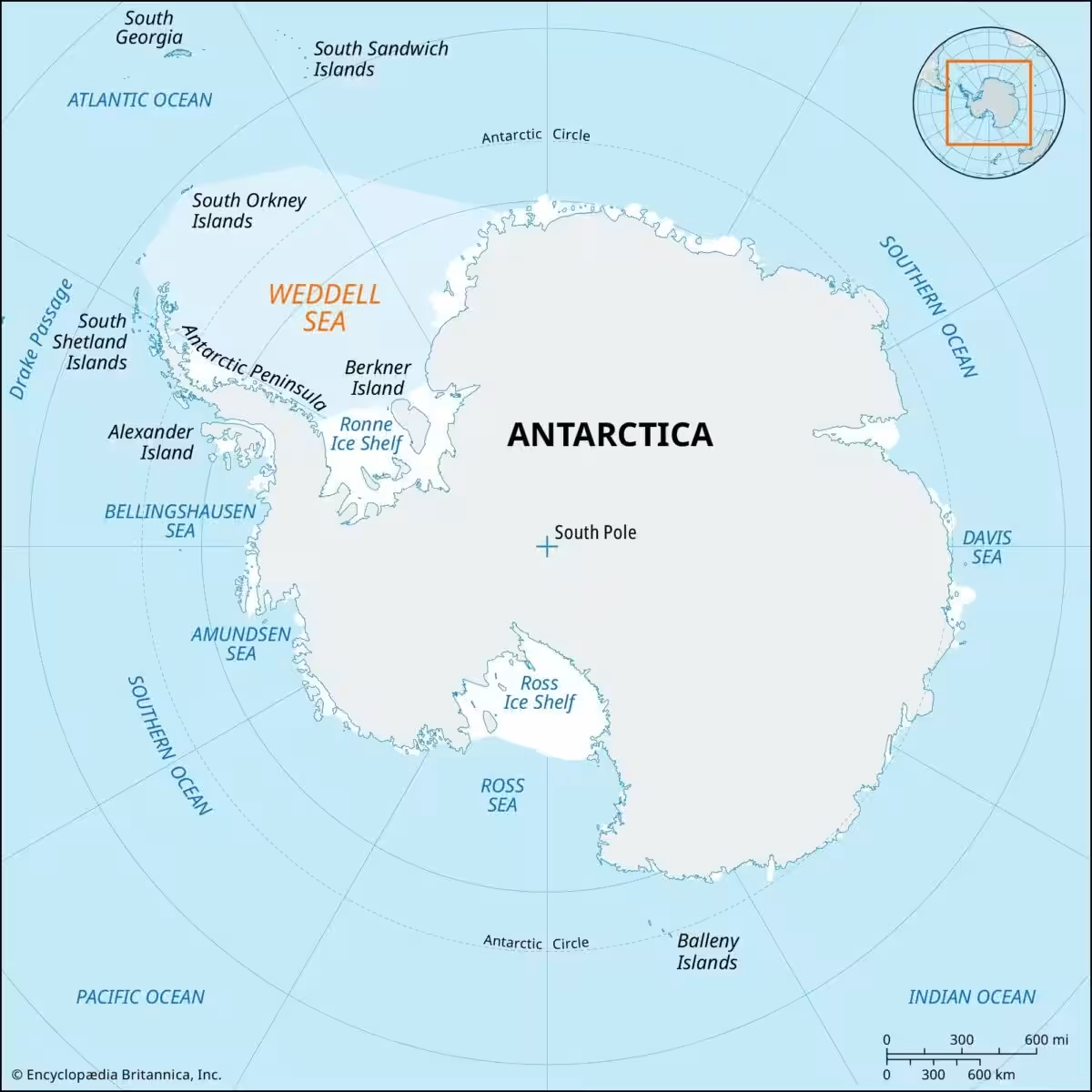
Russian research vessels have been emitting sound waves at the seafloor in the Weddell Sea, a remote and icy stretch of water off Antarctica claimed by the United Kingdom. The seismic data collected point to an estimated 511 billion barrels of oil, a volume that nearly doubles Saudi Arabia’s known reserves.
The House of Commons Environmental Audit Committee received this figure in evidence earlier this year, and it has brought a long-dormant question into the spotlight. Russia holds no territorial claim in Antarctica, but Argentina and Chile dispute Britain’s claim to the Weddell Sea. Yet Russian vessels continue to survey the seabed there, and lawmakers in London are now pressing a simple question: is this research, or is it prospecting under a scientific flag?
The answer to this question lies in the Antarctic Treaty, which dedicates the continent to peace and science. The treaty’s 1991 Environmental Protocol sharpens the restriction: any mineral resource activity not tied to scientific research is flatly prohibited. Russia has signed both agreements.
A Fine Line Between Science and Prospecting
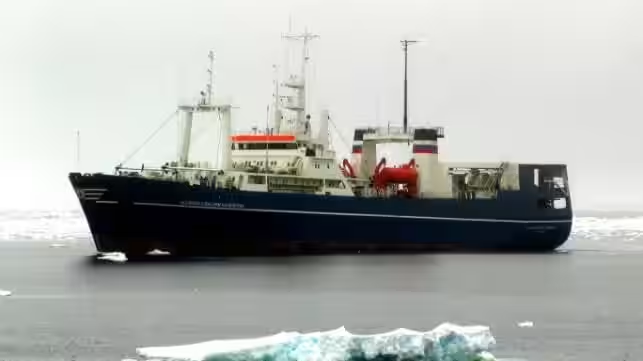
The vessel Alexander Karpinsky, operated by the Russian mineral exploration firm Rosgeo, carried out the surveys during the 65th Russian Antarctic Expedition. Professor Klaus Dodds, a geopolitics specialist at Royal Holloway, University of London, told the committee in written testimony that the work could be construed as prospecting rather than genuine research. He described it as a possible precursor for future resource extraction, Newsweek reported.
Seismic surveys map rock layers beneath the seabed with sound pulses. The equipment looks nearly identical whether the aim is geology or oil location. That overlap makes intent difficult to judge and trust fragile.
The treaty includes a verification tool. Article VII lets any member nation inspect another country’s stations and gear. No government has publicly used that power in response to the Weddell Sea surveys, though the option sits unused, ready if tensions rise further.
Assurances From Moscow, Caution From London
David Rutley, a junior minister at the Foreign, Commonwealth and Development Office, told the committee that Russia had recently reaffirmed its commitment to central elements of the treaty. Moscow, he said, has given repeated assurances that its surveying serves purely scientific ends. But Rutley also insisted that Russia must be held to account.
The Foreign Office stated separately that Russia has repeatedly told the Antarctic Treaty Consultative Meeting its activities are scientific. No treaty party has formally accused Moscow of breaking the mining ban.
Even so, the committee heard starker warnings. Dodds told lawmakers that Russia’s deteriorating relationship with Western countries since its full-scale invasion of Ukraine could ignite strategic competition that becomes far more explicit in Antarctica. The immediate threat, he said, is not active drilling. It is that seismic data collected under a research label could later support extraction if the treaty framework weakens.
A Frozen Continent With Seven Claimants
Seven countries maintain territorial claims in Antarctica: Argentina, Australia, Chile, France, New Zealand, Norway, and the United Kingdom. The treaty froze those claims when it was negotiated. The United States and most other nations do not recognize any of them. Russia holds no claim but runs five research stations across the continent.
Britain’s claim covers the Weddell Sea, the precise area Russian ships have been surveying. Argentina and Chile assert overlapping rights there. The treaty has long kept that knot of rival assertions in check. Some experts now worry the framework is being tested in slow motion.
The committee also examined a related development. In 2022, Russia and China jointly blocked proposals by other treaty nations to widen marine protected areas in Antarctic waters. Neither country has announced plans to abandon the treaty or challenge the mining ban directly. But their expanding footprint gives them greater influence over how the rules are interpreted and enforced.
Transparency Rules May Get a Harder Look
The next Antarctic Treaty Consultative Meeting is expected to address seismic survey protocols and whether additional transparency measures are required. British officials say they will keep monitoring Russian activities while accepting Moscow’s current assurances.
For now, the ships continue their work. The seismic lines grow longer. No drill has touched the seabed. The treaty’s inspection provisions remain available if member countries conclude that stronger verification is warranted.
The moment for that has not arrived, but the hearings in London made one point clear: the question is no longer hypothetical.
This article has been fact checked for accuracy, with information verified against reputable sources. Learn more about us and our editorial process.
Last reviewed on .
Article history
- Latest version
Reference(s)
- “UK’s Parliament Probes Russian Oil Exploration in Antarctica.” The Maritime Executive <https://maritime-executive.com/article/uk-s-parliament-probes-russian-oil-exploration-in-antarctica>.
- “The Antarctic Treaty | Antarctic Treaty.” <https://www.ats.aq/e/antarctictreaty.html>.
- McHardy, Martha. “Russia Just Found Huge Oil Reserves in Antarctica.”, May 14, 2024 Newsweek <https://www.newsweek.com/russia-ukraine-oil-antarctica-putin-1900233>.
Cite this page:
- Posted by Karan Das