Ancient Homo Antecessor Skull Fragments Show Surprising Modern‑Human‑Like Cranial Thickness
Three ancient Spanish skull fragments uncover an unexpected chapter in human evolution, challenging existing theories about our ancestors.
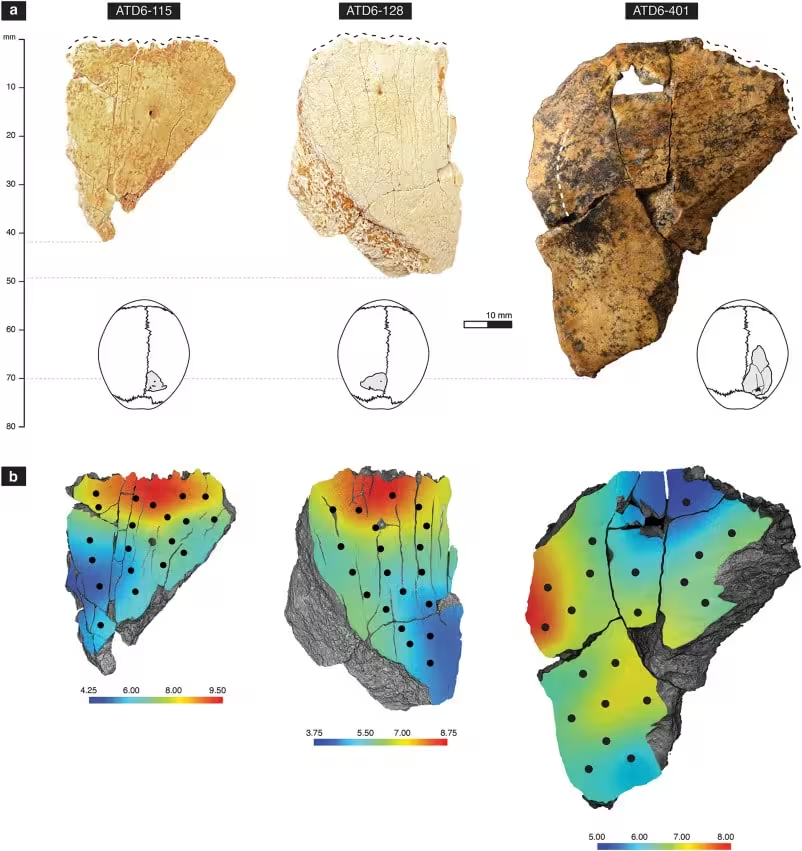
Three parietal bone fragments recovered from the Gran Dolina cave in northern Spain have revealed a cranial thickness pattern that challenges assumptions about the ancient hominin Homo antecessor. Although this species lived between roughly 1.2 million and 600 000 years ago, its skull bone dimensions align more closely with those of Neanderthals and modern humans than with earlier, more primitive relatives.
Inside the Parietal Bones of Early European Hominins
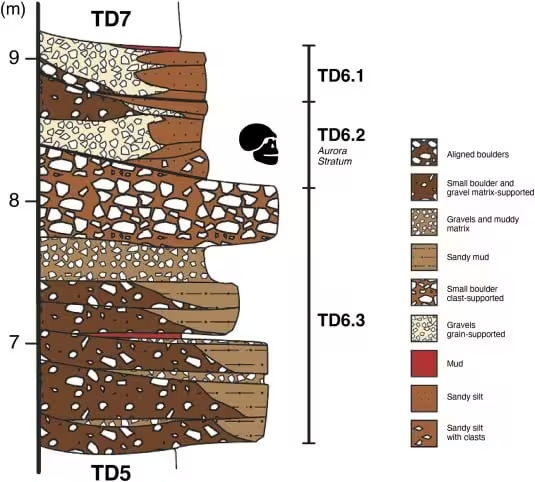
The specimens—catalogued as ATD6‑115, ATD6‑128 and ATD6‑401—originated from the TD6 layer of Gran Dolina, a key archaeological site near Burgos that first yielded Homo antecessor remains in 1994. Because complete skulls from this species are scarce, adult parietal fragments provide a rare glimpse into the mature cranial architecture of these early Europeans.
The new study was led by Rafael Gallareto‑Sande of Spain’s National Research Center on Human Evolution (CENIEH) and colleagues, who employed high‑resolution computed micro‑tomography to examine the internal structure of the bones without damaging them.
“This is the first time we have been able to compare the cranial thickness of this species quantitatively, layer by layer, with the available data for other members of the genus Homo,” Gallareto‑Sande explained.
Bone Thickness Aligns More with Modern Humans Than With Earlier Species
When the researchers measured overall bone thickness, the three Homo antecessor fragments fell within the range typical of modern humans and Neanderthals, and were considerably thinner than the robust skulls associated with Homo erectus and other early Pleistocene hominins. This finding undermines the long‑standing view that unusually thick cranial bones are a hallmark of more archaic lineages.
A closer look at the internal architecture revealed that the diploë—the porous middle layer of the cranial vault—constituted roughly 41 % to 50 % of total thickness in each specimen. This proportion mirrors that observed in Neanderthal and contemporary human crania.
However, the outer table of the skull was thinner and the inner table thicker than those of both Neanderthals and modern humans, indicating a unique combination of primitive and derived traits. “This provides extremely valuable information that helps us interpret the evolutionary position of the species,” Gallareto‑Sande noted, emphasizing that the skull does not fit neatly into a linear evolutionary sequence.
How Tiny Fossil Pieces Inform the Broader Human Evolution Debate
The taxonomic placement of Homo antecessor has been contentious since its initial description, with early hypotheses suggesting it might represent the last common ancestor of Neanderthals and modern humans. Subsequent morphological analyses and ancient protein data have instead positioned the species on a stem lineage leading toward both groups, a view echoed in recent discussions linking it to Neanderthals and Homo sapiens.
While the new measurements do not resolve the debate, they add a quantitative trait that can be compared across hominin species. The work also illustrates why even fragmentary fossils can yield evolutionary insights: microscopic bone structure preserves signals that are invisible in gross morphology, as demonstrated by the relevance of these three fragments despite the absence of a complete skull.
Given the limited sample size, Gallareto‑Sande cautioned that “The available sample is still limited and fragmentary, so any new fragment could refine these results.” He expressed optimism that ongoing excavations will uncover additional cranial material, enabling researchers to test the observed patterns and explore their implications more thoroughly. The current findings suggest that a hominin living hundreds of thousands of years before modern humans already possessed a cranial architecture that is surprisingly familiar to us today.
This article has been fact checked for accuracy, with information verified against reputable sources. Learn more about us and our editorial process.
Last reviewed on .
Article history
- Latest version
Reference(s)
- Gallareto-Sande, Rafael., et al. “Parietal thickness and Homo antecessor: A description of three new fragments from Gran Dolina, Atapuerca, Spain.” Journal of Human Evolution, vol. 218, September 1, 2026, pp. 103870 Elsevier BV, doi: 10.1016/j.jhevol.2026.103870. <https://www.sciencedirect.com/science/article/abs/pii/S0047248426000643>.
Cite this page:
- Posted by Zara Tariq